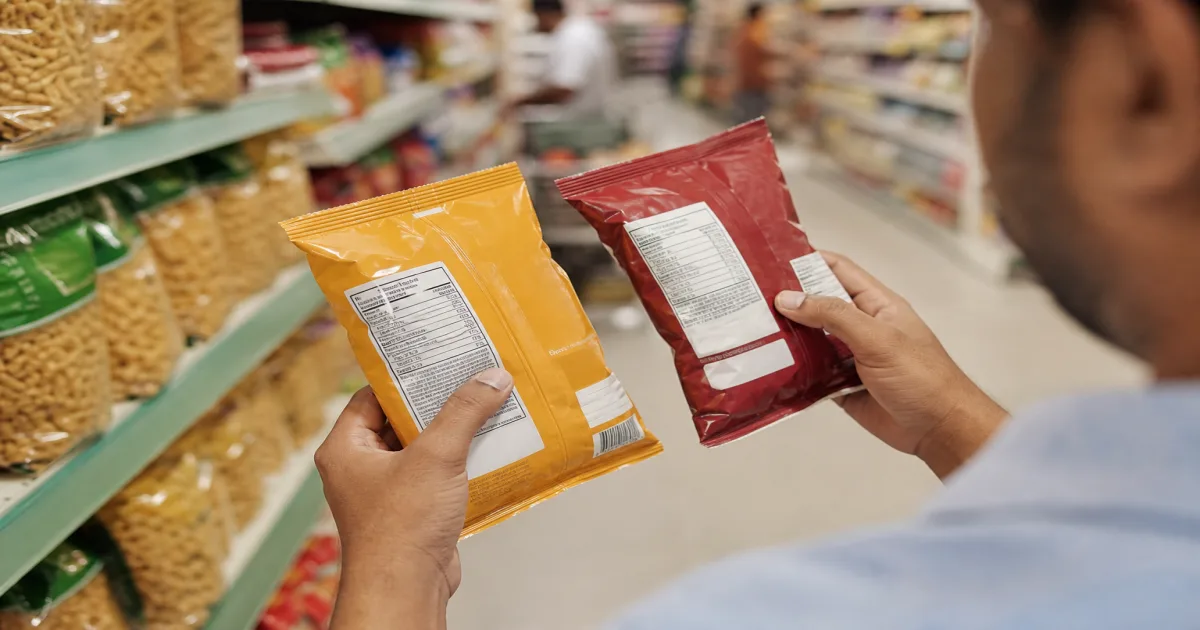
🏷️How to Read Food Labels in India 2026: Sugar, Salt & Fat
Front claims say “light” and “no added sugar.” The back panel tells the truth. Here is how to read Indian food labels amid the FSSAI front-of-pack debate — and which labs matter if the cart already won.
Scanura Editorial
Health Education Team
Written by Scanura Editorial for health education. This article is not a substitute for advice from a qualified doctor. About our editorial standards
How to Read Food Labels in India 2026: Sugar, Salt, Fat & Front-of-Pack
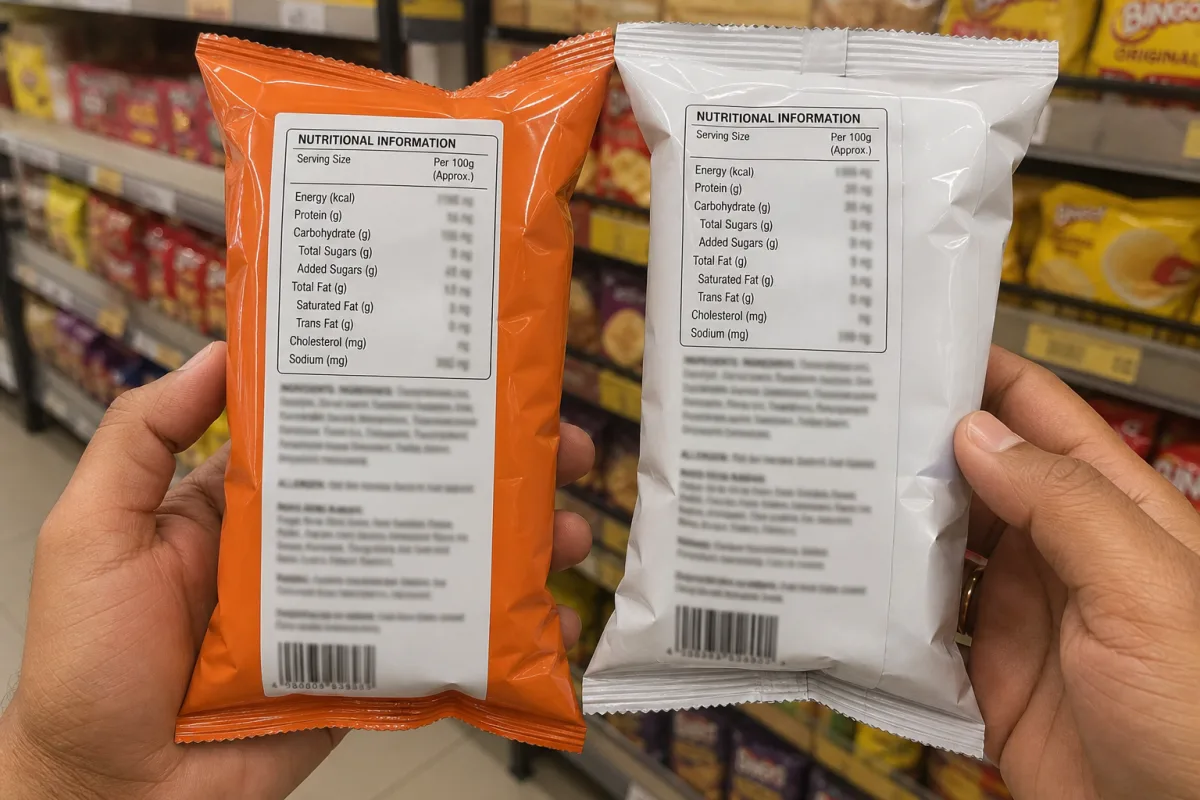
You pick up a biscuit pack that says “baked, not fried.” A namkeen bag says “light.” A juice carton says “no added sugar.” The back of the pack is a wall of tiny numbers. Meanwhile the Supreme Court and FSSAI are still arguing what should sit on the front of Indian packaged food — warning symbols vs a daily-limits nutrition table.
This is a 2026 shopper’s guide to how to read food labels in India: the back panel you already have, the front-of-pack fight you keep seeing in the news, and which blood tests matter if the habit is already showing up on a PDF.
Related reading: reduce sugar intake, blood pressure report, cholesterol / lipids, energy drinks FSSAI.
Why Labels Matter More in 2026
Ultra-processed snacks and sweet drinks grew for years faster than label literacy. Public-health groups and courts have pushed for clear front-of-pack warnings when a product is high in sugar, salt (sodium), or saturated fat. FSSAI’s August 2026 position before the Supreme Court leaned toward a numerical table (product nutrients next to recommended daily limits) rather than Chile-style “HIGH IN” octagons.
You do not need to wait for the final rule. The back-of-pack information is already mandatory on most packaged foods. Reading it well is the skill that actually changes the cart.
The 60-Second Label Check (India Packs)
Do this in order. Marketing on the front is last, not first.
| Step | Look for | Why |
|---|---|---|
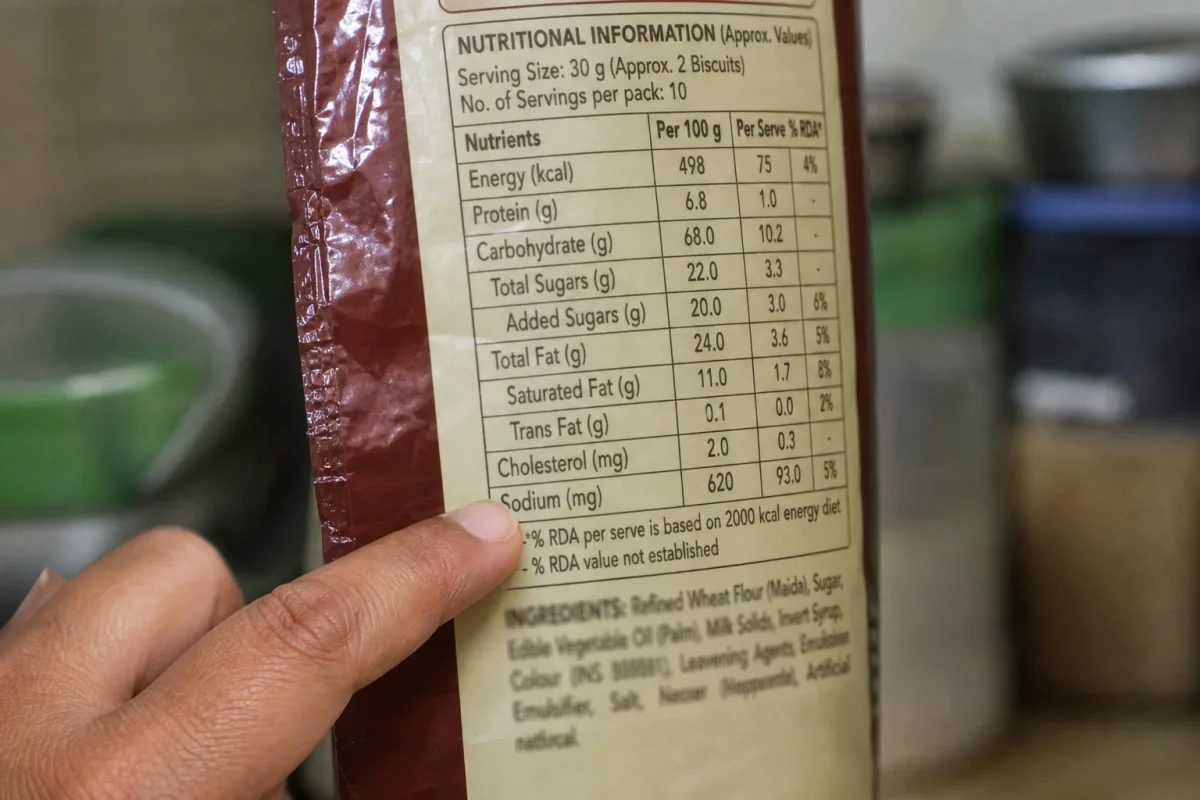
| 1. Serving size | “Per serve” vs “per 100 g / 100 mL” | A “low sugar” serve of 15 g can look fine until you eat half the pack |
| 2. Energy | kcal per serve and per 100 g | Compare like with like — always per 100 g for biscuits and namkeen |
| 3. Total sugars + added sugar clues | Sugars row; ingredients for sucrose, glucose, maltose, liquid glucose, fruit-juice concentrate | WHO/ICMR care about free / added sugar; juice concentrate still counts |
| 4. Sodium / salt | Sodium (mg) or salt (g) | WHO adult target is under ~5 g salt/day (~2,000 mg sodium) |
| 5. Total fat + saturated fat | Especially palm oil / vanaspati patterns | Saturated fat drives the lipid conversation with your clinician |
| 6. Ingredients list | First 3–5 ingredients dominate the product | If sugar, refined flour (maida), or palm oil are #1–#2, the claim on the front is theatre |
| 7. Claims | “Sugar-free,” “light,” “natural,” “immunity” | Claims are regulated; they are not a medical certificate |
Per 100 g vs Per Serve — The Classic Trap
| What the pack shows | What shoppers miss |
|---|---|
| Low sugar per serve | Serve is tiny (e.g. 2 biscuits); you ate 8 |
| “0% trans fat” | Still high in palm oil / saturated fat |
| “No added sugar” juice | Fruit-juice concentrate or natural sugars can still spike glucose |
| Protein printed large on front | Per 100 g protein is modest; carbs and sodium are high |
Rule: for biscuits, chips, namkeen, and chocolate, compare per 100 g. For drinks, check the whole bottle, not 100 mL, if you finish the bottle.
Front-of-Pack Debate: Warning Labels vs Daily-Limits Table
| Approach | What you would see | Strength | Weakness |
|---|---|---|---|
| Interpretive warnings (“HIGH IN sugar / salt / sat fat”) | Black octagons or similar | Fast for kids and busy parents; research in India favoured warnings for spotting “high-in” products | Industry resistance; MSME concerns |
| Numerical daily-limits table (FSSAI Aug 2026 lean) | Product numbers next to government daily caps | Transparent maths | Slower; needs numeracy; easy to ignore in a 10-second aisle decision |
| Health-star / traffic-light styles (studied globally) | Stars or colours | Visual | Mixed evidence vs hard warnings |
Until a final FoPL rule is notified, treat every big front claim as advertising, and verify on the back.
Hidden Names You Should Recognise
| On the ingredients list | Often means |
|---|---|
| Sugar, sucrose, glucose, fructose, maltose, dextrose, invert sugar, liquid glucose, corn syrup, malt extract | Free / added sugar |
| Fruit juice concentrate | Still free sugar in WHO framing |
| Palm oil, palmolein, vanaspati, partially hydrogenated | Fat quality story — check saturated / trans rows |
| Iodised salt, rock salt, black salt, sodium chloride | Still sodium |
| MSG / yeast extract / hydrolysed vegetable protein | Flavour + sodium load can climb |
Related: sugar-free ice cream & chocolate claims, fake dairy / analogue labels.
If Your Cart Is Mostly Packaged, Which Labs Matter?
Labels change the next purchase. Labs show whether the old pattern already moved metabolism.
| Test | Why it sits next to a label article |
|---|---|
| Fasting glucose + HbA1c | Liquid sugar and biscuit habits — blood sugar guide |
| Lipid profile | Saturated fat + refined carbs — lipid guide |
| Blood pressure | Hidden salt in namkeen and instant noodles — BP report |
| SGPT / fatty-liver context | Sweet drinks and fried snacks |
Do not start medicines from a grocery aisle. Do not stop medicines because a pack said “baked.”
How scanura Helps
If a glucose, HbA1c, lipid, or BP-related PDF is why you opened this page, upload it to scanura or create an account. scanura explains the numbers in Hindi or English so you walk into the clinic knowing which row is borderline vs diabetes- or lipid-range.
It does not OCR every biscuit pack in real time, and it does not replace FSSAI or a dietitian.
The blood test checker can range-check a single value while you wait for the full report explanation.
Key Takeaways
- Read per 100 g for snacks; read the whole bottle for drinks.
- Ingredients order beats front-of-pack adjectives.
- Track sugars, sodium, saturated fat first — those are the nutrients of concern in India’s FoPL debate.
- “No added sugar,” “light,” and “immunity” are claims, not prescriptions.
- Front-of-pack rules are still evolving in 2026; back-of-pack literacy works today.
- If the habit is old, check glucose/HbA1c, lipids, and BP — then upload the PDF to scanura and follow your clinician.
Disclaimer: This article is for educational purposes only. Front-of-pack labelling proposals before Indian courts and FSSAI can change after notification. Nutrient claims and lab ranges vary by product category, age, pregnancy, and laboratory method. scanura is not affiliated with FSSAI. scanura does not provide medical diagnosis or personal diet prescriptions. Always consult a qualified clinician or registered dietitian for medical decisions.
Medical References
Step-by-Step Guide
- 1
Ignore the front slogan first
“Light,” “baked,” and “no added sugar” are claims. Open the nutrition table and ingredients.
- 2
Compare snacks per 100 g
Per-serve numbers mislead when the serve is two biscuits and you ate eight.
- 3
Check sugars, sodium, and saturated fat
These are the nutrients of concern in India’s front-of-pack debate.
- 4
Read the first five ingredients
If sugar, maida, or palm oil lead the list, the cartoon on the front is marketing.
- 5
Watch serving size on drinks
Finish-the-bottle reality matters more than per 100 mL maths.
- 6
If the habit is old, check labs with a clinician
Glucose/HbA1c, lipids, and BP. Upload PDFs to scanura for a plain-language read.
📬 One health report guide, every week
Normal ranges, what your values mean, and what to ask your doctor — in plain language. Free, unsubscribe anytime.