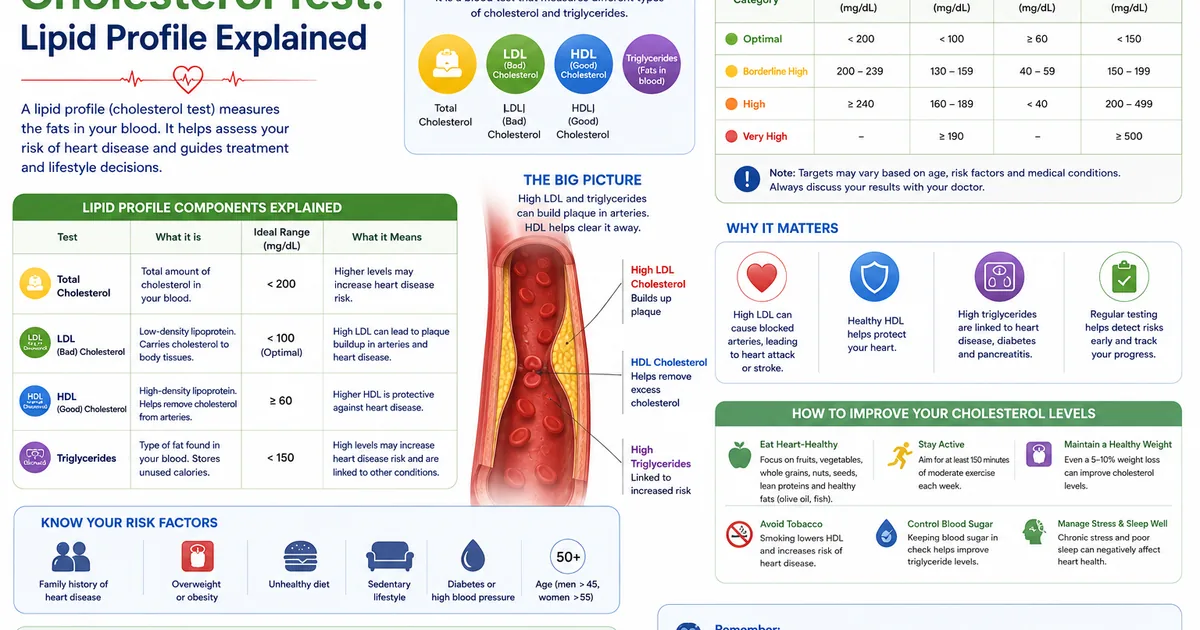
🫀Understanding Your Cholesterol Test: Lipid Profile Explained
Cholesterol report lete hain par samajh nahi aata? LDL, HDL, triglycerides, VLDL — kya sab hai ye? Ye 2026 guide har number ka plain-English explanation deta hai — kya dangerous hai, kya acha hai, aur apna report kaise samjhein.
Scanura Editorial
Health Education Team
Written by Scanura Editorial for health education. This article is not a substitute for advice from a qualified doctor. About our editorial standards
Understanding Your Cholesterol Test: Lipid Profile Explained
You've been told to "check your cholesterol" and you got a lipid profile done. The report came back with a bunch of numbers: Total Cholesterol, LDL, HDL, Triglycerides, maybe VLDL. Your doctor said some numbers are "high" and you need to "watch your diet." But what do these numbers actually mean? Which ones are dangerous? Which ones are actually good?
Here's the truth that most people don't realize: cholesterol is not a single thing. It's several different particles floating in your blood, some of which protect you and some of which kill you. Understanding the difference between these particles is one of the most important things you can do for your long-term health.
The Basics: What Is Cholesterol?
Cholesterol is a waxy, fat-like substance that your body needs to build cells, make hormones (like estrogen, testosterone, and cortisol), produce vitamin D, and create bile acids for digestion. Your liver makes all the cholesterol your body needs — you don't need to eat any.
But cholesterol doesn't dissolve in blood. It needs a delivery truck — a protein外壳 called a lipoprotein. Different lipoproteins carry cholesterol to different places, and this is where the story gets interesting.
The Five Players in Your Lipid Profile
1. LDL — Low-Density Lipoprotein (The "Bad" Cholesterol)
LDL is the particle that delivers cholesterol from your liver to your cells. The problem? When there's too much LDL, it deposits cholesterol in your artery walls, forming atherosclerotic plaques — the waxy buildup that narrows and hardens your arteries.
LDL is the single most important number in your lipid profile. It is the primary driver of heart disease and stroke.
LDL Cholesterol Levels:
| Level (mg/dL) | Category | What It Means |
|---|---|---|
| Below 70 | Optimal for high-risk patients | Excellent — if you have heart disease or diabetes, aim here |
| Below 100 | Optimal | Great — lowest risk |
| 100–129 | Near optimal | Good, but room for improvement |
| 130–159 | Borderline high | Lifestyle changes recommended |
| 160–189 | High | Consider medication alongside lifestyle changes |
| 190 and above | Very high | Medication almost always recommended |
Indian context: Indians tend to have smaller, denser LDL particles than Europeans — even at the same LDL-C level, Indians may have higher cardiovascular risk. This is one reason Indians have disproportionately high heart disease rates.
2. HDL — High-Density Lipoprotein (The "Good" Cholesterol)
HDL is the reverse transport system — it picks up excess cholesterol from your artery walls and carries it back to the liver for disposal. Think of HDL as a cleanup crew.
Higher HDL is generally better, but it's not as simple as "more HDL = less heart disease." The function of HDL matters more than the number.
HDL Cholesterol Levels:
| Level (mg/dL) | Category |
|---|---|
| Below 40 (men) / Below 50 (women) | Low — increased risk |
| 40–59 | Acceptable |
| 60 and above | High — protective against heart disease |
Key facts:
- Exercise raises HDL (the most effective way)
- Alcohol in moderation raises HDL, but this is NOT a reason to start drinking
- Smoking lowers HDL
- Medications (niacin, fibrates) can raise HDL, but clinical trials have NOT shown that raising HDL with drugs reduces heart attacks — HDL function matters more than the number
3. Triglycerides
Triglycerides are the main form of fat in your body. When you eat more calories than you need — especially from sugar and refined carbohydrates — your liver converts the excess into triglycerides and stores them as fat.
High triglycerides are a marker of metabolic syndrome — they cluster with high blood sugar, high blood pressure, and belly fat.
Triglyceride Levels:
| Level (mg/dL) | Category |
|---|---|
| Below 150 | Normal |
| 150–199 | Borderline high |
| 200–499 | High |
| 500 and above | Very high — risk of pancreatitis |
What raises triglycerides:
- Sugar and refined carbs (white bread, maida, cold drinks, sweets)
- Alcohol
- Obesity
- Physical inactivity
- Uncontrolled diabetes
- Hypothyroidism
- Certain medications (steroids, birth control pills, some diuretics)
How to lower triglycerides:
- Cut sugar and refined carbs (most effective)
- Lose weight (if overweight)
- Exercise regularly
- Limit alcohol
- Omega-3 fatty acids (fish oil) for very high triglycerides
- Control blood sugar if diabetic
4. Total Cholesterol
This is the sum of all cholesterol in your blood: LDL + HDL + VLDL. It's a useful screening number but not the most important — your total cholesterol can be "normal" while your LDL is dangerously high (if your HDL is also high).
| Level (mg/dL) | Category |
|---|---|
| Below 200 | Desirable |
| 200–239 | Borderline high |
| 240 and above | High |
Important: Total cholesterol alone is not enough to assess heart disease risk. Always look at the individual components (LDL, HDL, triglycerides).
5. VLDL — Very Low-Density Lipoprotein
VLDL is produced by your liver to carry triglycerides to your cells. It's atherogenic (like LDL) — it contributes to plaque formation. VLDL is usually calculated from triglycerides:
VLDL = Triglycerides ÷ 5 (if triglycerides are in mg/dL)
| Level (mg/dL) | Category |
|---|---|
| Below 30 | Normal |
| 30–50 | Borderline high |
| Above 50 | High |
Beyond the Basic Four: Additional Markers
Non-HDL Cholesterol
Non-HDL = Total Cholesterol – HDL
This measures all the potentially harmful cholesterol particles (LDL + VLDL + other atherogenic particles). Some guidelines now consider non-HDL a better predictor than LDL alone.
| Level (mg/dL) | Risk |
|---|---|
| Below 100 | Optimal (for high-risk patients) |
| Below 130 | Near optimal |
| 130–159 | Borderline high |
| Above 160 | High |
ApoB (Apolipoprotein B)
ApoB is the protein found on the surface of every atherogenic particle (LDL, VLDL, IDL). It measures the total number of harmful particles in your blood — not just the weight of cholesterol they carry.
| Level (mg/dL) | Risk |
|---|---|
| Below 60 | Optimal |
| 60–80 | Near optimal |
| 80–90 | Borderline high |
| Above 90 | High |
Why ApoB matters: Two people can have the same LDL cholesterol but different numbers of LDL particles. Someone with many small, dense LDL particles has higher risk than someone with fewer large LDL particles — even though their LDL-C number is identical. ApoB captures this difference.
Indian context: Indians tend to have the small, dense LDL pattern — which means ApoB is often elevated even when LDL-C looks acceptable. Ask for ApoB at your next checkup.
Lp(a) — Lipoprotein(a)
Lp(a) is a genetically determined particle that promotes both atherosclerosis AND clotting. It's not measured in a standard lipid panel.
| Level (mg/dL) | Risk |
|---|---|
| Below 30 | Optimal |
| 30–50 | Borderline |
| 50–125 | High |
| Above 125 | Very high |
Key facts:
- About 20% of Indians have elevated Lp(a) — higher than European populations
- Lp(a) levels are 80-90% genetically determined — diet and exercise have minimal effect
- Lp(a) is an independent risk factor — it predicts heart attacks even when all other numbers are normal
- Ask for Lp(a) at least once in your lifetime
How to Read Your Lipid Profile — A Simple Framework
Step 1: Look at LDL first
- Below 100 = good
- Above 160 = needs attention
- Above 190 = medication likely needed
Step 2: Check HDL
- Above 40 (men) / 50 (women) = acceptable
- Below 40 = risk factor
Step 3: Check triglycerides
- Below 150 = normal
- Above 200 = lifestyle changes needed
Step 4: Look at the ratio
- LDL/HDL ratio below 3.0 = good
- Ratio above 4.5 = elevated risk
Step 5: Consider non-HDL and ApoB if available
What Raises and Lowers Cholesterol
What Raises LDL (Bad Cholesterol)
- Saturated fat (ghee, butter, red meat, full-fat dairy)
- Trans fats (partially hydrogenated oils, baked goods, fried foods)
- Dietary cholesterol (eggs, organ meats) — has modest effect in most people
- Obesity
- Physical inactivity
- Genetics (familial hypercholesterolemia)
What Lowers LDL
- Statins — the most effective and well-studied medications (can lower LDL 30-50%)
- Ezetimibe — blocks cholesterol absorption (additional 15-20% reduction)
- PCSK9 inhibitors — injectable, very potent (additional 50-60% reduction)
- Diet — replacing saturated fat with unsaturated fat, increasing soluble fiber
- Plant sterols/stanols — 2g/day can lower LDL by 5-15%
- Weight loss — every 10 pounds lost lowers LDL by about 5-8%
What Raises HDL
- Exercise (most effective)
- Moderate alcohol (NOT recommended as treatment)
- Weight loss
- Smoking cessation
- Niacin (prescription only, rarely used now)
What Lowers Triglycerides
- Cut sugar and refined carbs (most effective)
- Exercise
- Weight loss
- Limit alcohol
- Omega-3 fish oil (prescription-strength for very high triglycerides)
- Control blood sugar
Indian Diet and Cholesterol: What You Need to Know
The typical Indian diet presents unique challenges for cholesterol management:
The ghee dilemma: Ghee is high in saturated fat and raises LDL. But in moderation (1-2 teaspoons per day), its effect is modest. The bigger issue is quantity — Indian cooking often uses more oil/ghee than necessary. Switch to mustard oil, olive oil, or groundnut oil for cooking.
The vegetarian advantage: Indian vegetarian diets are naturally lower in saturated fat if they're based on whole grains, legumes, vegetables, and fruits. The problem arises with excessive refined carbs (white rice, maida) and fried snacks — these raise triglycerides.
The south Indian breakfast: Idli, dosa, and vada can be part of a heart-healthy diet — but the coconut chutney (high in saturated fat) and the quantity of oil used in preparation matter.
TheNorth Indian thali: Roti, dal, sabzi is a balanced meal — but the paratha fried in ghee, the butter on the naan, and the cream in the dal makhani add significant saturated fat.
Practical swaps:
- Replace ghee with olive oil for cooking (keep ghee for occasional use)
- Replace white rice with brown rice or millets
- Replace maida roti with whole wheat or multigrain roti
- Reduce fried snacks — replace with roasted chana, makhana, or nuts
- Add more vegetables and salads to every meal
- Include nuts (30g/day) — almonds, walnuts, and pistachios lower LDL
Medication: When Do You Need It?
Lifestyle changes are the first line of treatment. But sometimes they're not enough — especially if your LDL is very high or you have additional risk factors.
You may need medication if:
- LDL is above 190 mg/dL (genetic high cholesterol)
- You have heart disease, diabetes, or stroke — regardless of LDL level
- Your 10-year heart disease risk is above 7.5% (using ASCVD risk calculator)
- Lifestyle changes haven't lowered LDL enough after 3-6 months
Statins — the most prescribed cholesterol medications:
| Statin | Typical Dose | LDL Reduction |
|---|---|---|
| Atorvastatin | 10–20 mg | 30–50% |
| Rosuvastatin | 5–10 mg | 30–50% |
| Simvastatin | 20–40 mg | 30–40% |
Common concerns about statins (addressed):
- "Statins cause muscle pain" — 5-10% of people experience muscle aches; serious muscle damage is rare (1 in 10,000)
- "Statins cause diabetes" — small increased risk (1-2%), but the heart-protective benefit far outweighs this risk
- "Once I start, I can never stop" — statins treat the underlying problem (high cholesterol); stopping them allows cholesterol to rise again
- "I can control cholesterol with diet alone" — sometimes true, but not always; genetics play a major role
Monitoring and Follow-Up
How Often to Test
- Initial test: Any time after age 20 (at least once)
- Low risk: Every 4-6 years
- Borderline or high risk: Every 6-12 months
- On medication: 6-8 weeks after starting or changing dose, then every 3-6 months
- Diabetics: Annually (more often if LDL is not at goal)
When to See a Cardiologist
- LDL above 190 mg/dL
- Family history of early heart disease (heart attack before 55 in men, 65 in women)
- You have multiple risk factors (diabetes, hypertension, smoking, obesity)
- You've had a heart attack, stroke, or stent placement
- Triglycerides above 500 mg/dL
- Your doctor is uncertain about treatment decisions
How scanura Helps
Upload your lipid profile to scanura and get:
- Plain-language explanation of every value — no medical jargon
- Colour-coded risk assessment for LDL, HDL, triglycerides, and non-HDL
- 10-year cardiovascular risk estimate based on your age, gender, blood pressure, cholesterol, diabetes, and smoking status
- Indian-specific reference ranges calibrated for South Asian populations
- Diet and lifestyle recommendations personalized to your specific abnormalities
- Questions to ask your doctor — like whether you need ApoB or Lp(a) testing
Key Takeaways
- LDL is the most important number — keep it below 100 mg/dL, or below 70 if you have heart disease or diabetes
- Triglycerides reflect your sugar and carb intake — cut sugar and refined carbs to lower them
- HDL above 40/50 is protective — exercise is the best way to raise it
- Non-HDL and ApoB are better predictors than LDL alone — especially for Indians with small, dense LDL
- Lp(a) is genetic — get it tested at least once in your lifetime
- Statins work — they reduce heart attacks by 25-35%; don't fear them if your doctor recommends them
- Diet matters — swap saturated fats for unsaturated fats, increase soluble fiber, reduce sugar
- Don't rely on total cholesterol alone — look at the individual components
Disclaimer: This article is for educational purposes only. scanura does not provide medical diagnosis. Always consult your cardiologist or doctor for medical decisions.
Medical References
Step-by-Step Guide
- 1
Get a complete lipid panel
Fasting for 10-12 hours is essential. Ask for: Total Cholesterol, LDL-C, HDL-C, Triglycerides, and optionally VLDL, non-HDL cholesterol, and ApoB.
- 2
Read your LDL cholesterol first
LDL is the main cholesterol that clogs arteries. Below 100 mg/dL is optimal. Below 70 mg/dL if you have heart disease or diabetes. Above 160 mg/dL is high.
- 3
Read your HDL cholesterol
HDL is the 'good' cholesterol that removes plaque from arteries. Above 40 mg/dL for men, above 50 mg/dL for women. Below 40 = high risk for heart disease.
- 4
Read your triglycerides
Below 150 mg/dL is normal. 150-199 = borderline high. 200-499 = high. 500+ = very high (pancreatitis risk). High triglycerides usually mean too much sugar/carbs in diet.
- 5
Calculate your risk
Don't look at cholesterol numbers alone. Use a risk calculator (like ASCVD) that factors in age, blood pressure, diabetes, and smoking. A 45-year-old with LDL 130 may need different treatment than a 65-year-old with LDL 130.
- 6
Retest in 6-12 weeks
After diet and lifestyle changes, retest in 6-12 weeks. After starting medication, retest in 6-8 weeks. Then every 3-6 months until stable.
📬 One health report guide, every week
Normal ranges, what your values mean, and what to ask your doctor — in plain language. Free, unsubscribe anytime.