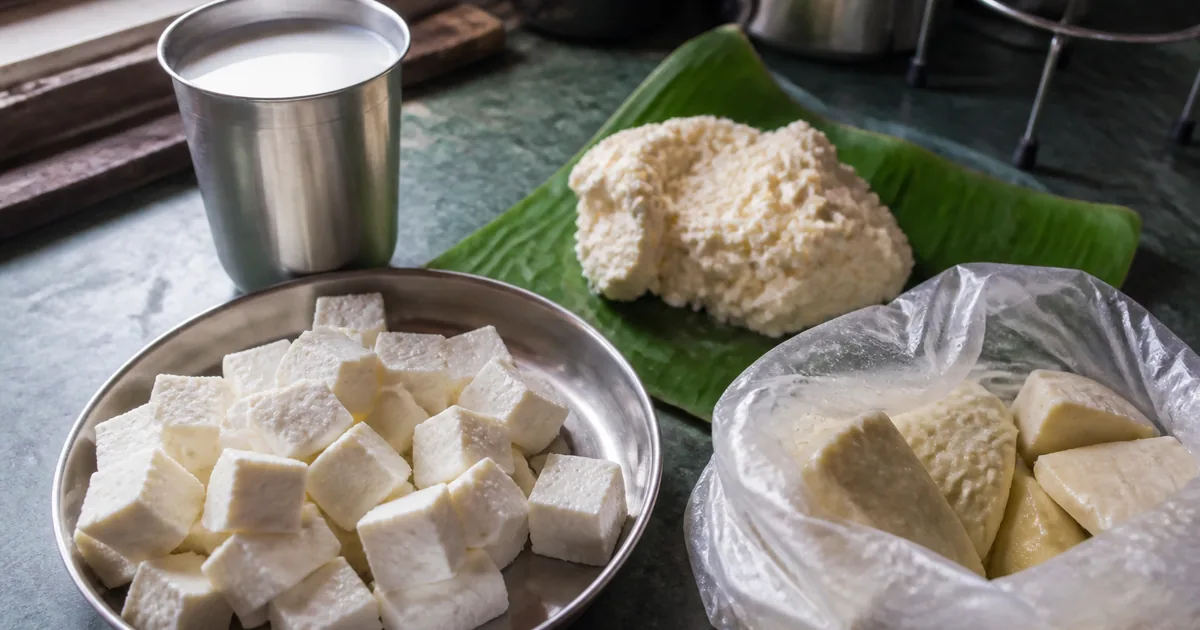
🧀Fake Paneer, Milk & Khoya in India (2026): How to Tell
India Today’s NCR sting and Ghaziabad raids put fake paneer, milk, and khoya in the news. Here is dairy vs analogue vs adulterated, which kitchen tests work, how to check FSSAI, and which labs matter if you got sick.
Scanura Editorial
Health Education Team
Written by Scanura Editorial for health education. This article is not a substitute for advice from a qualified doctor. About our editorial standards
Fake Paneer, Milk & Khoya in India (2026): How to Tell
In the first week of August 2026, India Today published an undercover investigation into an alleged fake dairy supply chain feeding Delhi-NCR: paneer, milk, and khoya produced in Mewat (Haryana) and western Uttar Pradesh (Shamli, Baghpat) and moved into mandis and wet markets in the capital. The same fortnight, Ghaziabad food-safety teams raided factories and destroyed large lots of paneer and khoya they said were made with laundry whitener, palm oil, and milk powder.
This is not a “never eat paneer again” piece. Real paneer remains one of the best everyday proteins for Indian vegetarians. The honest problem is three different products sharing one name:
| What you might be buying | Legal? | The catch |
|---|---|---|
| Dairy paneer (cow/buffalo milk, acid-set) | Yes, if it meets FSSAI composition | This is the product the word “paneer” is supposed to mean |
| Analogue paneer (vegetable fat / non-milk protein, labelled) | Yes, if labelled as analogue / non-dairy | Cheaper; not a milk product; must not wear the milk logo |
| Adulterated / fake paneer sold as dairy | No | Starch, oils, soapstone, whitener, detergent — sold as the real thing |
This 2026 guide covers what the raids actually found, how FSSAI defines paneer vs analogue, which kitchen tests work and which do not, how to check a 14-digit FSSAI licence on FoSCoS, and which blood and stool tests matter if you got sick — not if you merely ate one suspicious cube.
Related reading: how to read an LFT, kidney function / creatinine, electrolytes, typhoid tests.
What Happened in August 2026
Treat news investigations as allegations and enforcement snapshots, not a lab certificate for every shop in India. Still, the pattern is consistent enough to change how you buy dairy this monsoon and Sawan / festival season.
India Today investigation (published 6 August 2026)
The report said journalists traced bulk paneer and khoya from production sheds in Mewat (~130 km from Delhi) and operators in Shamli and Baghpat, into distribution points including Azadpur Mandi, Nangloi, and Dwarka Mor. Traders, the story said, quoted prices based on how much soy, milk powder, and selkhadi (soapstone) went into the mix — and that pure-milk paneer was not what that wholesale channel was selling.
Ingredients the investigation and follow-up coverage associated with this racket (not a complete chemical list, and not proven in court by this article):
| Material | Why it is used in fake dairy | Why it does not belong in “paneer” |
|---|---|---|
| Palm oil / vanaspati / Dalda | Cheap fat, weight, fry-shop mouthfeel | Replaces milk fat; analogue if labelled, fraud if sold as dairy paneer |
| Soy / vegetable protein | Bulk and “protein” on a cheap recipe | Not milk protein |
| Milk powder + water | Looks dairy, stretches volume | Can be legal in real paneer as milk solids — illegal when the rest is oil and stone |
| Selkhadi (soapstone / talc) | Whiteness, weight, yield | Not food. Mineral dust does not become paneer because it is white |
| Laundry whitener / optical brightener | Makes cubes look “hotel white” | Industrial/household chemical, not a dairy additive |
| Baking soda | Texture / yield tricks | Not how FSSAI paneer is defined |
Price as a clue, not a verdict: wholesale cubes quoted around ₹80/kg in the sting coverage are far below honest milk-fat economics. The Ghaziabad raid (below) described product moving to shops at ₹200–250/kg — still cheap enough to tempt a restaurant that bills “fresh paneer.” A premium brand at ₹400/kg can still be analogue if the label says so. Cheap is a red flag. Expensive is not a guarantee.
Ghaziabad factory raids (festival-season supply)
Local food-safety teams later reported busting three factories in Nahli village (Bhojpur area) and destroying about 868 kg of paneer and 170 kg of khoya on site, with samples sent to a Lucknow lab. Officials said the alleged mix included laundry whitener, palm oil, and milk powder, and that the product was being sent toward Delhi, Faridabad, Gurugram, Noida, Hapur, and nearby districts as Sawan demand rose.
That raid does not prove every NCR sweet shop is in the same network. It does prove regulators are treating whitener-white cubes as a live enforcement problem, not a WhatsApp rumour.
The 83% figure — read it carefully
Headlines said “83% of paneer fails.” The number that keeps getting copied is not a nationwide FSSAI census. Food-safety testing in Noida and Greater Noida (April 2024–March 2025) took paneer samples; reports were in for 83 of them, and about 83% of those 83 failed quality standards, with about 40% called unsafe (chemicals or unidentified liquids). Grain products failed at high rates in the same drive.
Use it as: loose, high-volume paneer in that belt failed a lot when tested. Do not use it as: “four out of five packets in Kochi or Pune are poison.”
Dairy Paneer vs Analogue vs Fake
FSSAI’s dairy regulations are blunt about the name.
Paneer / chhana is the product obtained from cow or buffalo milk (or a mix), with or without milk solids, by precipitation with sour milk, lactic acid, or citric acid. Composition:
| Product | Moisture | Milk fat |
|---|---|---|
| Paneer / chhana | Not more than 70% | Not less than 50% of dry matter |
| Low-fat paneer / chhana | Not more than 70% | Not more than 15% of dry matter; sealed pack + label only |
If it is not that, it should not be sold as paneer.
Analogue in the dairy context (FSSAI FAQ language): a product in which non-milk constituents replace milk constituents in part or in whole, but the thing still looks or functions like a dairy food. Analogue paneer is typically vegetable oil + protein + emulsifiers pressed into cubes.
Analogue is legal when it is labelled — including statements on the lines of contains [named non-milk constituent] / contains no milk fat. It must not use the FSSAI milk logo. Hotels and restaurants that swap analogue for dairy paneer are supposed to say so. Selling analogue cubes from an open tray as “fresh paneer” is the fraud.
Adulterated paneer is the third bucket: dairy or analogue recipes spiked with starch, detergent, soapstone, formalin-class preservatives, or whitener, or dairy paneer that fails fat/moisture/hygiene limits. That is unsafe or substandard food, not a lifestyle choice.
Ministry of Health / FSSAI consumer posts make the same split: analogue ≠ adulterated. One is a labelled substitute. The other is a health and legal problem.
What Real Paneer Usually Looks and Behaves Like
None of these is a lab. Together they beat “the shopkeeper said it is fresh.”
| Check | More consistent with dairy paneer | More consistent with analogue / fake |
|---|---|---|
| Cut surface | Slightly granular, moist, milky | Smooth like rubber, plastic, or soap |
| Squeeze | Crumbles, whey can weep | Bounces back, squeaks, no whey |
| Smell | Mild milk | Soap, oil, empty “chemical white” |
| Dry-roast / tawa | Softens, browns, little free oil | Pools of oil like a fryer, cube stays rubbery |
| Salted water / boil | Holds shape, milky water | Disintegrates into slime, or sheds oil |
| After-taste | Dairy | Waxy, vanaspati, or bitter soda |
Khoya / mawa: real khoa is milk concentrated by boiling. Fake khoa in the same raids was described as milk powder + Dalda + selkhadi for weight. If a kilo of “khoya” is dramatically cheaper than the milk it would take to make it, you are not looking at a bargain. You are looking at math that does not work.
Loose milk: water, detergent, starch, and urea are the classic adulterants in FSSAI’s household DART booklet. Packed milk with a live 14-digit licence is not automatically honest — but it is traceable. Unlabelled cans on a cycle are not.
Kitchen Tests: What They Catch (and Miss)
FSSAI’s DART booklet (Detect Adulteration with Rapid Test) is written for households. It is useful. It is not a notified laboratory. Soapstone, palm oil, and optical brightener will not all show up in a drop of iodine.
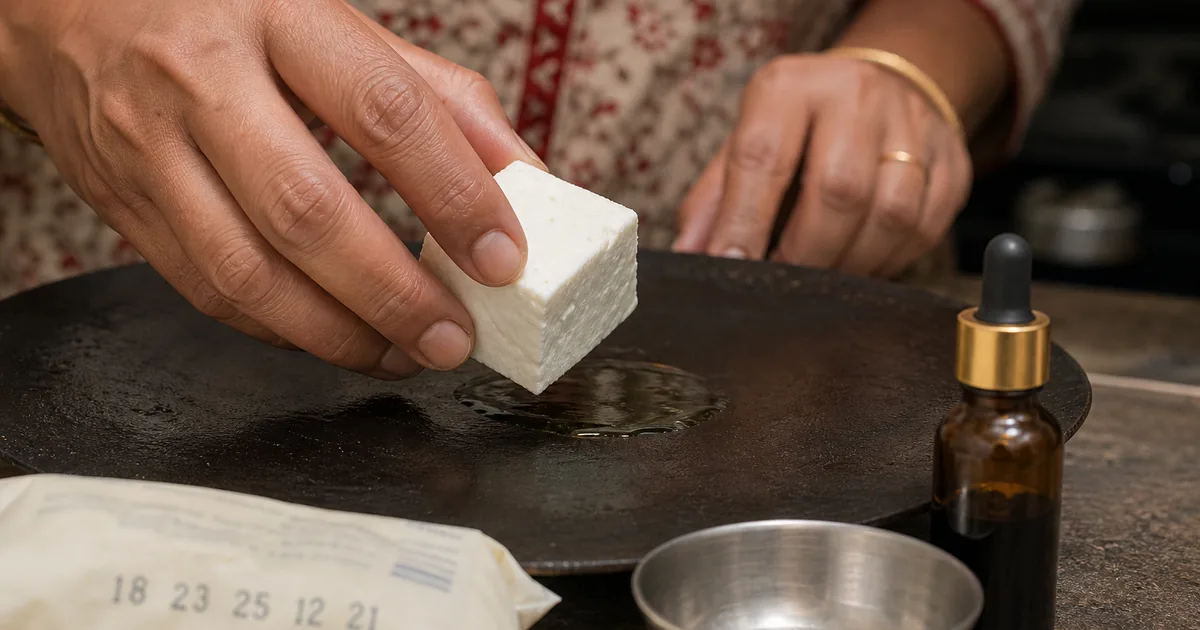
1. Iodine / starch test (the one that is actually a method)
FSSAI dairy manuals use iodine to detect added starch or cereal flour in milk and milk products (including khoa):
- Mash ~2 g paneer or khoa with a little water (or use 3 mL milk).
- Boil, then cool to room temperature.
- Add 2–3 drops of 1% iodine (pharmacy tincture of iodine is the usual home stand-in; it stains skin and clothes).
- Blue / bluish-black → starch is present. Iodine stays brown-yellow → this test did not find starch.
Limit of detection in the official milk method is on the order of 0.02 g/100 mL. A negative iodine test does not mean the cube is dairy paneer. Analogue made from oil + soy can be starch-free and still not paneer.
2. Oil-on-the-tawa test
Heat a dry pan, add a cube, no ghee. A large slick of oil that looks like cooking fat rather than milk browning is a practical analogue/vanaspati clue. It will not prove soapstone.
3. What not to trust from Reels
- “If it burns like plastic it is fake.” Overheated dairy protein also smells awful.
- “Lemon juice proves everything.” Acid is how real paneer is made.
- “One viral strip kit is a court document.” Rapid kits vary; they are screening, not an FSSAI notified-lab report.
If you need a legal sample, that is a food safety officer with a sampling protocol — not your katori.
How to Check the FSSAI Number (2 Minutes)
Packed milk, paneer, and khoa should carry a 14-digit FSSAI licence or registration number.
- Open FoSCoS (Food Safety Compliance System).
- Use licence / registration search (or FBO search). Enter the 14-digit number from the pack.
- Confirm the business name, address, status (active), and food categories roughly match what you bought.
- A missing number, a number that does not exist, a cancelled licence, or a dairy product wearing no milk logo when it claims to be paneer is a reason to put it back.
Analogue packs should look honestly non-dairy on the front: oil/protein in the ingredients, analogue / non-dairy wording, no milk logo.
Loose wet-market cubes often have no licence on the product — only the shop’s board, if that. You are trusting a trader, not a labelled manufacturer. That is the channel the August 2026 stories were about.
Report a problem
| Channel | Use |
|---|---|
| Helpline | 1800-11-2100 (FSSAI, 24×7 toll-free) |
| Food Safety Connect | foscos.fssai.gov.in/consumergrievance or the Food Safety Connect app |
| State FDA / food safety officer | For a shop you can point to on a map |
Keep the pack, bill, and photos. A complaint without a product is a story; a complaint with a lot code is evidence.
How to Buy With Less Risk
There is no zero-risk Indian dairy market. There is lower-risk shopping.
- Prefer sealed, refrigerated packs from manufacturers you can look up on FoSCoS.
- Read “analogue” / oil / starch on the ingredient list. If you want dairy protein, do not buy the cheaper cube that is honest about being oil.
- Ask the restaurant whether the paneer is dairy or analogue. A kitchen that cannot answer is telling you something.
- Skip unlabelled bulk for kids, pregnancy, and anyone immunocompromised unless you trust the dairy.
- Do not assume “hotel white” is quality. Whitener exists specifically to fake that look.
- Make paneer at home when you can: milk + lemon or vinegar, drain, press. You then know the milk you started with — still check that milk’s pack.
- Khoya for sweets: festival demand is when fake mawa pays. Buy from a dairy with a licence, or make a small batch.
scanura does not lab-test food. It does explain the reports you get if a bad batch made you ill.
If You Already Ate It — What Actually Matters
Most people who ate a greasy cube will get nothing worse than an oily meal. Do not induce vomiting “to get the chemicals out.”
See a doctor or urgent care the same day if you have:
- Repeated vomiting or diarrhoea with blood
- Severe abdominal pain, high fever, or you cannot keep water down
- Confusion, collapse, or signs of dehydration (very dry mouth, no urine, dizziness)
- Symptoms in a child, pregnant person, or older adult
Chemical irritation (detergent, strong alkali, industrial whitener) can look like food poisoning. So can bacterial contamination of poorly stored dairy (the boring, common risk). A clinician decides which.
Do not start random “detox” medicines, high-dose vitamin C, or unprescribed antibiotics because of a news sting.
Blood and Stool Tests — Only If You Are Unwell
There is no paneer blood test. Labs cannot see last Tuesday’s cube. Tests are for complications, not for proving a shop cheated you.
| Situation | Tests a doctor may order | Why |
|---|---|---|
| Acute gastroenteritis | Electrolytes, creatinine, sometimes CBC | Dehydration and kidney stress |
| Prolonged fever after street dairy | CBC, typhoid / blood culture, other fever workup | Dairy is not the only vehicle; monsoon fever still needs a panel |
| Jaundice, dark urine, right-upper pain | LFT / SGPT | Hepatitis and other liver injury — not a DIY “toxin panel” |
| Persistent vomiting, low urine | KFT | Volume loss; not a proof of soapstone |
| Blood in stool | Clinical exam ± stool occult blood | Bleeding needs a doctor, not a blog |
Soapstone / selkhadi: news copy often jumps to “kidney and cancer.” Inhaled mineral dust is a known occupational lung hazard. Eating non-food minerals is still a bad idea and can irritate the gut; it is not the same as a one-meal cancer diagnosis. Do not order a full-body PET scan because of one palak paneer.
If you already have PDFs from an ER or lab, upload them to scanura or create an account. scanura explains creatinine, SGPT, sodium/potassium, and CBC in English or Hindi so the follow-up visit is about decisions, not decoding abbreviations. It does not replace emergency care and it does not certify a food sample.
You can also type a flagged value into the blood test checker for a quick range read — still not a diagnosis.
Who Should Be Extra Careful
| Who | Why |
|---|---|
| Young children | Smaller body, higher risk from dehydration and from non-food chemicals |
| Pregnancy | Foodborne illness and unnecessary chemical exposure; stick to traceable packs |
| Chronic kidney or liver disease | Less reserve if a GI illness hits hard |
| Restaurants / tiffin for a crowd | One bad bulk lot hits many people; analogue-without-disclosure is also a trust problem |
| Festival sweet-making | Khoya demand spikes fake mawa |
Key Takeaways
- August 2026 NCR coverage (India Today sting + Ghaziabad raids) is about fake or analogue dairy sold as the real thing — oils, powder, whitener, soapstone — not about banning paneer.
- FSSAI paneer is milk, acid-set, ≤70% moisture, ≥50% milk fat on dry matter (unless labelled low-fat in a sealed pack).
- Analogue paneer is legal if labelled and must not use the milk logo. Unlabelled analogue is fraud.
- The 83% fail number is Noida/Greater Noida sample reports, not a national score.
- Iodine detects starch, not palm oil or soapstone. A negative starch test is not a purity certificate.
- Check the 14-digit licence on FoSCoS; complain via 1800-11-2100 or Food Safety Connect.
- If you are sick, treat dehydration and warning signs — do not induce vomiting or self-order a “toxin panel.”
- scanura reads lab PDFs, not food. Upload KFT, LFT, electrolytes, or CBC if a clinician already ordered them.
Disclaimer: This article is for educational purposes only. It summarises public news and FSSAI standards as of 20 August 2026. Investigations and raids are allegations and enforcement actions, not a finding against every dairy brand or shop. Lot lists, licences, and lab reports can change. scanura is not affiliated with FSSAI, India Today, or any dairy company. scanura does not test food and does not provide medical diagnosis. If you may have eaten unsafe food and have severe symptoms, contact a qualified clinician or emergency services. Paneer, khoa, and related names are used as common food terms; this is news and health-education coverage, not an official recall page.
Medical References
- India Today — Fake paneer, milk, khoya investigation (6 Aug 2026)
- FSSAI — Food Safety and Standards (Food Products Standards and Food Additives) Regulations, 2011 (chhana/paneer)
- FoSCoS — FSSAI licence and registration search
- FSSAI — Food Safety Connect / consumer grievance
- FSSAI — Detect Adulteration with Rapid Test (DART) booklet
Step-by-Step Guide
- 1
Know the three products
Dairy paneer (FSSAI composition), labelled analogue (legal substitute), and adulterated cubes sold as dairy (illegal).
- 2
Look at price, texture, and the tawa
₹80/kg wholesale is a red flag. Rubbery cubes that pool oil on a dry pan are more consistent with vegetable fat than milk.
- 3
Use iodine only for starch
Boil a mash, cool, add iodine. Blue-black suggests starch. A negative test does not prove the cube is dairy paneer.
- 4
Check the 14-digit FSSAI number on FoSCoS
Search foscos.fssai.gov.in. Confirm the licence is active and matches the business. Analogue must not use the milk logo.
- 5
Prefer sealed, refrigerated packs
Loose unlabelled wet-market cubes are the channel August 2026 investigations described. Ask restaurants if they use dairy or analogue.
- 6
If you are sick, get clinical care — then read the PDF
Do not induce vomiting. Electrolytes, KFT, LFT, or CBC are for complications. Upload the report to scanura; scanura does not test food.
📬 One health report guide, every week
Normal ranges, what your values mean, and what to ask your doctor — in plain language. Free, unsubscribe anytime.