🫀Understanding Your Blood Pressure Report: Systolic, Diastolic & What the Numbers Mean
Your blood pressure reading says 120/80 — but what do those two numbers actually mean? Here's a complete guide to understanding, monitoring, and managing your blood pressure.
Scanura Editorial
Health Education Team
Written by Scanura Editorial for health education. This article is not a substitute for advice from a qualified doctor. About our editorial standards
Understanding Your Blood Pressure Report: Systolic, Diastolic & What the Numbers Mean
You've seen blood pressure numbers everywhere — on health websites, in newspaper ads, on your grandparents' medication bottles. But what do those two numbers — like 120/80 or 140/90 — actually mean? Why does your doctor keep asking about them? And what happens if they're too high?
Blood pressure is one of the most important health numbers you'll ever know. It's often called the "silent killer" because high blood pressure usually has no symptoms — but it silently damages your heart, brain, kidneys, and blood vessels for years before something serious happens.
This guide will help you understand exactly what your blood pressure numbers mean, how to monitor them at home, and what lifestyle changes can keep them in check.
What is Blood Pressure?
Your heart is a pump. Every time it beats, it pushes blood through your arteries (blood vessels) to deliver oxygen and nutrients to every cell in your body. Blood pressure is the force that this moving blood exerts on the walls of your arteries.
Think of it like water flowing through a garden hose. If the water pressure is too high, the hose can burst. If it's too low, water won't reach where it needs to go. Your blood vessels work the same way.
Blood pressure is measured in millimeters of mercury (mmHg) — a historical unit from when blood pressure was measured using actual mercury columns.
The Two Numbers: Systolic and Diastolic
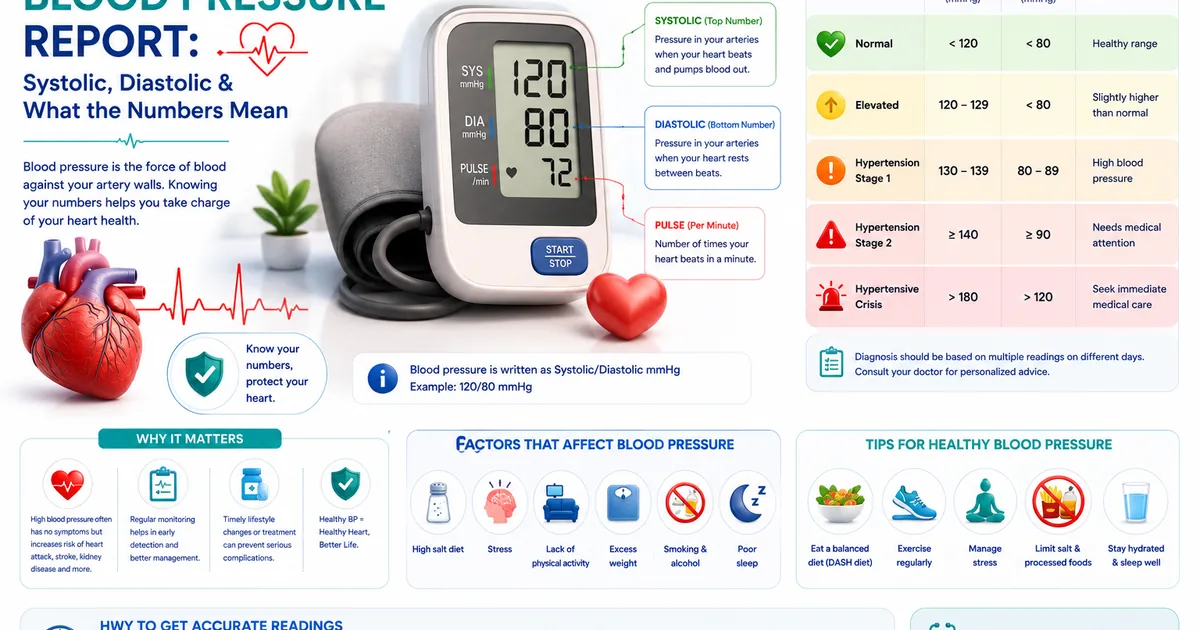
Every blood pressure reading has two numbers, written as a fraction — like 120/80.
Systolic Pressure (Top Number)
The systolic pressure is the force in your arteries when your heart beats (contracts). This is the higher number because the heart is actively pumping, creating maximum pressure.
When your doctor says "your systolic is 120," they mean the pressure in your arteries peaks at 120 mmHg each time your heart pumps.
Diastolic Pressure (Bottom Number)
The diastolic pressure is the force in your arteries when your heart rests between beats. This is the lower number because the heart is relaxed and refilling with blood.
When your doctor says "your diastolic is 80," they mean even when your heart is resting, there's still 80 mmHg of pressure in your arteries.
Why Both Numbers Matter
- High systolic with normal diastolic = isolated systolic hypertension (common in older adults)
- Normal systolic with high diastolic = diastolic hypertension (common in younger adults)
- Both high = combined hypertension (most common)
Research shows that both numbers independently predict heart disease risk. A 20 mmHg increase in systolic pressure doubles your risk of heart disease. A 10 mmHg increase in diastolic pressure increases stroke risk by 40%.
Blood Pressure Categories
The American Heart Association and Indian hypertension guidelines classify blood pressure into these categories:
| Category | Systolic (mmHg) | Diastolic (mmHg) | |
|---|---|---|---|
| Normal | Below 120 | and | Below 80 |
| Elevated | 120 – 129 | and | Below 80 |
| Stage 1 Hypertension | 130 – 139 | or | 80 – 89 |
| Stage 2 Hypertension | 140 – 159 | or | 90 – 99 |
| Stage 3 Hypertension | 160 – 179 | or | 100 – 109 |
| Hypertensive Crisis | 180 or higher | and/or | 120 or higher |
What Each Category Means
Normal (below 120/80): Your blood pressure is in the healthy range. Keep up the good work with lifestyle habits.
Elevated (120-129 / below 80): Your blood pressure is trending upward. This is the warning zone. Without changes, you're likely to develop hypertension within months. Lifestyle modifications at this stage can prevent the need for medication.
Stage 1 Hypertension (130-139 / 80-89): Your blood pressure is consistently high. Your doctor will likely recommend lifestyle changes AND may consider medication, especially if you have diabetes, kidney disease, or established heart disease.
Stage 2 Hypertension (140-159 / 90-99): Your blood pressure is significantly high. Medication is almost always needed along with lifestyle changes. Without treatment, your risk of heart attack, stroke, and kidney damage increases dramatically.
Stage 3 Hypertension (160-179 / 100-109): Severe hypertension. Aggressive treatment needed. High risk of organ damage.
Hypertensive Crisis (180+ / 120+): This is a medical emergency. If you have a reading this high AND symptoms (chest pain, shortness of breath, vision changes, severe headache, confusion), call an ambulance immediately. Even without symptoms, a reading this high needs same-day medical attention.
Blood Pressure by Age — Does Age Matter?
Yes. Blood pressure tends to increase with age because arteries become stiffer over time. Here are general guidelines:
| Age Group | Normal BP Range |
|---|---|
| Children (6-13 years) | 90-110 / 55-70 |
| Teenagers (14-17 years) | 100-120 / 60-80 |
| Young adults (18-39 years) | 100-125 / 60-80 |
| Middle-aged (40-59 years) | 110-135 / 70-85 |
| Older adults (60+ years) | 110-140 / 70-90 |
Important: "Normal" blood pressure doesn't change with age. A 70-year-old with 130/80 still has elevated blood pressure. The fact that it's "normal for their age" doesn't mean it's safe.
How to Measure Blood Pressure at Home
Home blood pressure monitoring is more accurate than clinic readings for most people. Here's why: many people have "white coat hypertension" — their BP spikes in the clinic due to anxiety. Home readings in a relaxed setting are more representative.
Choosing a Monitor
- Upper-arm cuff monitors are the most accurate
- Wrist monitors are less reliable (position-dependent)
- Finger monitors are unreliable — avoid them
- Look for validated devices (check the dableducational.org list)
- Popular brands: Omron, Microlife, Beurer
How to Measure Correctly
30 minutes before:
- No caffeine, exercise, or smoking
- Empty your bladder
- Sit quietly for 5 minutes
During measurement:
- Sit in a chair with back supported
- Feet flat on the floor (don't cross legs)
- Arm supported on a table at heart level
- Cuff on bare upper arm (not over clothing)
- Cuff should be snug but not tight
- Don't talk during measurement
- Take 2 readings, 1 minute apart
- Record the average
When to measure:
- Morning: Within 1 hour of waking, before breakfast and medications
- Evening: Before dinner
- Duration: Record daily for 7 days to get a reliable picture
- Bring the log to your doctor
Common Mistakes to Avoid
- Measuring over clothing
- Talking during measurement
- Not supporting the arm
- Cuff too small (gives falsely high readings)
- Measuring right after exercise or a meal
- Using a wrist monitor held at chest level
High Blood Pressure: The Silent Killer
Hypertension is called the "silent killer" because it usually has no symptoms. You can feel perfectly fine while your blood pressure is 160/100 — slowly damaging your organs.
What High BP Does to Your Body
Heart:
- Forces the heart to work harder → enlargement → heart failure
- Accelerates atherosclerosis (plaque buildup) → heart attack
- Causes coronary artery disease
Brain:
- Damages blood vessels → stroke (hemorrhagic or ischemic)
- Reduces blood flow → vascular dementia
- Increases risk of brain aneurysm
Kidneys:
- Damages kidney blood vessels → chronic kidney disease
- Can lead to kidney failure → dialysis needed
- High BP is the #2 cause of kidney failure (after diabetes)
Eyes:
- Damages retinal blood vessels → hypertensive retinopathy
- Can cause vision loss
Blood Vessels:
- Weakens artery walls → aneurysm
- Accelerates plaque buildup everywhere
When to See a Doctor
Get your blood pressure checked if:
- You're over 30 and haven't had it checked
- You have a family history of hypertension
- You're overweight or obese
- You have diabetes or kidney disease
- You have symptoms: severe headache, chest pain, vision changes, nosebleeds, shortness of breath
- You're pregnant
How to Lower Blood Pressure Naturally
The DASH Diet
DASH stands for Dietary Approaches to Stop Hypertension. It's the most evidence-based diet for lowering blood pressure. Studies show it can reduce systolic BP by 8-14 mmHg.
What to eat:
- Fruits and vegetables (8-10 servings/day)
- Whole grains (brown rice, millets, oats)
- Lean proteins (fish, chicken, legumes, nuts)
- Low-fat dairy (curd, milk)
- Nuts, seeds, and legumes
What to limit:
- Sodium (salt): below 5g per day (about 1 teaspoon)
- Red meat and processed meats
- Sweets and sugary drinks
- Saturated fats (butter, ghee, coconut oil)
- Alcohol
The salt connection: Reducing salt from 10g to 5g per day can lower systolic BP by 5-6 mmHg. This is one of the most powerful dietary changes you can make.
Practical salt tips:
- Don't add salt at the table
- Use spices, herbs, lemon, and garlic for flavor instead
- Avoid pickles, papad, chips, namkeen, and processed foods
- Read labels — most sodium comes from packaged foods
- Wash canned foods before eating
Exercise for Blood Pressure
Regular exercise can lower systolic BP by 5-8 mmHg.
Best exercises:
- Aerobic (cardio): Walking, jogging, cycling, swimming — 150 minutes/week
- Resistance training: Weight lifting, bodyweight exercises — 2-3 times/week
- Isometric exercises: Wall sits, hand grip exercises — emerging evidence for BP reduction
The walking effect: 30 minutes of brisk walking, 5 days per week, is sufficient to lower blood pressure significantly.
Weight Loss
Every 1 kg of weight loss reduces systolic BP by approximately 1 mmHg. If you're 10 kg overweight, losing that weight could drop your BP by 10 mmHg — potentially eliminating the need for medication.
Stress Management
Chronic stress keeps cortisol and adrenaline elevated, which raises blood pressure. Effective strategies:
- Deep breathing exercises (10 minutes daily)
- Meditation or yoga
- Regular physical activity
- Adequate sleep (7-8 hours)
- Social connections
- Limiting screen time
Limit Alcohol
More than 2 drinks per day raises blood pressure significantly. If you drink, limit to: 1 drink for women, 2 drinks for men per day. One drink = 350ml beer, 150ml wine, or 45ml spirits.
Medication: When Lifestyle Isn't Enough
If your blood pressure is consistently above 130/80 despite lifestyle changes, your doctor will likely prescribe medication. This isn't failure — it's medicine.
Common blood pressure medications:
- ACE inhibitors (enalapril, ramipril) — relax blood vessels
- ARBs (losartan, telmisartan) — similar to ACE inhibitors
- Calcium channel blockers (amlodipine) — relax artery walls
- Diuretics (hydrochlorothiazide) — remove excess fluid
- Beta blockers (metoprolol, atenolol) — slow heart rate
Don't stop medication because you feel fine. High blood pressure is asymptomatic. Stopping medication allows BP to rise again, often dangerously.
How scanura Helps
Upload your health reports to scanura for:
- Blood pressure interpretation in plain language
- Risk assessment for heart disease and stroke
- Personalized lifestyle recommendations
- Questions to ask your cardiologist
- Tracking BP trends over time
Key Takeaways
- Blood pressure has two numbers: systolic (when heart beats) and diastolic (when heart rests) — both matter
- Normal is below 120/80 — anything above needs attention
- High blood pressure is the silent killer — it damages organs without symptoms
- Home monitoring is more accurate than clinic readings
- Reduce salt to below 5g/day — this alone can drop BP by 5-6 mmHg
- Walk 30 minutes daily — can drop BP by 5-8 mmHg
- Don't stop medication without consulting your doctor — high BP is lifelong management
Disclaimer: This article is for educational purposes only. scanura does not provide medical diagnosis. Always consult your cardiologist or doctor for medical decisions.
Medical References
Step-by-Step Guide
- 1
Check your BP at home
Use a validated automatic upper-arm cuff. Sit quietly for 5 minutes before measuring. Take 2 readings 1 minute apart and record the average.
- 2
Understand the numbers
Top number (systolic) = pressure when heart beats. Bottom number (diastolic) = pressure when heart rests. Both matter.
- 3
Know your category
Normal: below 120/80. Elevated: 120-129 / below 80. Stage 1 hypertension: 130-139 / 80-89. Stage 2: 140+ / 90+. Crisis: 180+ / 120+.
- 4
Track daily for 1 week
Measure BP morning and evening for 7 days. Share the log with your doctor. One reading doesn't tell the full story.
- 5
Lifestyle changes first
Reduce salt (below 5g/day), exercise 30 minutes daily, lose weight if overweight, limit alcohol, manage stress.
- 6
See your doctor if elevated
If BP is consistently above 130/80, consult your doctor. Medication may be needed alongside lifestyle changes.
📬 One health report guide, every week
Normal ranges, what your values mean, and what to ask your doctor — in plain language. Free, unsubscribe anytime.