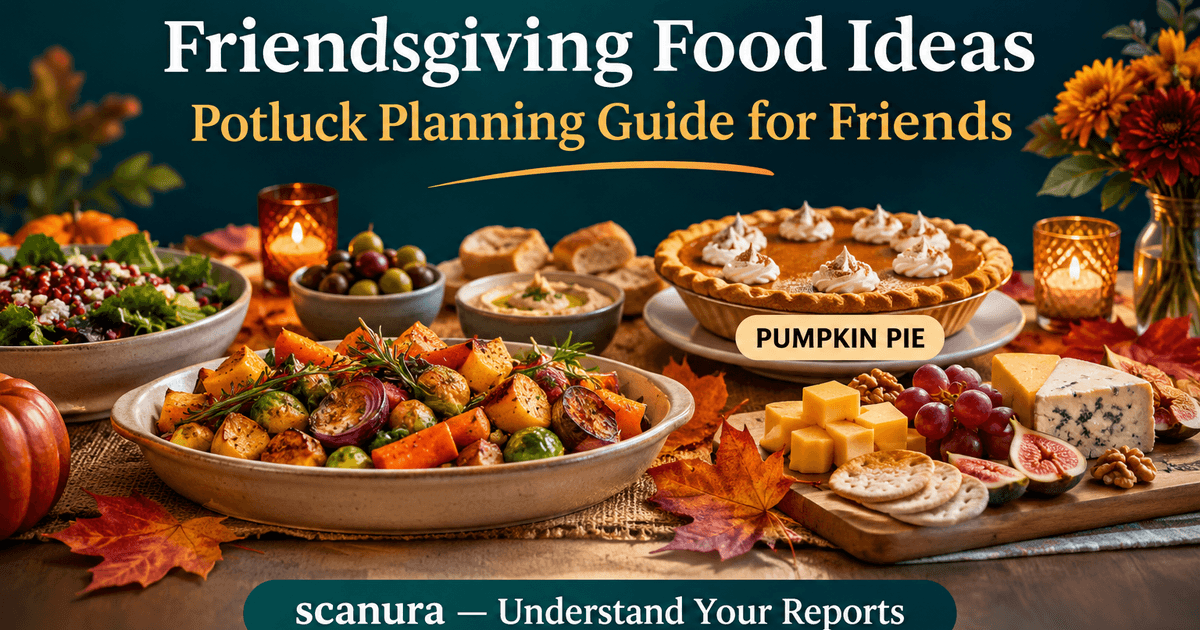
🍂Friendsgiving Food Ideas: A Potluck Planning Guide for Friends
What to bring to Friendsgiving? This potluck guide covers side dishes, desserts, appetizers, hosting tips, food safety basics, and allergy etiquette so you show up with the right dish.
Scanura Editorial
Health Education Team
Written by Scanura Editorial for health education. This article is not a substitute for advice from a qualified doctor. About our editorial standards
Friendsgiving Food Ideas: A Potluck Planning Guide for Friends
You've been invited to Friendsgiving — or you're hosting it — and the big question is: what should you bring, cook, or serve? Friendsgiving is the casual, friend-first version of Thanksgiving, usually celebrated in November. Unlike a family holiday dinner, Friendsgiving is typically a potluck: everyone brings a dish, and the host provides the space and often the turkey or main protein.
This guide gives you practical Friendsgiving food ideas, potluck etiquette, a planning timeline, food-safety basics, and how to handle allergies — so you can show up with the right dish and enjoy the day.
Quick Answer: What to Bring to Friendsgiving
| If you're... | Bring this | Why |
|---|---|---|
| A guest (first-timer) | A crowd-pleasing side (mashed potatoes, roasted vegetables, dinner rolls) | Sides travel well and are hard to mess up |
| A guest (confident cook) | A dessert (pie, crumble, cookies) or appetizer (cheese board, deviled eggs) | Desserts and appetizers are easy to portion |
| The host | Turkey/main protein, drinks, plates, and serving utensils | Host provides the centerpiece and setup |
| Short on time | Store-bought platter + one homemade touch | Balance convenience with personal contribution |
Rule of thumb: Coordinate with the host before you cook. A shared sign-up sheet prevents five people bringing cranberry sauce and nobody bringing vegetables.
What Friendsgiving Is (and What It Isn't)
Friendsgiving is a modern twist on Thanksgiving celebrated with friends instead of (or in addition to) family. It's usually held on or around the fourth Thursday of November, but many groups pick a weekend that works for everyone.
Key terms to know:
| Term | What it means |
|---|---|
| Potluck | Each guest brings a prepared dish to share |
| Host | Provides the venue, main protein, drinks, and tableware |
| Guest | Brings one agreed-upon dish (side, dessert, appetizer, or drinks) |
| Dietary accommodation | A dish that works for vegetarian, vegan, gluten-free, or allergy-restricted guests |
Unlike a formal Thanksgiving dinner, Friendsgiving is relaxed. There's no dress code, no assigned seating, and no pressure to cook a 12-course meal.
Friendsgiving Food Ideas by Course
Appetizers (arrive early, graze while cooking)
- Cheese and charcuterie board — cheddar, brie, crackers, grapes, nuts, honey, olives. Easy to assemble, no reheating needed.
- Deviled eggs — classic, make-ahead, crowd-pleaser. Add paprika or everything bagel seasoning for variety.
- Stuffed mushrooms — cream cheese, garlic, herb filling. Bake ahead, reheat briefly.
- Roasted butternut squash hummus with pita chips and raw vegetables
- Cranberry brie bites — puff pastry, brie, cranberry sauce
Sides (the heart of Friendsgiving)
- Mashed potatoes — buttery, garlicky. Keep warm in a slow cooker.
- Roasted Brussels sprouts — toss with olive oil, salt, pepper; add bacon or balsamic glaze.
- Sweet potato casserole — with or without marshmallows. Make ahead, bake day-of.
- Green beans — roasted with almonds or a simple green bean casserole.
- Cranberry sauce — homemade (fresh cranberries, orange zest, sugar) beats canned.
- Dinner rolls — store-bought, brushed with melted butter. Acceptable and appreciated.
- Wild rice pilaf — with dried cranberries, pecans, and herbs.
- Roasted root vegetables — carrots, parsnips, potatoes with rosemary and thyme.
Mains (usually the host's responsibility)
- Roast turkey breast — smaller and faster than a whole bird.
- Herb-roasted chicken — a great alternative if not everyone eats turkey.
- Mushroom Wellington — an impressive vegetarian main.
- Glazed ham — salty-sweet contrast to the sides.
- Plant-based loaf — for vegan guests.
Desserts
- Pumpkin pie — classic, can be made a day ahead.
- Apple crisp — easier than pie, serves a crowd.
- Pecan pie bars — handheld, easier to serve than a whole pie.
- Chocolate mousse cups — individual portions, make-ahead.
- Mini cheesecakes — bake in a muffin tin.
- Cookies and brownies — grab-and-go, good for leftovers.
Drinks
- Apple cider — hot or cold.
- Sparkling cranberry punch — cranberry juice, sparkling water or prosecco, lime.
- Mulled wine — cozy option for cooler weather.
- Coffee and tea station — for after dinner.
Potluck Etiquette: Do's and Don'ts
| Do | Don't |
|---|---|
| Ask the host what's needed before cooking | Show up with a dish nobody asked for and no serving utensil |
| Label your dish with ingredients (especially allergens) | Bring something that needs last-minute assembly at the host's kitchen |
| Bring your dish in a serving container you don't need back | Expect the host to have oven/stovetop space free for your dish |
| Offer to help with setup or cleanup | Arrive empty-handed without coordinating first |
| Consider dietary restrictions (vegetarian, gluten-free, nut allergies) | Assume everyone eats everything |
Food Safety Basics (USDA / FDA Guidelines)
Foodborne illness is no fun, especially at a holiday gathering. Follow these U.S. Department of Agriculture and Food and Drug Administration basics:
- Keep hot foods hot (above 140°F / 60°C) and cold foods cold (below 40°F / 4°C). Bacteria grow fastest between 40°F and 140°F — the "danger zone."
- Don't leave perishable food out for more than 2 hours (1 hour if it's above 90°F / 32°C).
- Use a food thermometer to check that turkey, chicken, and stuffing reach safe internal temperatures (165°F / 74°C for poultry).
- Wash hands and surfaces before and after handling raw meat, poultry, or eggs.
- Don't reuse marinades that touched raw meat unless boiled first.
- Label dishes with allergens — common ones include nuts, dairy, eggs, wheat, and soy.
Planning Timeline
| When | What to do |
|---|---|
| 3–4 weeks before | Set date, create guest list, choose host |
| 2 weeks before | Create sign-up sheet; assign categories (appetizer, side, dessert, drinks, main) |
| 1 week before | Confirm who's bringing what; shop for non-perishables |
| 2–3 days before | Make desserts, cranberry sauce, or casseroles that keep well |
| Day before | Prep vegetables, set table, chill drinks |
| Day of | Cook/reheat mains and sides; set out appetizers; enjoy |
How to Read a Potluck Sign-Up Sheet
If the host sends a sign-up sheet:
- Check what's already claimed — don't duplicate unless asked.
- Choose a category that fits your skill level and time.
- Note dietary restrictions listed by other guests.
- Confirm your dish so the host can plan around it.
- Ask about reheating — will oven space be available?
Safety, Allergies, and When to Seek Advice
Food allergies can be serious. Common allergens at Friendsgiving include:
- Nuts (pecans in pie, walnuts in salad)
- Dairy (butter in mashed potatoes, cheese in appetizers)
- Eggs (in baked goods, custards)
- Wheat/gluten (rolls, stuffing, pie crust)
- Soy (in some vegetarian mains)
If you're hosting: Ask guests about allergies in advance. Label every dish with its top allergens. Keep allergen-free dishes separate with their own serving utensils to avoid cross-contact.
If you're a guest with allergies: Tell the host. Bring a dish you know is safe for you. Don't hesitate to ask what's in a dish before eating.
Foodborne illness red flags: Nausea, vomiting, diarrhea, fever, or stomach cramps after eating. Most cases resolve on their own, but seek medical care if you have:
- Blood in vomit or stool
- Signs of dehydration (dry mouth, dizziness, little urination)
- Fever above 102°F (39°C)
- Symptoms lasting more than 3 days
This article is educational, not medical advice. If you have a food allergy or suspect food poisoning, consult a qualified healthcare professional.
Frequently Asked Questions
Q: Do I have to cook from scratch? A: No. Store-bought platters, bakery desserts, and pre-made sides are perfectly acceptable. Add one homemade touch if you want.
Q: What if I don't have an oven? A: Bring a no-bake dish (cheese board, crudités, cookies) or something that can be served at room temperature.
Q: How much should I make? A: Plan for about 4–6 ounces (110–170g) of each side per person, plus a little extra. It's better to have leftovers than to run out.
Q: Can I bring a dish that needs reheating? A: Only if the host agrees and has oven/stovetop space. Otherwise, bring something served at room temperature.
Q: What's the difference between Friendsgiving and Thanksgiving? A: Thanksgiving is typically family-focused and more formal. Friendsgiving is friend-focused, casual, and usually potluck-style.
Key Takeaways
- Friendsgiving is a casual, potluck-style Thanksgiving with friends — coordinate with the host before cooking.
- Sides, desserts, and appetizers are the safest guest contributions — they travel well and are hard to mess up.
- The host usually provides the main protein, drinks, and tableware — guests bring one agreed-upon dish.
- Label your dish with ingredients, especially common allergens like nuts, dairy, eggs, and gluten.
- Keep hot foods above 140°F (60°C) and cold foods below 40°F (4°C) — don't leave perishables out more than 2 hours.
- Make desserts and cranberry sauce 1–2 days ahead to reduce day-of stress.
- Store-bought is fine — add one homemade touch if you want to contribute personally.
- Ask about dietary restrictions and speak up if you have allergies before eating.
Sources and Further Reading
- USDA — Food Safety Basics
- FDA — Food Safety for Consumers
- CDC — Food Safety
- FoodSafety.gov — Holiday Food Safety
Disclaimer: This article is for general educational and entertainment purposes only. It is not medical, nutritional, or food-safety advice. Food allergies and foodborne illness can be serious. Consult a qualified healthcare professional or your local health authority for personal dietary or food-safety questions. scanura does not provide catering, event planning, or food safety certification.
Medical References
Step-by-Step Guide
- 1
Ask the host what's needed
Before cooking, check with the Friendsgiving host about what dish category is still open (appetizer, side, dessert, drinks, or main).
- 2
Pick a dish that fits your skill level
Sides, desserts, and appetizers travel well and are beginner-friendly. Bring store-bought if you're short on time.
- 3
Label your dish with allergens
Write down common allergens (nuts, dairy, eggs, gluten, soy) on a card next to your dish to help guests with food allergies.
- 4
Follow food-safety basics
Keep hot foods above 140°F (60°C) and cold foods below 40°F (4°C). Don't leave perishable food out for more than 2 hours.
- 5
Enjoy and help clean up
Offer to help with setup or cleanup, and take leftovers home if the host offers.
📬 One health report guide, every week
Normal ranges, what your values mean, and what to ask your doctor — in plain language. Free, unsubscribe anytime.