
❤️Heart Attack in Young Indians: Lp(a), Lipids, hs-CRP & HbA1c
CAD in the 30s is a panel, not a lipid post. Lp(a) once, fasting lipids, hs-CRP when well, HbA1c, and BP — not troponin unless it is an emergency.
Scanura Editorial
Health Education Team
Written by Scanura Editorial for health education. This article is not a substitute for advice from a qualified doctor. About our editorial standards
Heart Attack in Young Indians: Lp(a), Lipids, hs-CRP & HbA1c
You are 32. You gym three days a week. Your uncle had a stent at 47. The corporate “lipid package” says LDL is 118 and “borderline.” A cardiologist added Lp(a), hs-CRP, and HbA1c. WhatsApp says troponin. The gym trainer says “cut oil.”
This is not another walkthrough of every cholesterol number. You already have a full lipid profile guide and a cardiac-marker encyclopaedia. This page is the cluster people actually type: heart attack in the 30s in India — which tests, once, while you still feel well.
South Asians develop coronary disease years earlier than many European populations. Family history, diabetes, smoking, central fat, and a genetic particle called Lp(a) often sit behind a “not that bad” LDL. The useful outpatient panel is lipids + Lp(a) once + hs-CRP when you are well + HbA1c + blood pressure. Troponin is for chest-pain pathways, not a wellness add-on.
Related reading: hs-CRP vs ordinary CRP, HbA1c as a 3-month average, homocysteine.
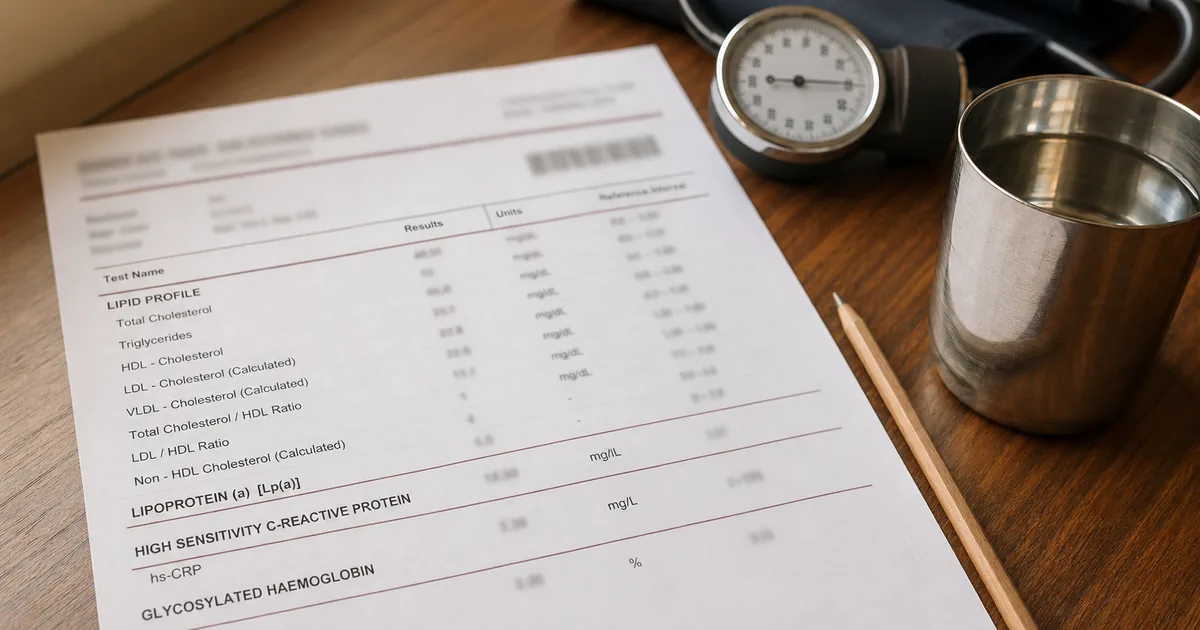
Why “Young” Heart Attacks Are an India Story
Premature coronary artery disease usually means a first event before 55 in men and 65 in women (definitions vary slightly by guideline). In Indian clinics the typical patient is often younger still — 30s and 40s with a family stent story, a smoking history, or new diabetes.
Drivers that cluster in Indian adults:
| Factor | Why it matters here |
|---|---|
| South Asian risk | Plaque and events at a lower BMI than Western cutoffs; waist often tells more than the weighing scale |
| Family history | First-degree relative with early heart attack or sudden death is a risk multiplier, not a rumour |
| Diabetes and prediabetes | India carries a huge undiagnosed burden; sugar risk starts before fasting glucose looks “high” |
| Lp(a) | Genetic particle; diet barely moves it; common enough that “LDL looks fine” is incomplete |
| Smoking / vaping / hookah | Still the fastest-moving preventable risk in young men |
| Triglycerides + low HDL | The “Indian lipid pattern” — not always a sky-high LDL |
This panel is for prevention and risk sorting. It does not diagnose a heart attack happening today.
The Panel — and What Does Not Belong on It
Order this when you feel well (with a clinician)
| Test | Role on this panel | Fasting? |
|---|---|---|
| Lipid profile | LDL, HDL, triglycerides, non-HDL; ApoB if the lab offers it or LDL is confusing | Usually 8–12 hours |
| Lp(a) | Once in a lifetime for most people (repeat only if the method/units change or a specialist asks) | Usually not required |
| hs-CRP (cardiac / high-sensitivity) | Quiet arterial inflammation when you are not infected | No |
| HbA1c (+ fasting glucose if advised) | Hidden diabetes / prediabetes — a major Indian CAD driver | HbA1c: no; glucose: yes |
| Blood pressure | Still the cheapest “test” in the room | Sit 5 minutes; repeat |
Optional, story-dependent: TSH if weight/fatigue, creatinine if medicines or kidney history, homocysteine if vegetarian B12 risk is high. Homocysteine is a supporting clue, not the headline of this panel.
Do not add these “just in case”
| Test | When it actually belongs |
|---|---|
| Troponin / hs-troponin | Emergency or chest-pain protocol — serial draws, ECG, hospital |
| BNP / NT-proBNP | Breathlessness, suspected heart failure — not a gym package |
| CT coronary angiogram / calcium score | Specialist decision after risk discussion — not the first PDF |
| Random “cardiac enzymes” from a chemist | Noise. Timing and assay matter |
If you have chest pain, pressure, jaw/arm pain, sudden breathlessness, or collapse — go to emergency care. Do not wait for an Lp(a) appointment. Details on troponin belong in the cardiac markers guide, not this prevention page.
Lipids Here: Pattern, Not a Second Textbook
Read the lipid row as risk context, then tap through to the lipid profile guide for LDL vs HDL vs VLDL definitions.
What this young-CAD page cares about:
| Finding | How to use it (educational) |
|---|---|
| LDL-C | Still the main treatable particle cholesterol. “Normal for the lab” is not always “low enough” if you already have disease, diabetes, or a ferocious family history — targets are risk-based, clinician-set |
| Non-HDL-C | Total minus HDL — useful when triglycerides are high |
| Triglycerides | Often high in Indian carb-heavy, low-activity patterns; also rise after a non-fasting draw or a sweet breakfast |
| HDL-C | Low HDL is common; raising it with potions is not the goal — lower the apoB-containing particles |
| ApoB (if reported) | Counts atherogenic particles. Helps when LDL and triglycerides disagree |
A young adult with LDL 110, triglycerides 280, HDL 32, and a parent with an MI at 48 is a different conversation from LDL 110 in isolation. That is why this is a panel, not a lipid blog.
Lp(a): The Once-in-a-Lifetime Line
Lipoprotein(a) is LDL-like with an extra protein (apo(a)). Levels are mostly genetic. Diet, running, and “oil change” barely move them.
| Rough educational bands (mg/dL)* | How clinicians often talk |
|---|---|
| Below ~30 | Lower genetic Lp(a) burden |
| ~30–50 | Intermediate — interpret with family history and other risks |
| Above ~50 | Clearly elevated on many consensus cutoffs |
| Very high (lab-specific; sometimes >70–125) | Specialist conversation; still not an emergency by itself |
*Indian labs print mg/dL or nmol/L. Do not convert casually or mix a nmol cutoff with a mg/dL number. Always use your report’s method and range.
Facts that stop panic-Googling:
- About one in five people worldwide have high Lp(a); South Asian cohorts often sit at the higher end of that story.
- High Lp(a) adds risk even when LDL looks acceptable.
- A high result does not mean a heart attack is due next month. It means other risks get managed more seriously (BP, tobacco, LDL, diabetes).
- Dedicated Lp(a)-lowering drugs are specialist / trial territory in 2026 — not a chemist protocol.
If Lp(a) is high, the actionable list is boring and real: stop smoking, know your BP, treat LDL to a tighter target if your cardiologist says so, fix sugar. Repeat Lp(a) every year is usually waste.
hs-CRP: Only When You Are Not Sick
hs-CRP is the same protein as ordinary CRP, measured in the low range used for vascular risk, not monsoon fever.
| hs-CRP (mg/L), when well | Educational heart-risk band (AHA-style) |
|---|---|
| < 1.0 | Lower inflammatory risk band |
| 1.0–3.0 | Intermediate |
| > 3.0 | Higher — if you were not infected, injured, or flaring arthritis |
Do not use an hs-CRP drawn during dengue, COVID, a dental abscess, or the week after a marathon as a “heart score.” That is infection CRP wearing a cardiac label. Full distinction: CRP quantitative vs hs-CRP.
A high hs-CRP with a normal lipid row still matters — inflammation and particles are two different levers. A low hs-CRP does not cancel smoking or a parent’s early MI.
HbA1c: The Silent Multiplier
Diabetes is one of the strongest coronary risk factors in India. Many people in their 30s have prediabetes with no thirst, no “sugar family drama,” and a normal random glucometer at a mall camp.
| HbA1c (typical lab) | Educational reading |
|---|---|
| Below 5.7% | Usual non-diabetes band (lab-specific) |
| 5.7–6.4% | Prediabetes zone — lifestyle window |
| 6.5% or higher | Diabetes range — confirm per clinician (repeat / glucose as advised) |
Anaemia, recent transfusion, and some haemoglobin variants can distort HbA1c — another reason a doctor reads the whole CBC + sugar story. Deep dive: HbA1c explained and fasting vs PP vs HbA1c.
Triglycerides, fatty liver, and a rising HbA1c often travel together. That is metabolic risk, not a separate “heart vitamin” problem.
How to Read the Cluster (Not One Red Star)
| Pattern | Typical next conversation |
|---|---|
| High Lp(a) + family early CAD + ordinary LDL | Do not shrug. Tighten modifiable risks; ask about ApoB and imaging only if the clinician thinks it changes management |
| LDL high + HbA1c 6.1% + waist 98 cm | Metabolic + lipid plan — insulin resistance if weight and PCOS/fatigue fit |
| hs-CRP 4.2 + fever last week | Repeat hs-CRP when well; do not start a statin from that one printout alone |
| All “normal” + daily smoking + BP 148/94 | The PDF is not the whole risk. Treat BP and tobacco |
| Troponin ordered on a wellness package, you feel fine | Ask why. A tiny bump still needs clinical interpretation — not Twitter |
Keep units, dates, and fasting status on every PDF. Switching labs without noting the method makes fake “trends.”
What To Do After the PDF
- If you have acute chest symptoms — hospital first. This article is for the quiet Tuesday panel.
- List family events with ages (MI, stroke, sudden death, bypass) before the consult.
- Stop tobacco. No panel outruns cigarettes.
- Walk BP and waist into the room — not only LDL.
- Do not start or stop statins, aspirin, or “blood thinners” from a reel. Aspirin in a healthy 30-year-old is a bleeding decision, not a default.
- Repeat lipids/HbA1c on a schedule, not weekly. Lp(a) stays put.
Upload the lipid + Lp(a) + hs-CRP + HbA1c PDFs together to scanura or create an account. scanura explains the cluster in English or Hindi so you walk in with questions — it does not replace a cardiologist, and it does not read an ECG.
The blood test checker is a single-value range read. Premature CAD is a pattern.
When to Worry
| Situation | Action |
|---|---|
| Chest pain, sweating, nausea, one-sided weakness, sudden severe breathlessness | Emergency services — not a blog, not scanura |
| Known high Lp(a) + new effort angina | Same-week clinician, not “wait for the annual package” |
| HbA1c in diabetes range | Physician plan; heart risk rises with uncontrolled sugar |
| hs-CRP sky-high with fever | Treat the infection story; repeat cardiac hs-CRP later |
| Statin muscle pain or dark urine | Call the prescriber — do not silently stop and restart |
Questions to Ask Your Doctor
- “Given my family history and South Asian risk, is my LDL target lower than the lab’s ‘normal’?”
- “Should I add ApoB, or is non-HDL enough on this report?”
- “Is this hs-CRP valid, or was I unwell when it was drawn?”
- “My Lp(a) is high — what actually changes in my plan this year?”
- “Do I need an ECG, treadmill, or imaging, or is risk-factor control first?”
- “Is aspirin indicated for me — or more harm than help?”
Key Takeaways
- Young CAD in India is a panel problem — lipids, Lp(a) once, hs-CRP when well, HbA1c, and BP — not a standalone cholesterol post.
- Troponin is for emergencies, not preventive packages.
- Lp(a) is genetic; lifestyle still matters because it treats everything else.
- hs-CRP during infection is not a heart score.
- Diabetes risk is coronary risk — HbA1c belongs on this sheet.
- Family history and tobacco can outweigh a “borderline” LDL.
- Aspirin and statins are prescriptions, not WhatsApp protocols.
- Upload the full cluster to scanura, then follow the clinician — chest pain still goes to hospital.
Disclaimer: This article is for educational purposes only. Risk cutoffs, Lp(a) units, and treatment thresholds vary by lab and guideline. scanura does not provide medical diagnosis and is not an emergency service. Always consult a qualified clinician for personal cardiovascular decisions.
Medical References
Step-by-Step Guide
- 1
Treat chest pain as an emergency, not a lab package
Troponin belongs on a chest-pain pathway with ECG. Do not add it to a wellness panel because of family history alone.
- 2
Fast 8–12 hours for the lipid row
Ask for a standard lipid profile and ApoB if available. Read non-HDL and triglycerides with LDL, not LDL in isolation.
- 3
Get Lp(a) once
Levels are mostly genetic. Repeat only if the lab method or units change, or a specialist asks.
- 4
Draw hs-CRP only when you are well
Infection, injury, or a recent fever ruins the cardiac reading. Use the high-sensitivity / cardiac assay, not ordinary CRP from a dengue workup.
- 5
Add HbA1c and blood pressure
Hidden diabetes and hypertension drive young CAD in India as much as cholesterol.
- 6
Upload the cluster, then see a clinician
Bring family history with ages. scanura explains the PDF; it does not replace a cardiologist.
📬 One health report guide, every week
Normal ranges, what your values mean, and what to ask your doctor — in plain language. Free, unsubscribe anytime.