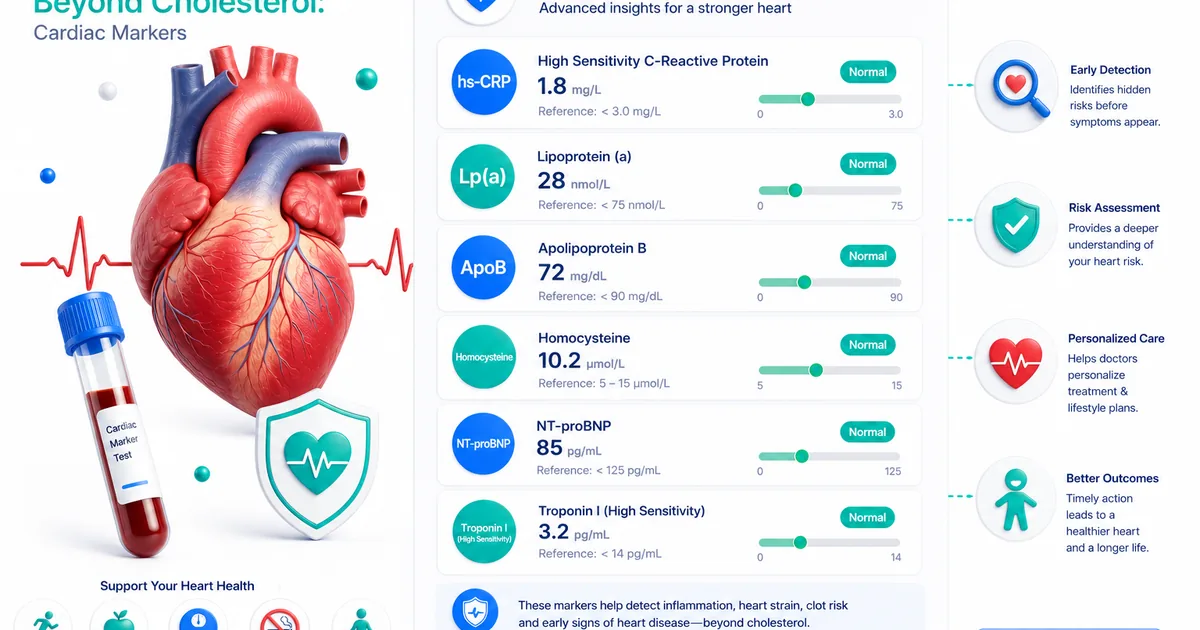
❤️Heart Health Beyond Cholesterol: Cardiac Markers Explained
Cholesterol is just one piece of the heart health puzzle. hs-CRP, Troponin, BNP, Lp(a), Homocysteine, and ApoB reveal risks that standard lipid panels miss entirely.
Scanura Editorial
Health Education Team
Written by Scanura Editorial for health education. This article is not a substitute for advice from a qualified doctor. About our editorial standards
Heart Health Beyond Cholesterol: Cardiac Markers Explained
When most people think of heart health, they think of cholesterol — LDL, HDL, triglycerides. But cholesterol tells only part of the story. Your heart's true risk profile is written in a different set of blood markers that most people never hear about.
These advanced cardiac markers can catch heart disease years before a standard lipid panel would raise any alarm. Let's walk through each one.
Why Cholesterol Alone Isn't Enough
A standard lipid panel measures cholesterol and triglycerides. It tells you how much fat is floating in your blood. But it doesn't tell you:
- Whether your arteries are inflamed (inflammation causes plaque to rupture)
- Whether your heart muscle is under strain (fluid overload, weak pumping)
- Whether you have genetically high lipoprotein(a) that standard LDL tests miss
- Whether homocysteine is silently damaging your blood vessel walls
That's where advanced cardiac markers come in.
The 6 Key Cardiac Markers
1. hs-CRP (High-Sensitivity C-Reactive Protein)
| Risk Level | hs-CRP (mg/L) |
|---|---|
| Low risk | Below 1.0 |
| Moderate risk | 1.0 – 3.0 |
| High risk | Above 3.0 |
What it measures: Systemic inflammation, specifically arterial wall inflammation.
Why it matters: Heart attacks don't happen because arteries are "clogged" — they happen because a plaque ruptures and a clot forms on top of it. Inflammation weakens the plaque's fibrous cap, making rupture more likely. hs-CRP detects this inflammation.
Key facts:
- hs-CRP is an independent risk factor — it predicts heart attacks even when cholesterol is normal
- It rises with any infection, so retest after ruling out acute illness
- The JUPITER trial showed that statins reduced heart attacks by 44% in people with elevated hs-CRP, even with normal cholesterol
- Ideal target: below 1.0 mg/L
Indian context: Chronic low-grade inflammation from obesity, diabetes, and stress is increasingly common in urban India. hs-CRP is especially valuable for Indians because standard cholesterol panels often underestimate risk in South Asian populations.
2. Troponin I (hs-TnI)
| Level | Interpretation |
|---|---|
| Normal | Below 0.04 ng/mL |
| Grey zone | 0.04 – 0.1 ng/mL |
| Abnormal | Above 0.1 ng/mL |
What it measures: A protein released when heart muscle cells are damaged or dying.
Why it matters: Troponin is the gold standard for diagnosing a heart attack (myocardial infarction). If you have chest pain and Troponin is elevated, emergency treatment is needed within minutes.
Key facts:
- High-sensitivity Troponin (hs-TnI) can detect heart muscle damage hours before symptoms become severe
- Even mildly elevated Troponin (above 0.04) in someone without chest pain may indicate chronic heart strain — this is called "chronic myocardial injury"
- Troponin can be elevated from heart failure, severe pneumonia, pulmonary embolism, and kidney disease — not just heart attacks
- A single normal Troponin during chest pain does NOT rule out a heart attack — serial testing at 3 and 6 hours is standard
When to get tested: Chest pain, shortness of breath, unexplained fatigue with exertion, or post-surgery cardiac screening.
3. BNP (B-type Natriuretic Peptide)
| Level (pg/mL) | Interpretation |
|---|---|
| Normal | Below 100 |
| Grey zone | 100 – 400 |
| Likely heart failure | Above 400 |
What it measures: A hormone released when the heart chambers are stretched from fluid overload.
Why it matters: BNP is the most reliable blood test for diagnosing and monitoring heart failure. When the heart can't pump efficiently, blood backs up into the lungs, and the heart wall stretches — triggering BNP release.
Key facts:
- BNP above 400 in someone with breathlessness is nearly diagnostic of heart failure
- BNP rises with age and kidney disease — use NT-proBNP (age-adjusted thresholds) in patients over 70
- BNP is used to monitor treatment — a dropping BNP means the heart is responding to therapy
- BNP can be falsely low in obese patients (BMI > 30) due to receptor clearance
Indian context: Heart failure affects approximately 10-12 million Indians. Early detection through BNP can prevent emergency hospitalisations. If you have unexplained breathlessness, especially when lying down or walking uphill, ask for a BNP test.
4. Lp(a) — Lipoprotein(a)
| Level (mg/dL) | Risk |
|---|---|
| Optimal | Below 30 |
| High | Above 50 |
| Very high | Above 125 |
A genetically determined lipoprotein — 80-90% determined by genetics, not diet. About 20% of Indians have elevated Lp(a). It doubles or triples heart attack risk even when all other numbers are normal. Get it tested at least once in your lifetime, especially with family history of early heart disease.
For a full deep-dive on Lp(a), ApoB, and advanced lipid markers, see our Cholesterol & Lipid Profile Guide.
5. Homocysteine
| Level (μmol/L) | Risk |
|---|---|
| Optimal | Below 10 |
| Borderline | 10 – 15 |
| High | Above 15 |
What it measures: An amino acid that, at high levels, damages the inner lining of blood vessels (endothelium).
Why it matters: Elevated homocysteine accelerates atherosclerosis by damaging artery walls and promoting blood clots. It's often called the "silent destroyer" because it causes no symptoms until damage is significant.
Key facts:
- High homocysteine is caused by deficiencies in Vitamin B12, B6, and folate — all common in India
- Vegetarians are at especially high risk because B12 is found almost exclusively in animal products
- Homocysteine above 15 μmol/L increases heart attack risk by 2-3x
- Simple supplementation (B-complex vitamins) can lower homocysteine by 25-50%
- Homocysteine is also linked to stroke, dementia, and recurrent pregnancy loss
Indian context: India has one of the highest rates of vegetarianism in the world, and B12 deficiency is rampant. Studies show 40-80% of Indian vegetarians have borderline-to-high homocysteine levels. This is a low-cost, high-impact test that should be part of every annual health checkup.
6. ApoB (Apolipoprotein B)
| Level (mg/dL) | Risk |
|---|---|
| Optimal | Below 60 |
| Borderline high | 80 – 90 |
| High | Above 90 |
Measures the total number of atherogenic particles — a better predictor than LDL cholesterol alone. Each harmful particle (LDL, VLDL) carries exactly one ApoB molecule. Indians tend to have small, dense LDL, so ApoB may be elevated even when LDL-C looks acceptable.
For a full breakdown of ApoB, non-HDL cholesterol, and when to request these tests, see our Cholesterol & Lipid Profile Guide.
What Your Cardiac Panel Should Include
For a comprehensive heart health assessment, request:
| Test | Why |
|---|---|
| hs-CRP | Detects arterial inflammation |
| Troponin I | Rules out heart muscle damage |
| BNP | Screens for heart failure |
| Lp(a) | Genetic clotting + plaque risk |
| Homocysteine | Blood vessel damage marker |
| ApoB | Total atherogenic particle count |
| Standard lipid panel | Cholesterol + triglycerides baseline |
When to Get a Cardiac Marker Panel
- After age 40 — regardless of symptoms, as baseline screening
- Family history of early heart disease — especially with Lp(a)
- Diabetes or hypertension — both accelerate cardiovascular disease
- Unexplained chest pain or breathlessness — Troponin + BNP
- Obese or sedentary — hs-CRP and ApoB screening
- Vegetarian — homocysteine screening for B12 deficiency impact
How scanura Helps
When you upload your cardiac marker panel to scanura:
- Flag each marker with colour-coded risk levels: green (optimal), amber (borderline), red (high), dark red (critical)
- Calculate your composite cardiovascular risk by combining multiple markers
- Explain each marker in plain Hindi and English with Indian-specific reference ranges
- Generate 5 doctor questions tailored to your specific abnormal findings
- Track changes over time — see if your hs-CRP or ApoB is trending in the right direction
Disclaimer: This article is for educational purposes only. scanura does not provide medical diagnosis. Always consult your cardiologist for medical decisions.
Medical References
Step-by-Step Guide
- 1
Get a cardiac biomarker panel
Ask your doctor for hs-CRP, Troponin I, BNP, Lp(a), Homocysteine, and ApoB alongside your standard lipid profile. Fasting for 8-12 hours is recommended.
- 2
Check hs-CRP (high-sensitivity C-reactive protein)
Below 1.0 mg/L = low risk. 1.0–3.0 = moderate risk. Above 3.0 = high risk. This measures arterial inflammation — a key predictor of heart attack that cholesterol alone misses.
- 3
Review Troponin I
Normal is below 0.04 ng/mL. Even mildly elevated Troponin signals heart muscle damage. If you have chest pain and Troponin is elevated, seek emergency care immediately.
- 4
Check BNP (B-type Natriuretic Peptide)
Below 100 pg/mL = normal. 100–400 = grey zone. Above 400 = likely heart failure. BNP rises when the heart is under strain from fluid overload.
- 5
Review Lp(a) and ApoB
Lp(a) above 50 mg/dL is genetically elevated and independently increases heart attack risk. ApoB above 90 mg/dL indicates more atherogenic particles than standard cholesterol panels reveal.
- 6
Consult a cardiologist
If hs-CRP is above 3.0, Troponin is elevated, BNP is above 400, or Lp(a) is above 50 mg/dL, consult a cardiologist for risk assessment and prevention strategy.
📬 One health report guide, every week
Normal ranges, what your values mean, and what to ask your doctor — in plain language. Free, unsubscribe anytime.