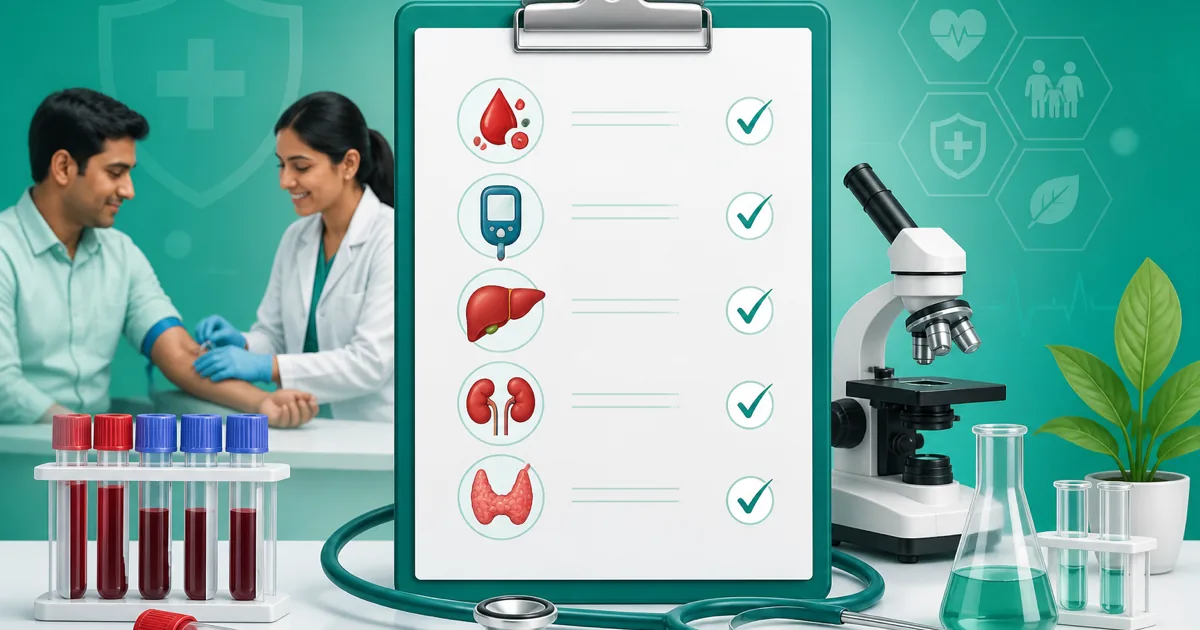
🏥Full Body Checkup Mein Kya Kya Hota Hai? Complete Test List India
Confused by a 40-test health package? Here’s what a typical full body checkup in India actually includes, which tests matter by age, and how to read the report without panic.
Scanura Editorial
Health Education Team
Written by Scanura Editorial for health education. This article is not a substitute for advice from a qualified doctor. About our editorial standards
Full Body Checkup Mein Kya Kya Hota Hai? Complete Test List India
You booked a "Full Body Checkup" on Practo, Healthians, or at your local pathology lab. The package name sounded impressive — Platinum, Executive, Comprehensive — and the price was ₹999 to ₹4,999. Now the phlebotomist is asking you to come fasting, carry two IDs, and drink only water after 10 PM. You wonder: full body checkup mein actually kya-kya hota hai? Which tests matter? Which ones are just marketing?
Full body checkups are among the most popular health purchases in urban India — corporate HR teams mandate them, parents gift them to children abroad, and families compare reports over WhatsApp. Yet the test list varies wildly between labs. One package includes Vitamin D and B12; another skips thyroid. Understanding what each test measures helps you read the report intelligently instead of panicking at every red highlight.
This guide lists what a typical Indian full body package contains, how to read the combined report, fasting rules, which tests matter by age, realistic cost ballparks, and when a targeted test beats a mega-panel. For deeper dives on individual sections, see our CBC guide, blood sugar guide, and LFT guide.
Full Body Checkup Kya Hai?
A full body checkup (also called health package, master health checkup, or preventive profile) is a bundled set of blood and urine tests designed to screen common conditions before symptoms appear. It is not a substitute for seeing a doctor when you are unwell — it is a snapshot of metabolism, organs, blood counts, and deficiencies.
Think of it as a dashboard, not a diagnosis. Abnormal values need clinical correlation: your age, medicines, symptoms, and past reports.
Typical Tests in an Indian Full Body Package
Most packages from Thyrocare, Dr Lal PathLabs, SRL, Metropolis, and hospital chains include some combination of the following:
1. Complete Blood Count (CBC)
| Component | What It Screens |
|---|---|
| Haemoglobin (Hb) | Anaemia — extremely common in Indian women |
| WBC count | Infection, inflammation |
| Platelets | Clotting problems, dengue monitoring |
| RBC indices (MCV, MCH) | Iron vs B12/folate deficiency patterns |
| Differential count | Neutrophils, lymphocytes, eosinophils breakdown |
Why it matters: Anaemia affects 50%+ of Indian women of reproductive age. A normal-looking person can have Hb of 9 g/dL.
2. Blood Sugar — Fasting Glucose and Often HbA1c
| Test | Normal Range (Typical) | Purpose |
|---|---|---|
| Fasting blood sugar (FBS) | 70 – 99 mg/dL | One-time morning glucose |
| Post-prandial (PP) sugar | <140 mg/dL (2 hr after meal) | After-meal spike detection |
| HbA1c | <5.7% | 3-month average — best for diabetes screening |
India has 100+ million people with diabetes. Many are first detected on a checkup. See our HbA1c guide.
3. Lipid Profile (Cholesterol Panel)
| Test | Typical Normal | Notes |
|---|---|---|
| Total cholesterol | <200 mg/dL | Less useful alone |
| LDL ("bad") cholesterol | <100 mg/dL (ideal); <130 acceptable for low risk | Target varies by heart risk |
| HDL ("good") cholesterol | >40 mg/dL (men); >50 mg/dL (women) | Higher is protective |
| Triglycerides | <150 mg/dL | Rises after heavy meals — fasting essential |
| VLDL, Total/HDL ratio | Lab-specific | Cardiac risk markers |
South Asians often have normal LDL but high triglycerides and low HDL — a pattern missed if only total cholesterol is checked.
4. Liver Function Test (LFT)
| Marker | Also Called | What High Means |
|---|---|---|
| SGPT / ALT | — | Liver cell injury — fatty liver, hepatitis, medicines |
| SGOT / AST | — | Liver, muscle, heart — see SGOT vs SGPT guide |
| ALP | Alkaline phosphatase | Bile duct, bone |
| Bilirubin | Total/direct | Jaundice, bile obstruction |
| Albumin, total protein | — | Liver synthetic function, nutrition |
| GGT | Gamma-GT | Alcohol, fatty liver, medicines |
India context: Non-alcoholic fatty liver disease (NAFLD) affects 20–30% of urban Indians — often silent until LFT is checked.
5. Kidney Function Test (KFT / RFT)
| Test | Normal Range (Typical) | Notes |
|---|---|---|
| Serum creatinine | 0.6 – 1.2 mg/dL (varies by muscle mass, sex) | Core kidney marker |
| Blood urea / BUN | 15 – 40 mg/dL | Dehydration, kidney, high protein diet |
| Uric acid | 3.5 – 7.2 mg/dL (men); lower in women | Gout, kidney stones |
| eGFR | >90 mL/min (calculated) | Staging chronic kidney disease |
Diabetes and hypertension are leading causes of kidney disease in India. Creatinine alone can look normal until significant damage occurs — eGFR helps.
6. Thyroid Profile
| Test | Typical Normal | Purpose |
|---|---|---|
| TSH | 0.4 – 4.0 mIU/L (lab-specific) | Primary screening test |
| Free T3, Free T4 | Lab-specific | If TSH abnormal or symptoms persist |
Hypothyroidism is common in Indian women — fatigue, weight gain, irregular periods. Many packages include only TSH, which is sufficient for screening.
7. Urine Routine & Microscopy
Checks for:
- Protein or blood in urine — kidney, bladder issues
- Sugar or ketones — uncontrolled diabetes
- Pus cells, bacteria — urinary tract infection (UTI)
- Crystals — kidney stone risk
A ₹50 urine test catches problems that ₹5000 blood panels miss.
8. Vitamin D (25-OH Vitamin D)
| Level (ng/mL) | Interpretation |
|---|---|
| <20 | Deficiency — very common in India |
| 20 – 30 | Insufficiency |
| 30 – 100 | Adequate (most labs) |
| >100 | Possible excess — usually supplementation related |
Despite abundant sunlight, 70–90% of Indians are Vitamin D deficient due to indoor lifestyles, pollution, covered clothing, and dark skin pigmentation requiring longer sun exposure.
9. Vitamin B12
| Level (pg/mL) | Interpretation |
|---|---|
| <200 | Deficiency |
| 200 – 300 | Borderline — common in vegetarians |
| >300 | Adequate (lab-specific cutoffs vary) |
Vegetarian and vegan Indians, elderly with poor absorption, and patients on metformin or PPIs (omeprazole) are at high risk.
Not all budget packages include ferritin — yet iron stores matter more than haemoglobin alone for Indian women.
Kya-Kya Hota Hai: Package Tier Comparison
| Package Tier | Typical Price (India, 2026) | Usually Includes | Often Skips |
|---|---|---|---|
| Basic / Essential | ₹699 – ₹1,499 | CBC, FBS, lipid, LFT, KFT, urine | HbA1c, thyroid, vitamins |
| Standard / Smart | ₹1,500 – ₹2,999 | Above + TSH, HbA1c, uric acid | B12, Vitamin D, iron studies |
| Comprehensive / Platinum | ₹3,000 – ₹5,999 | Above + Vitamin D, B12, ferritin, ESR, calcium | Hormones, cancer markers, imaging |
| Executive / Premium | ₹6,000 – ₹15,000+ | Above + hs-CRP, homocysteine, PSA (men), CA-125 (women), echo, X-ray | MRI, advanced genetics |
Tip: Compare test count AND test names, not just package title. A "60-test" package may count each lipid fraction separately.
Fasting Rules — Kaise Taiyaar Rahein
Most packages require 8–12 hours overnight fasting:
| Do | Don't |
|---|---|
| Fast from 10 PM (or midnight) until blood draw | No tea, coffee, milk, juice |
| Drink plain water freely | No smoking (can affect some tests) |
| Take essential medicines unless doctor says otherwise | No heavy exercise morning of test |
| Bring previous reports and medicine list | Don't fast if diabetic on insulin without doctor advice |
Post-meal sugar (PPBS) needs a separate visit: fasting sample first, then eat a standard meal (75 g glucose in OGTT, or lab-specified diet), then blood draw at 2 hours.
Report Kaise Padhein — Section by Section
When your 15-page PDF arrives:
| Step | Action |
|---|---|
| 1. Look at reference ranges | Every lab uses slightly different cutoffs — trust YOUR lab's range |
| 2. Flag only significant abnormalities | Borderline values (e.g., LDL 132 when cutoff is 130) need context, not panic |
| 3. Read patterns, not isolated numbers | High SGPT + high triglycerides + fatty liver on ultrasound = metabolic syndrome pattern |
| 4. Compare with last year | Trend matters — HbA1c rising from 5.4 to 5.9 over 2 years is more concerning than one borderline reading |
| 5. Note what's missing | No ferritin? No TSH? You may need add-on tests |
Upload the full PDF to scanura at /signup — get plain-language explanations in English or Hindi, with each section linked to what it means for your age and symptoms.
Kaun Se Tests Umar Ke Hisaab Se?
| Age Group | Priority Tests |
|---|---|
| 20s – 30s | CBC, ferritin, fasting sugar + HbA1c, lipids, TSH, Vitamin D, B12 |
| 40s – 50s | Above + annual HbA1c, LFT for fatty liver, PSA (men 50+), Pap smear/mammogram (women) |
| 60+ | Creatinine/eGFR, calcium, continued HbA1c and lipids, thyroid |
Cancer markers and cardiac stress tests are usually not needed without symptoms or family history.
Full Body Checkup vs Targeted Tests
| Situation | Better Choice |
|---|---|
| Annual wellness, no symptoms | Full body package — cost-effective screening |
| Diabetes already diagnosed | HbA1c, kidney, lipids, urine microalbumin — not full panel every 3 months |
| Trying to conceive | Targeted hormone panel, rubella immunity, thyroid — not executive package |
| Chest pain, weight loss, blood in stool | Doctor-led investigation — not checkup alone |
| Fatty liver on ultrasound | Repeat LFT, fibrosis markers — may skip redundant vitamins |
ICMR and Indian medical societies emphasise risk-based screening — more tests do not equal better health if they lead to unnecessary biopsies, CT scans, or anxiety. Premium add-ons like hs-CRP, PSA, and CA-125 help only when your doctor recommends them for specific risk — not as routine extras for healthy young adults.
What to Do After Your Report
| Finding | Next Step |
|---|---|
| Mild anaemia | Ferritin, iron studies, dietary changes — iron deficiency guide |
| Prediabetes (FBS 100–125 or HbA1c 5.7–6.4%) | Lifestyle changes, retest 6 months — prediabetes guide |
| High SGPT | Ultrasound liver, alcohol review — SGPT guide |
| Low Vitamin D | Supplementation 1000–2000 IU/day — recheck 3 months |
| High TSH | Free T4, thyroid antibodies, endocrinology if needed |
| All normal | Maintain lifestyle, repeat in 12 months — not 3 months |
Bring the report to a family physician or general physician who knows your history. Corporate checkup "review calls" are helpful but not a substitute for continuity of care.
When to Worry
Seek prompt medical attention (not just a repeat checkup) if:
- Haemoglobin below 8 g/dL — severe anaemia
- Fasting sugar above 126 mg/dL or HbA1c ≥6.5% on two occasions — diabetes
- Creatinine rising or eGFR below 60 — kidney impairment
- Platelets below 50,000 or WBC very high/low — haematology referral
- Total bilirubin above 3 mg/dL with yellow eyes — jaundice workup
- TSH above 10 with symptoms — hypothyroidism treatment
- Unexplained weight loss, persistent fever, blood in urine/stool — regardless of "normal" checkup
A normal full body report does not rule out cancer, heart disease, or conditions needing imaging. It screens common metabolic and blood disorders.
Key Takeaways
- Full body checkup = bundled screening tests — typically CBC, sugar/HbA1c, lipids, LFT, KFT, thyroid, urine, and often Vitamin D and B12.
- Compare package test lists, not just names or prices — a ₹999 basic panel may miss HbA1c and ferritin.
- Fast 8–12 hours for accurate sugar and lipids; water is allowed.
- Read patterns across sections — fatty liver, prediabetes, and high triglycerides often cluster together.
- Age matters — young adults need anaemia and vitamin screening; older adults need kidney, diabetes, and cancer screening beyond blood tests.
- Typical cost in India: ₹700–₹5,000 for blood-based packages; premium with imaging costs ₹10,000+.
- Abnormal results need doctor follow-up — not WhatsApp self-diagnosis or repeat checkups alone.
- Upload your report to scanura at /signup for section-by-section explanations before your doctor visit.
Disclaimer: This article is for educational purposes only. scanura does not provide medical diagnosis. Always consult your doctor for medical decisions.
Medical References
Step-by-Step Guide
- 1
Pick tests by age and risk
Under 30 with no symptoms may need fewer tests than adults over 40 with diabetes family history.
- 2
Fast 8–12 hours when required
Lipids and fasting glucose usually need fasting. Water is typically allowed — confirm with the lab.
- 3
Scan the core panels first
Start with CBC, sugar/HbA1c, lipids, LFT, KFT, and TSH before diving into every optional marker.
- 4
Note flagged values only
Circle highs/lows, then read them with symptoms and prior reports — not in isolation.
- 5
Retest before major decisions
Mild one-time abnormalities often need a repeat after lifestyle changes or recovery from illness.
- 6
Decode then discuss
Upload the PDF to scanura for plain language, then confirm the plan with your doctor.
📬 One health report guide, every week
Normal ranges, what your values mean, and what to ask your doctor — in plain language. Free, unsubscribe anytime.