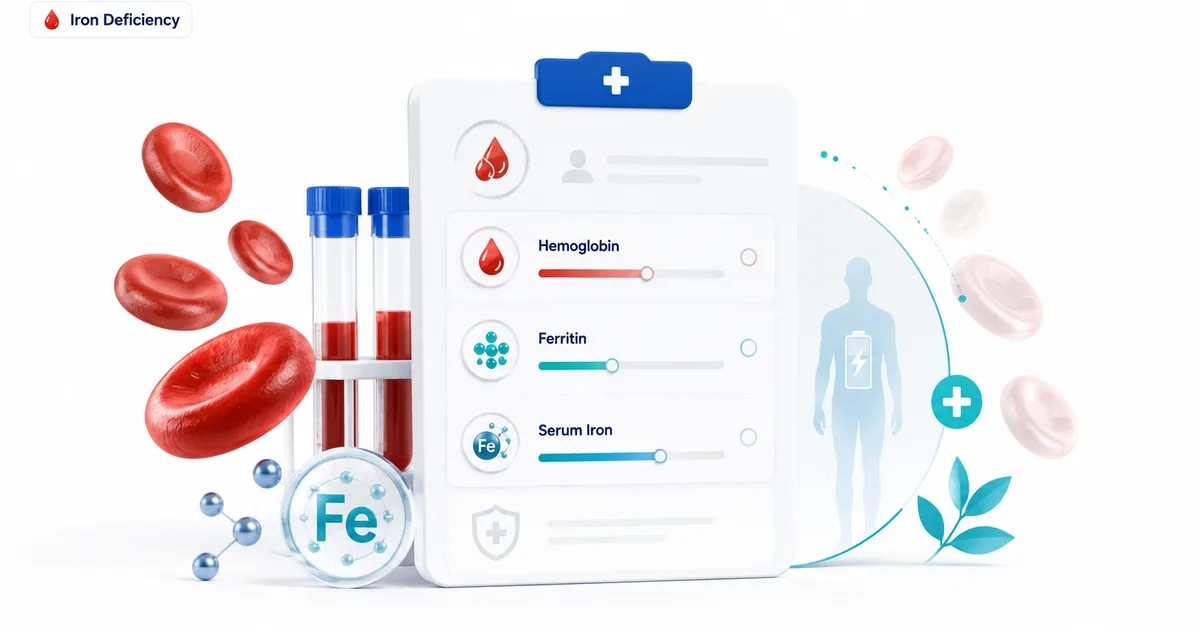
🩸Iron Deficiency Anemia: Complete Guide to Blood Tests, Symptoms & Treatment
Feeling tired all the time? Iron deficiency is the most common nutritional deficiency in India — especially in women. Here's how to diagnose, treat, and prevent it.
Scanura Editorial
Health Education Team
Written by Scanura Editorial for health education. This article is not a substitute for advice from a qualified doctor. About our editorial standards
Iron Deficiency Anemia: Complete Guide to Blood Tests, Symptoms & Treatment
You wake up tired. By noon, you're exhausted. Climbing stairs leaves you breathless. Your hair is falling out, your skin is pale, and you can't concentrate at work. You've been to three doctors, and they all say the same thing: "You're anemic."
But what does that actually mean? What tests do you need? What kind of iron supplement should you take? And why does India have such a massive anemia problem?
Iron deficiency anemia is the most common nutritional deficiency in the world — and India is one of the worst-affected countries. Nearly 50% of Indian women and 25% of Indian men are anemic. It's so common that many people don't even realize they have it — they just think being tired is "normal."
This guide will walk you through everything: the blood tests, what the numbers mean, the best supplements, dietary changes, and when you need IV iron therapy.
What is Iron Deficiency Anemia?
Iron deficiency anemia occurs when your body doesn't have enough iron to produce adequate hemoglobin. Hemoglobin is the protein in red blood cells that carries oxygen from your lungs to every tissue in your body.
Without enough iron:
- Your body produces fewer, smaller, and paler red blood cells
- These cells carry less oxygen
- Your organs and tissues don't get enough oxygen
- You feel tired, weak, and short of breath
The progression happens in stages:
- Iron depletion — stored iron (ferritin) drops, but hemoglobin is still normal
- Iron-deficient erythropoiesis — iron stores are exhausted, production of red blood cells is impaired
- Iron deficiency anemia — hemoglobin drops below normal, symptoms appear
The key insight: you can have iron deficiency without anemia (stage 1), and this stage already causes symptoms like fatigue, hair loss, and restless legs.
The Blood Tests — What You Need
If your doctor suspects iron deficiency, they'll order a panel of tests. Here's what each one tells you:
1. Complete Blood Count (CBC)
The CBC gives you the first clues:
| Parameter | Normal (Women) | Normal (Men) | In Iron Deficiency |
|---|---|---|---|
| Hemoglobin | 12.0-15.5 g/dL | 13.5-17.5 g/dL | Low |
| Hematocrit | 36-48% | 40-54% | Low |
| MCV (Mean Corpuscular Volume) | 80-100 fL | 80-100 fL | Low (<80 fL) — microcytic |
| MCH (Mean Corpuscular Hemoglobin) | 27-33 pg | 27-33 pg | Low — hypochromic |
| MCHC | 32-36 g/dL | 32-36 g/dL | Low |
| RDW | 11.5-14.5% | 11.5-14.5% | High — indicates mixed population of cells |
Key findings in iron deficiency anemia:
- Low hemoglobin (obviously)
- Low MCV (microcytic — small red blood cells)
- Low MCH/MCHC (hypochromic — pale red blood cells)
- High RDW (anisocytosis — variation in cell size)
2. Serum Iron
This measures the amount of iron circulating in your blood.
| Level | Meaning |
|---|---|
| 60-170 mcg/dL | Normal |
| Below 60 mcg/dL | Low — suggests iron deficiency |
| Below 30 mcg/dL | Significantly low |
Note: Serum iron fluctuates throughout the day and with meals. It's not the most reliable test on its own.
3. Serum Ferritin — The Most Important Test
Ferritin is the storage form of iron. It reflects your total body iron stores. This is the single most sensitive test for iron deficiency.
| Level | Meaning |
|---|---|
| Above 30 ng/mL | Adequate iron stores |
| 12-30 ng/mL | Possible iron deficiency (early stage) |
| Below 12 ng/mL | Confirms iron deficiency |
| Below 5 ng/mL | Severe iron depletion |
Critical point: Ferritin can be falsely normal or elevated in:
- Infection (ferritin is an acute phase reactant)
- Liver disease
- Inflammatory conditions (rheumatoid arthritis, IBD)
- Malignancy
If you have any of these conditions, your doctor may need to interpret ferritin in context or use other markers.
4. Total Iron Binding Capacity (TIBC)
TIBC measures how much transferrin (the iron transport protein) is available to bind iron. When iron is low, the body produces more transferrin — so TIBC goes up.
| Level | Meaning |
|---|---|
| 240-450 mcg/dL | Normal |
| Above 450 mcg/dL | High — suggests iron deficiency |
| Below 240 mcg/dL | Low — may indicate chronic disease |
5. Transferrin Saturation (TSAT)
This is calculated: (Serum Iron ÷ TIBC) × 100. It tells you what percentage of your transferrin is actually carrying iron.
| Level | Meaning |
|---|---|
| 20-50% | Normal |
| Below 20% | Suggests iron deficiency |
| Below 15% | Significant iron deficiency |
| Below 10% | Severe deficiency — may need IV iron |
TSAT is one of the earliest markers of iron deficiency — it drops before ferritin and hemoglobin.
Symptoms of Iron Deficiency Anemia
Common Symptoms
- Fatigue — the hallmark symptom. Feeling tired despite adequate sleep
- Weakness — general lack of energy
- Shortness of breath — especially with exertion (climbing stairs, walking)
- Pale skin, nail beds, and inner eyelids — the "pallor" of anemia
- Dizziness or lightheadedness
- Cold hands and feet
- Headaches
- Difficulty concentrating — "brain fog"
- Restless legs syndrome — especially at night
Less Common but Important Symptoms
- Pica — craving non-food items (ice, dirt, clay, starch)
- Pagophagia — compulsive ice chewing (highly specific for iron deficiency)
- Brittle nails — koilonychia (spoon-shaped nails)
- Hair loss — telogen effluvium
- Cracked corners of the mouth — angular cheilitis
- Smooth, sore tongue — glossitis
- Difficulty swallowing — Plummer-Vinson syndrome (severe, long-standing deficiency)
- Restless legs syndrome — strong association with iron deficiency
In Children
- Growth retardation
- Developmental delays
- Behavioral problems
- Recurrent infections
- Poor school performance
Who is at Risk in India?
Women (Highest Risk)
- Menstrual blood loss — the #1 cause in premenopausal women
- Heavy periods (menorrhagia) — soaking through a pad every 1-2 hours
- Periods lasting more than 7 days
- Large blood clots
- Pregnancy — iron demand doubles
- Breastfeeding — continued iron demand
- Poor dietary intake — especially in vegetarian diets
Children and Adolescents
- Rapid growth increases iron demand
- Picky eating
- Excessive milk intake (milk inhibits iron absorption)
Vegetarians and Vegans
- Plant-based iron (non-heme iron) is less absorbable than animal-based iron (heme iron)
- Indian vegetarian diets are high in phytates (from lentils, whole grains) which inhibit iron absorption
People with Chronic Conditions
- Celiac disease (malabsorption)
- Inflammatory bowel disease (ulcerative colitis, Crohn's)
- Chronic kidney disease
- Chronic liver disease
- H. pylori infection
- Regular NSAID use (ibuprofen, aspirin — causes GI bleeding)
Post-Gastric Bypass Surgery
- Reduced stomach acid impairs iron absorption
Iron Supplements — A Complete Guide
Types of Oral Iron
| Supplement | Elemental Iron | Common Dose | Notes |
|---|---|---|---|
| Ferrous sulfate | 20% elemental iron | 325mg (65mg elemental) | Most common, most studied |
| Ferrous gluconate | 12% elemental iron | 325mg (38mg elemental) | Better tolerated, fewer side effects |
| Ferrous fumarate | 33% elemental iron | 325mg (107mg elemental) | Highest elemental iron per tablet |
| Carbonyl iron | ~100% | 45-60mg | Better absorbed, fewer GI side effects |
| Ferrous bisglycinate | Chelated iron | 28mg | Best absorbed, gentle on stomach |
How to Take Iron Supplements
The best absorption strategy:
- Take on an empty stomach (1 hour before or 2 hours after meals)
- Take with vitamin C (200mg) — increases absorption by 2-3 times
- Take with orange juice or a vitamin C tablet
- Take at bedtime if morning dose causes nausea
What to AVOID when taking iron:
- Tea (tannins block absorption by 60-70%)
- Coffee (similar effect to tea)
- Dairy products (calcium inhibits absorption)
- Calcium supplements (take at least 2 hours apart)
- Antacids (reduce stomach acid needed for absorption)
- PPIs (omeprazole, pantoprazole — reduce acid)
- Whole grains and legumes (phytates inhibit absorption)
The "every other day" approach: Recent research shows that taking iron every other day may be as effective as daily dosing, with fewer side effects and better absorption. The body's iron absorption regulators (hepcidin) normalize after 24 hours, so alternate-day dosing may be optimal.
Side Effects of Oral Iron
- Constipation — the most common complaint
- Nausea and stomach upset
- Dark stools (normal — don't worry)
- Diarrhea (less common)
- Metallic taste
Tips to minimize side effects:
- Start with a low dose and increase gradually
- Take with food if stomach upset occurs (reduces absorption slightly)
- Switch to a different form (ferrous gluconate or carbonyl iron)
- Try every-other-day dosing
- Stay hydrated and eat fiber to prevent constipation
When Oral Iron Isn't Enough
IV iron therapy is needed when:
- Oral iron is not tolerated (severe GI side effects)
- Oral iron is not absorbed (celiac disease, IBD, post-gastric bypass)
- Ongoing blood loss exceeds oral iron replacement capacity
- Severe anemia needing rapid correction (hemoglobin <7 g/dL)
- Pregnancy with severe anemia (third trimester)
Common IV iron formulations:
- Iron sucrose (Venofer) — given in multiple small doses
- Ferric carboxymaltose (Ferinject) — single high-dose infusion (can give 1000mg at once)
- Iron dextran — less commonly used now due to anaphylaxis risk
Iron-Rich Foods — Indian Diet Guide
Heme Iron (Best Absorbed — 15-35% absorption)
| Food | Iron per serving |
|---|---|
| Red meat (mutton) | 2.5-3.0 mg per 100g |
| Chicken liver | 9.0 mg per 100g |
| Fish (pomfret) | 2.0 mg per 100g |
| Egg yolk | 2.7 mg per yolk |
Non-Heme Iron (Plant-based — 2-20% absorption)
| Food | Iron per serving |
|---|---|
| Spinach (palak) | 6.4 mg per cup (cooked) |
| Soybean | 8.8 mg per cup |
| Masoor dal | 6.6 mg per cup (cooked) |
| Rajma (kidney beans) | 5.2 mg per cup |
| Chana (chickpeas) | 4.7 mg per cup |
| Amaranth (rajgira) | 7.6 mg per 100g |
| Ragi | 3.9 mg per 100g |
| Jaggery (gur) | 11.0 mg per 100g |
| Dates (khajoor) | 1.0 mg per date |
| Pumpkin seeds | 2.5 mg per 30g |
Iron Absorption Enhancers
- Vitamin C: Citrus fruits, amla, tomatoes, bell peppers, guava
- Heme iron: If you eat non-vegetarian food, include it in iron-rich meals
- Cooking in cast iron cookware: Can increase iron content of food
Iron Absorption Inhibitors
- Tannins: Tea, coffee (avoid within 2 hours of iron-rich food)
- Phytates: Whole grains, legumes, nuts (soaking and sprouting reduces phytates)
- Calcium: Dairy products, calcium supplements
- Polyphenols: Cocoa, red wine
Anemia in Pregnancy — Special Considerations
Iron deficiency anemia in pregnancy is associated with:
- Preterm delivery
- Low birth weight
- Increased maternal mortality
- Impaired fetal brain development
Iron requirements in pregnancy:
- First trimester: 30 mg/day
- Second trimester: 30 mg/day
- Third trimester: 30 mg/day (some guidelines recommend 60mg)
- Total additional iron needed: approximately 1000mg over the entire pregnancy
When to start IV iron in pregnancy:
- Hemoglobin below 10 g/dL in the second or third trimester
- Intolerance to oral iron
- Need for rapid correction
Monitoring and Follow-Up
What to Expect After Starting Treatment
| Time | What Happens |
|---|---|
| 1-2 weeks | Symptoms start improving (energy, breathlessness) |
| 4-6 weeks | Hemoglobin should rise by 1-2 g/dL |
| 8-12 weeks | Hemoglobin should normalize |
| 3-6 months | Ferritin should normalize (takes longer than hemoglobin) |
When to Retest
- 8-12 weeks after starting treatment — check CBC and ferritin
- 3-6 months — confirm ferritin has normalized
- After stopping supplements — recheck in 3-6 months to ensure stores remain adequate
How Long to Take Supplements
- Continue oral iron for 3-6 months after hemoglobin normalizes to replenish iron stores
- Don't stop just because hemoglobin is normal — ferritin may still be low
- Some patients with ongoing blood loss (heavy periods) may need long-term supplementation
When to See a Specialist
Consult a haematologist if:
- Anemia is severe (hemoglobin <8 g/dL)
- Oral iron fails to improve hemoglobin after 8-12 weeks
- Ferritin remains low despite adequate supplementation
- You're a man or postmenopausal woman with iron deficiency (rule out GI malignancy)
- You have recurrent iron deficiency despite treatment
- You need IV iron therapy
- You have unexplained bleeding (GI, urinary, or menstrual)
How scanura Helps
Upload your blood test reports to scanura for:
- Plain-language explanation of ferritin, TIBC, serum iron, and CBC values
- Risk assessment for iron deficiency
- Personalized dietary recommendations
- Supplement guidance
- Questions to ask your doctor
Key Takeaways
- Ferritin is the most important test — below 12 ng/mL confirms iron deficiency even if hemoglobin is normal
- Transferrin saturation below 20% is an early marker of iron deficiency
- Take iron with vitamin C — increases absorption 2-3 times
- Avoid tea and coffee within 2 hours of iron supplements
- Continue supplements for 3-6 months after hemoglobin normalizes to rebuild stores
- Indian women are at highest risk — menstrual blood loss + vegetarian diet = perfect storm
- Always find the cause — don't just treat the numbers
- IV iron is an option if oral iron fails or is not tolerated
Disclaimer: This article is for educational purposes only. scanura does not provide medical diagnosis. Always consult your haematologist or doctor for medical decisions.
Step-by-Step Guide
- 1
Get a complete iron panel
Ask for CBC, Serum Iron, Ferritin, TIBC, and Transferrin Saturation. Fast for 8-12 hours before the test.
- 2
Check serum ferritin
Ferritin below 12 ng/mL confirms iron deficiency even if hemoglobin is normal. Ferritin 12-30 = possible deficiency. Above 30 = adequate stores.
- 3
Check transferrin saturation
Below 20% suggests iron deficiency. Below 15% = significant deficiency. This is the earliest marker of iron deficiency.
- 4
Identify the cause
In women: heavy periods, pregnancy, poor diet. In men and postmenopausal women: GI blood loss, celiac disease, NSAID use. Always find the cause.
- 5
Start oral iron supplements
Take ferrous sulfate 325mg (65mg elemental iron) with vitamin C. Take on empty stomach or with citrus. Avoid dairy, tea, and coffee for 2 hours.
- 6
Retest in 8-12 weeks
Hemoglobin should rise by 1-2 g/dL in 4-6 weeks. Ferritin takes 3-6 months to normalize. Continue supplements for 3-6 months after hemoglobin normalizes.
📬 One health report guide, every week
Normal ranges, what your values mean, and what to ask your doctor — in plain language. Free, unsubscribe anytime.