🩸Understanding Your CBC Report: A Complete Guide
Got a CBC blood test result but confused by all the numbers? Here's a plain-language breakdown of every value — what it means, normal ranges, and when to worry.
Scanura Editorial
Health Education Team
Written by Scanura Editorial for health education. This article is not a substitute for advice from a qualified doctor. About our editorial standards
Understanding Your CBC Report: A Complete Guide
A Complete Blood Count (CBC) is one of the most frequently ordered blood tests in Indian clinics, diagnostic chains, and hospitals. It may appear on a routine annual package, before surgery, during a fever workup, or when you feel persistently tired. The report itself is dense with abbreviations — Hb, WBC, RBC, MCV, platelets — and lab-specific reference ranges that are easy to misread without context.
This guide walks through what a CBC measures, how Indian labs commonly report values, which patterns usually need a doctor’s attention, and how to prepare for a follow-up visit. It is educational only; your clinician interprets results against your symptoms, history, and other tests.
What a CBC Actually Measures
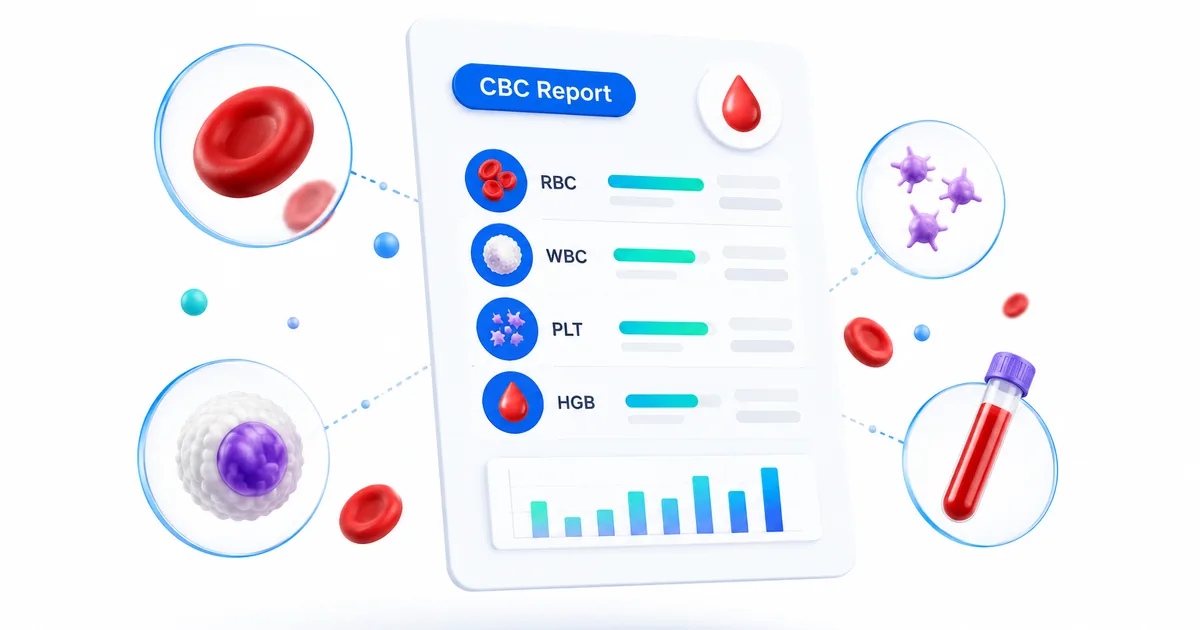
Blood has cellular components and plasma. A CBC focuses on the cells:
- Red blood cells (RBCs) — carry oxygen from the lungs to tissues
- Haemoglobin (Hb) — the oxygen-carrying protein inside RBCs
- Haematocrit (Hct / PCV) — the percentage of blood volume made up of RBCs
- White blood cells (WBCs) — immune cells that respond to infection and inflammation
- Platelets — help form clots when you bleed
- Red cell indices (often included) — MCV, MCH, MCHC, RDW help classify anaemia types
Many Indian reports also list a differential count (neutrophils, lymphocytes, eosinophils, monocytes, basophils) and sometimes a peripheral smear comment.
Think of the CBC as a dashboard: one panel cannot diagnose every disease, but it often points the doctor toward the next useful question.
Key Values and Typical Adult Ranges
Reference ranges vary by lab, analyser, age, sex, pregnancy, and altitude. Use the range printed on your report as the primary guide. The tables below are common adult examples used for education.
Haemoglobin (Hb)
| Group | Typical range |
|---|---|
| Adult men | about 13.0 – 17.5 g/dL |
| Adult non-pregnant women | about 12.0 – 15.5 g/dL |
- Low Hb often means anaemia. In India, iron deficiency is a leading cause, especially among women of reproductive age, adolescents, and people with poor dietary iron intake or chronic blood loss.
- High Hb may reflect dehydration, smoking, living at high altitude, or less commonly a primary blood disorder — a doctor decides which applies.
Symptoms of low Hb can include fatigue, breathlessness on exertion, pale nails or conjunctiva, dizziness, and reduced exercise tolerance. Mild abnormalities without symptoms are still worth discussing, but they are not automatically an emergency.
Total WBC count
| Typical adult range | |
|---|---|
| Total WBC | about 4,000 – 11,000 /µL |
- High WBC (leukocytosis) can appear with bacterial infection, inflammation, stress, steroids, or smoking. Extremely high counts need prompt medical review.
- Low WBC (leukopenia) can follow viral illness, certain medicines, bone marrow issues, or autoimmune disease. Persistently low counts warrant clinician follow-up.
A single mildly abnormal WBC after a recent fever is common; trends and the differential matter more than one isolated number.
Differential count (quick orientation)
| Cell type | Rough idea of role |
|---|---|
| Neutrophils | Often rise in bacterial infection |
| Lymphocytes | Often change with viral illness |
| Eosinophils | May rise with allergy or some parasites |
| Monocytes | Can rise in some infections and recovery phases |
Never self-diagnose infection type from a differential alone — clinical examination and other tests decide treatment.
RBC count and haematocrit
| Typical adult examples | |
|---|---|
| RBC (men) | about 4.5 – 6.0 million/µL |
| RBC (women) | about 4.0 – 5.5 million/µL |
| Hct (men) | about 40% – 50% |
| Hct (women) | about 36% – 46% |
Low RBC/Hct usually tracks with anaemia. High values can follow dehydration (concentrated blood) or true polycythemia. Rehydration and repeat testing sometimes clarify mild spikes.
Platelet count
| Typical range | |
|---|---|
| Platelets | about 1.5 – 4.0 lakh/µL (150,000 – 400,000 /µL) |
- Low platelets (thrombocytopenia) increase bleeding or bruising risk. Dengue and other viral illnesses commonly lower platelets in India; values below about 1 lakh/µL usually need closer medical monitoring, and very low counts need urgent care.
- High platelets can be reactive (infection, iron deficiency, inflammation) or, less often, a primary marrow disorder.
Red cell indices (why MCV matters)
| Index | What it hints at |
|---|---|
| MCV low | Smaller cells — often iron deficiency or thalassemia trait |
| MCV high | Larger cells — B12/folate deficiency, alcohol, some medicines |
| RDW high | More variation in cell size — common in nutritional anaemia |
These indices help doctors classify anaemia before ordering iron studies, B12, HPLC, or smear review. See also our guides on iron deficiency anaemia and MCV/MCH/MCHC.
Common CBC Patterns You May See Discussed
| Pattern | What doctors often consider next |
|---|---|
| Low Hb + low MCV | Iron studies, diet/blood-loss history, sometimes HPLC |
| Low Hb + high MCV | B12/folate, alcohol, medicines, thyroid |
| High WBC + neutrophilia + fever | Infection workup |
| Low platelets in monsoon fever | Dengue/other viral protocols, hydration, repeat counts |
| Isolated mild abnormality, no symptoms | Confirm with repeat test, clinical correlation |
When Abnormal Results Usually Need Attention
Seek timely medical advice (do not wait for a blog article to “clear” you) if you have:
- Hb that is markedly low for your sex/age with severe breathlessness, chest pain, fainting, or black stools
- Platelets dropping quickly or below the threshold your doctor flagged for dengue/fever care
- Very high or very low WBC with fever, mouth ulcers, unexplained bruising, or extreme fatigue
- Persistent anaemia on repeat tests despite supplements
Slightly out-of-range values with no symptoms are common. Panic-Googling rare cancers from a single borderline flag is rarely helpful — bring the PDF to your doctor instead.
How to Prepare for a CBC
- Fasting is usually not required for a standalone CBC (confirm with your lab if it is part of a larger package).
- Tell the phlebotomist about medicines, chemotherapy, recent fever, pregnancy, or transfusion history.
- Stay hydrated unless instructed otherwise.
- Keep previous CBCs — trends over months are more informative than one snapshot.
Questions Worth Asking Your Doctor
- Which values on this CBC are clinically important for me, not just marked “high/low” by the analyser?
- Do I need iron studies, B12, smear, or HPLC next?
- When should we repeat the CBC?
- Could medicines, recent illness, or dehydration explain this pattern?
- What symptoms should make me return sooner?
Using Scanura With a CBC Report
If you upload a CBC PDF or photo to Scanura, the product can highlight values relative to common ranges, explain markers in plain Hindi or English, and suggest questions for your clinician. That is educational support — not a diagnosis or a replacement for professional care.
India-Focused Notes on Anaemia and Infection Season
Anaemia screening through CBC is especially relevant for adolescents, women with heavy periods, pregnant people (under obstetric protocols), and adults with chronic disease. Dietary iron from vegetarian plates is less bioavailable; pairing dals and greens with vitamin C–rich foods helps a little, but documented deficiency still needs measured iron studies and medical treatment — not only jaggery myths.
During monsoon and dengue season, serial platelet counts may be ordered. Hydration, warning signs (bleeding, severe abdominal pain, lethargy), and hospital thresholds are set by your treating doctor. A home CBC printout is not a discharge summary.
Absolute vs relative changes
Labs sometimes report absolute neutrophil or lymphocyte counts. Those absolute numbers are more meaningful than percentages alone when total WBC is very high or very low. If your report only shows percentages, your clinician can still interpret them in context.
After treatment
If you start iron, B12, or antibiotics, ask when to repeat the CBC. Rechecking too early can look disappointing; too late can miss non-response. Keep the same lab when possible so methods stay comparable.
Educational only. Scanura does not provide medical diagnosis. Always consult a qualified doctor for personal medical decisions. Lab reference ranges vary.
Step-by-Step Guide
- 1
Get your CBC test done
Visit a diagnostic lab or hospital for a Complete Blood Count test. Fasting is not required for CBC.
- 2
Receive your report
Collect your report from the lab or download it online. It typically includes WBC, RBC, haemoglobin, platelets, and haematocrit values.
- 3
Check haemoglobin levels
For men: 13.5-17.5 g/dL is normal. For women: 12.0-15.5 g/dL is normal. Low haemoglobin indicates anaemia.
- 4
Review white blood cell count
Normal WBC range is 4,000-11,000 per microlitre. High WBC may indicate infection or inflammation.
- 5
Examine platelet count
Normal range is 1.5-4.0 lakh/mcL. Low platelets increase bleeding risk, especially after dengue fever.
- 6
Consult your doctor
Share the report with your doctor for proper interpretation. Use scanura for instant plain-language explanations.
📬 One health report guide, every week
Normal ranges, what your values mean, and what to ask your doctor — in plain language. Free, unsubscribe anytime.