🔬What Is PSA in Blood Test? Meaning, Range & High PSA
PSA is a prostate protein measured in men’s blood — not an automatic cancer diagnosis. Learn what PSA means, age-related ranges, why it rises, and when to see a urologist.
Scanura Editorial
Health Education Team
Written by Scanura Editorial for health education. This article is not a substitute for advice from a qualified doctor. About our editorial standards
What Is PSA in Blood Test? Meaning, Normal Range & High PSA
Your health checkup package included a line called PSA, or your doctor ordered a PSA blood test after urinary symptoms. The report shows a number in ng/mL — and suddenly every search result mentions prostate cancer. Pause. PSA means Prostate-Specific Antigen. It is a useful marker for prostate health, but it is not a cancer diagnosis by itself.
This guide explains what PSA is, why it is measured, normal ranges (including age-related guides), what high and low values can mean, how to prepare for the test, and when to see a urologist — in plain language for Indian men and families. For a deeper screening and biopsy pathway guide, see our complete PSA prostate health guide.
Quick Answer
| Question | Short answer |
|---|---|
| What is PSA? | A protein made by the prostate gland, measured in blood |
| Who is it for? | Men (the prostate is a male gland) |
| Normal ballpark | Often below ~4 ng/mL, but age matters |
| High PSA always cancer? | No — enlargement, infection, and recent ejaculation can also raise it |
| Next step if high | Repeat / clinical exam / urologist — not instant panic |
What Is PSA?
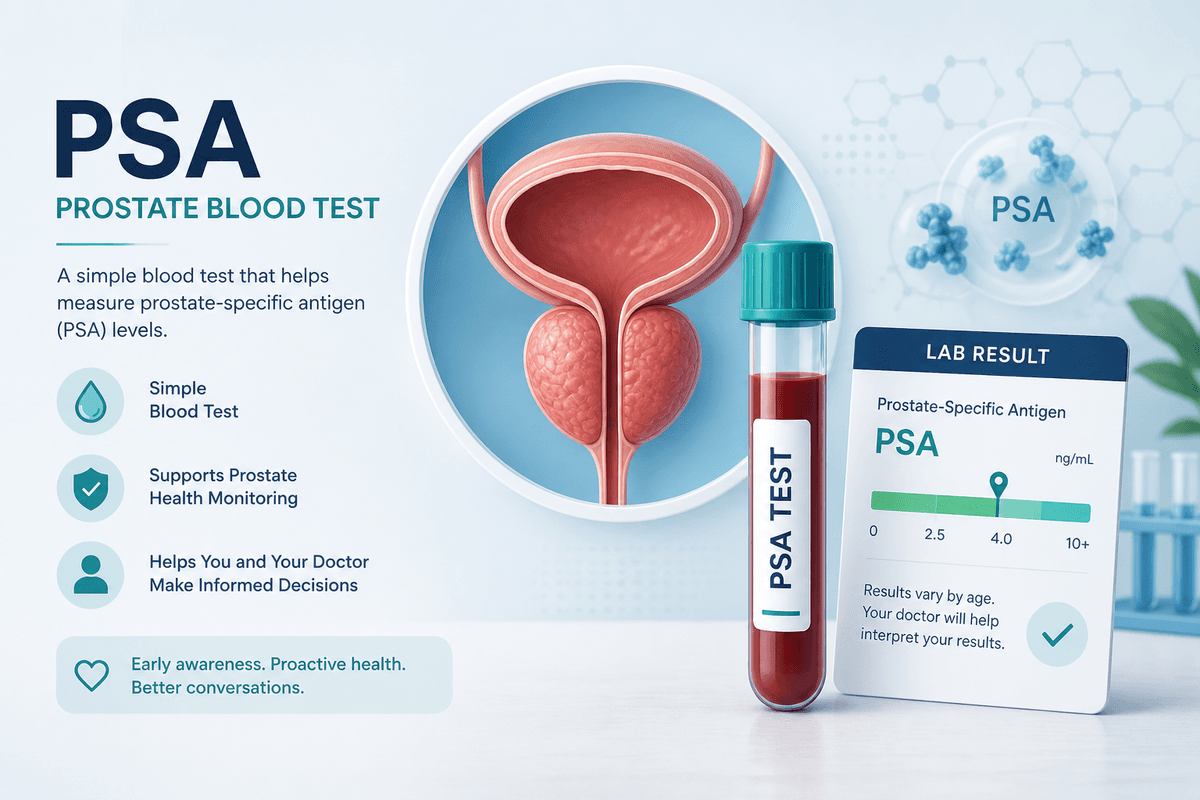
PSA (Prostate-Specific Antigen) is a protein produced mainly by cells in the prostate — a walnut-sized gland below the bladder that helps make semen.
Small amounts of PSA normally enter the bloodstream. When the prostate is:
- Enlarged (very common with age)
- Inflamed or infected
- Disturbed by procedures or recent ejaculation
- Affected by prostate cancer
…more PSA can leak into blood, and the lab number rises.
Key point: PSA is prostate-specific, not cancer-specific. Many men with raised PSA do not have cancer. Some men with cancer have PSA in the "normal" range. That is why doctors use PSA as a clue, not a final verdict.
Why Doctors Order a PSA Blood Test
| Reason | Purpose |
|---|---|
| Screening | Looking for early prostate cancer risk in men without clear symptoms (usually after shared decision-making, often age 50+) |
| Urinary symptoms | Weak stream, night urination, hesitancy — often BPH (benign enlargement) |
| Infection follow-up | After prostatitis treatment |
| Monitoring | After prostate cancer treatment or while watching a known condition |
| Executive checkup packages | Common add-on for men over 40–45 in India |
If PSA appears on a corporate package without counselling, ask your doctor whether screening fits your age, family history, and preferences.
PSA Normal Range
Labs often print a reference such as 0 – 4 ng/mL. That flat cutoff is a starting point, not the whole story.
| PSA (total) | Common interpretation |
|---|---|
| Below 4 ng/mL | Usually reassuring — still interpret with age and symptoms |
| 4 – 10 ng/mL | Grey zone — often repeat test + further evaluation |
| Above 10 ng/mL | Higher concern — urology assessment usually needed |
Age-adjusted upper limits (educational guide)
PSA tends to rise as the prostate enlarges with age:
| Age | Approximate upper limit |
|---|---|
| 40–49 | ~2.5 ng/mL |
| 50–59 | ~3.5 ng/mL |
| 60–69 | ~4.5 ng/mL |
| 70+ | ~6.5 ng/mL |
Your clinician may also look at:
- PSA velocity — how fast PSA rises over months/years
- Free PSA % — lower free-to-total ratio can raise cancer suspicion in the grey zone
- PSA density — PSA relative to prostate size on ultrasound/MRI
Always compare against your lab's printed range and clinical exam findings (including digital rectal exam when done).
What Does High PSA Mean?
1. Benign prostatic hyperplasia (BPH)
Age-related prostate enlargement is the most common reason for mildly elevated PSA in older men. Symptoms: frequent urination, weak stream, getting up at night.
2. Prostatitis (inflammation/infection)
Can push PSA very high, sometimes into double digits. Fever, pelvic pain, or painful urination are clues. PSA often falls after treatment.
3. Prostate cancer
Cancer can raise PSA, especially as disease progresses — but PSA alone cannot stage or confirm cancer. Diagnosis needs clinical evaluation and, when indicated, imaging and biopsy.
4. Temporary / mechanical causes
- Ejaculation within 24–48 hours before the test
- Recent prostate exam, catheter, cystoscopy, or biopsy
- Acute urinary retention
- Sometimes prolonged cycling (debated; mention it to your doctor)
5. Medicines that lower PSA
Finasteride and dutasteride (used for BPH or hair loss) roughly halve PSA. Tell your doctor if you take them — interpretation must adjust.
| Cause | Cancer? |
|---|---|
| BPH | No |
| Prostatitis | No (infection/inflammation) |
| Recent ejaculation / procedure | No |
| Prostate cancer | Possible — needs proper workup |
What If PSA Is Low or "Normal"?
A low or normal PSA is generally reassuring, especially without symptoms or risk factors. It does not give a 100% guarantee against prostate cancer — aggressive tumours occasionally produce little PSA. Screening decisions still consider family history, ancestry, and urinary/systemic symptoms.
After prostate removal for cancer, PSA is expected to fall to very low/undetectable levels; a rising PSA later needs oncology/urology follow-up.
How to Prepare for a PSA Test
- Ask whether to avoid ejaculation for 24–48 hours before the draw.
- Tell the lab/doctor about finasteride/dutasteride, recent UTI, catheter, or prostate procedure.
- PSA is a simple venous blood test — usually no overnight fasting required unless bundled with sugar/lipid tests.
- If the first result is borderline, a repeat PSA after a few weeks is often wiser than rushing to invasive tests.
- Discuss whether free PSA or imaging is useful in your case.
When to See a Urologist
Book a specialist review if you have:
- PSA persistently above your age-adjusted range
- PSA above 10 ng/mL
- Rising PSA on serial tests
- Blood in urine/semen, bone pain, unexplained weight loss with abnormal PSA
- Strong family history of prostate cancer and an abnormal or borderline result
- Bothersome urinary symptoms needing treatment, even if PSA is only mildly raised
Do not ignore symptoms because "PSA is normal," and do not assume the worst because "PSA is 5." Bring the full report — scanura can help you understand the numbers before the visit.
PSA Screening: Pros and Cons (Brief)
| Potential benefit | Potential downside |
|---|---|
| Finds some cancers earlier | False alarms → anxiety and extra tests |
| May reduce advanced disease in some men | Overdiagnosis of slow cancers that may never harm |
| Simple blood test | Biopsy risks (infection, bleeding) if pursued |
Shared decision-making (especially ages ~50–70, earlier if high risk) is the modern approach — not automatic yearly testing for every man without discussion. Details: PSA complete guide.
How to Read Your PSA Report Checklist
- Confirm the test is total PSA (and free PSA if listed).
- Note the unit — almost always ng/mL.
- Compare with the lab reference and your age.
- Check for previous PSA values (trend matters).
- List symptoms, medicines, and recent procedures.
- Plan next steps with a doctor — repeat, treat infection, imaging, or referral.
Related reading: CBC guide · testosterone test for men · urine routine explained
Key Takeaways
- PSA = Prostate-Specific Antigen — a blood marker of prostate activity, not a standalone cancer test.
- Typical lab cutoff is often ~4 ng/mL, but age-adjusted interpretation is smarter.
- High PSA can mean BPH, prostatitis, recent ejaculation/procedures, or cancer — context decides.
- Finasteride/dutasteride lower PSA; always disclose them.
- Borderline results often need repeat testing, not immediate panic.
- Persistently high or rising PSA → urologist.
- Screening has benefits and harms — decide with your doctor.
- Upload reports to scanura for plain-language explanations before your appointment.
Disclaimer: This article is for educational purposes only and is not personalised medical advice or a cancer screening recommendation. PSA interpretation depends on age, medicines, symptoms, exam findings, and trends. Consult a qualified doctor or urologist for decisions about testing, imaging, or biopsy.
Medical References
Step-by-Step Guide
- 1
Know what PSA measures
PSA (prostate-specific antigen) is a protein from the prostate. Blood levels rise with enlargement, infection, some procedures, and sometimes cancer — it is not cancer-specific.
- 2
Check the number and your age
Many labs use about 0–4 ng/mL as a guide. Age-adjusted limits are often more accurate; ask your doctor to interpret for your age.
- 3
Prepare before the blood draw
Ask whether to avoid ejaculation for 24–48 hours. Tell your clinician about finasteride/dutasteride, recent UTI, catheter, or prostate exam.
- 4
Do not panic at one borderline result
PSA in the 4–10 ng/mL grey zone is often repeated and assessed with symptoms and exam before invasive tests.
- 5
Look for reversible causes
Prostatitis, BPH, and recent ejaculation or procedures can raise PSA without cancer.
- 6
See a urologist when needed
Persistently high or rising PSA, PSA above 10 ng/mL, or concerning urinary/systemic symptoms deserve specialist review.
📬 One health report guide, every week
Normal ranges, what your values mean, and what to ask your doctor — in plain language. Free, unsubscribe anytime.