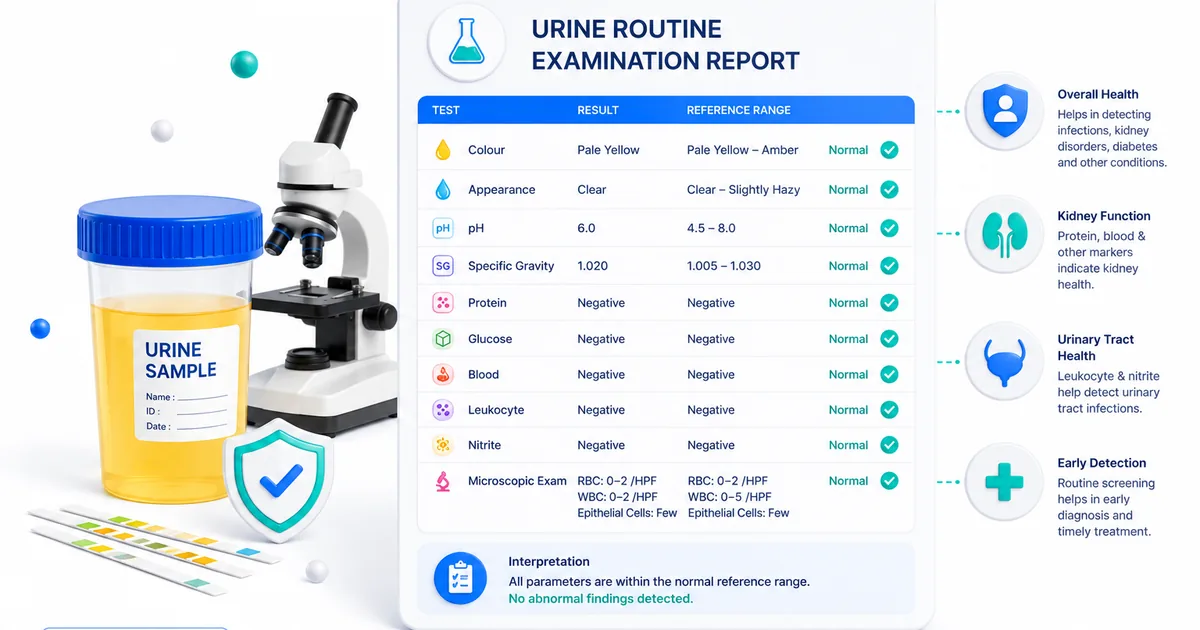
🔬Urine Routine Examination (Urine R/E) Explained: What Every Value Means
The urine routine test is one of the most ordered — and least understood — tests in India. Here's a plain-language guide to everything on your urine report, from protein to pus cells.
Scanura Editorial
Health Education Team
Written by Scanura Editorial for health education. This article is not a substitute for advice from a qualified doctor. About our editorial standards
Urine Routine Examination (Urine R/E) Explained: What Every Value Means
The urine routine examination — called Urine R/E, Urine ME, or urinalysis — is one of the cheapest and most informative tests available. For just ₹80–150, it screens for urinary tract infections, kidney disease, diabetes, and even liver problems.
Yet most people stare at their urine report and have no idea what any of it means. Let's fix that.
The Three Sections of a Urine Report
Every urine routine report has three parts:
- Physical examination — colour, clarity, specific gravity
- Chemical examination — protein, glucose, pH, blood, ketones, bilirubin
- Microscopic examination — pus cells, red blood cells, casts, crystals, bacteria
Section 1: Physical Examination
Colour
| Colour | Possible Meaning |
|---|---|
| Pale yellow | Normal (well hydrated) |
| Dark yellow / amber | Concentrated urine, dehydration |
| Orange | Liver or bile duct issue, certain medications |
| Red / pink | Blood in urine (haematuria) — requires urgent evaluation |
| Cloudy / milky | Infection, pus cells, phosphate crystals |
| Foul-smelling | Urinary tract infection (UTI) |
Specific Gravity (SG)
| Level | What It Means |
|---|---|
| 1.005 – 1.030 | Normal range |
| Below 1.005 | Overhydrated, or kidneys can't concentrate urine |
| Above 1.030 | Dehydration, or concentrated sample |
Specific gravity measures how concentrated the urine is. Kidneys that aren't functioning properly lose the ability to concentrate urine — and SG stays persistently low.
Section 2: Chemical Examination
pH
| Level | What It Means |
|---|---|
| 4.5 – 8.0 | Normal |
| Persistently alkaline (above 7) | Possible UTI with urea-splitting bacteria |
| Persistently acidic (below 5) | High protein diet, diabetes, or metabolic acidosis |
Protein
Normal: Negative / Trace (not detected)
Protein in urine — called proteinuria — is one of the most important abnormal findings. Healthy kidneys keep protein in the blood. When kidneys are damaged, protein leaks into urine.
| Finding | Possible Cause |
|---|---|
| Trace | May be normal after exercise or fever — repeat test |
| 1+ | Early kidney disease, hypertension-related damage |
| 2+ or above | Significant kidney damage — nephrologist referral needed |
Proteinuria in a diabetic patient is a critical red flag. It indicates diabetic nephropathy — kidney damage from diabetes — and requires immediate attention.
Glucose
Normal: Negative (not detected)
Glucose in urine almost always means blood glucose is very high — typically above 180 mg/dL (the kidney's glucose threshold). This strongly suggests undiagnosed or poorly controlled diabetes.
Rarely, glucose appears in urine with normal blood sugar — called renal glycosuria — a benign condition.
Ketones
Normal: Negative
Ketones appear when the body is burning fat instead of carbohydrates:
- Uncontrolled Type 1 diabetes (diabetic ketoacidosis — a medical emergency)
- Very low carbohydrate diet or prolonged fasting
- Vomiting and inability to eat
Blood (Haematuria)
Normal: Negative
Blood in urine — even microscopic — always requires follow-up.
| Cause Category | Examples |
|---|---|
| Urinary tract | UTI, kidney stones, bladder stones |
| Kidney disease | Glomerulonephritis, IgA nephropathy |
| Trauma | After vigorous exercise (usually resolves) |
| Serious | Bladder or kidney tumour (especially in adults over 40) |
Never ignore blood in urine, even if you feel no pain. Painless haematuria in an adult over 40 must be investigated to rule out malignancy.
Bilirubin and Urobilinogen
| Finding | Possible Meaning |
|---|---|
| Bilirubin positive | Liver disease, bile duct obstruction |
| Urobilinogen high | Liver disease, haemolytic anemia |
Section 3: Microscopic Examination
This is where the report gets highly specific — a technician looks at a spun sample under a microscope and counts cells per high-power field (HPF).
Pus Cells (WBCs in Urine)
| Level | What It Means |
|---|---|
| 0 – 5 per HPF | Normal |
| 5 – 10 per HPF | Borderline — repeat test |
| Above 10 per HPF | Significant — likely UTI or kidney inflammation |
Elevated pus cells = pyuria. This is the hallmark finding of a urinary tract infection (UTI). However, pus cells can also indicate kidney inflammation (interstitial nephritis) without infection.
Red Blood Cells (RBCs in Urine)
| Level | What It Means |
|---|---|
| 0 – 3 per HPF | Normal |
| 3 – 10 per HPF | Mild haematuria — investigate |
| Above 10 per HPF | Significant haematuria — urgent evaluation |
Casts — The Most Diagnostic Finding
Casts are cylindrical structures formed in the kidney tubules. They are microscopic "moulds" that tell you what's happening inside the kidney itself.
| Type of Cast | Clinical Significance |
|---|---|
| Hyaline casts (few) | Normal — seen after exercise or dehydration |
| RBC casts | Glomerulonephritis — kidney inflammation. Always abnormal — urgent referral |
| WBC casts | Kidney infection (pyelonephritis) or interstitial nephritis |
| Granular casts | Significant kidney disease — urgent evaluation |
| Waxy / broad casts | Advanced chronic kidney disease |
Finding RBC casts or granular casts on a urine report is a nephrology emergency. Do not ignore this finding.
Bacteria and Yeast
- Bacteria present + pus cells: UTI confirmed — culture and sensitivity test needed to identify the organism and choose the right antibiotic
- Bacteria without pus cells: May be sample contamination — repeat with a fresh mid-stream sample
- Yeast: Possible fungal UTI — more common in diabetics and immunocompromised patients
Crystals
| Crystal Type | Association |
|---|---|
| Calcium oxalate | Most common kidney stone type |
| Uric acid crystals | High uric acid, gout |
| Triple phosphate | UTI with urea-splitting bacteria |
| Cystine crystals | Rare genetic disorder |
Crystals alone are not diagnostic of kidney stones but indicate risk.
How to Collect a Valid Sample
A urine report is only as good as the sample:
- Use mid-stream clean catch — let the first stream of urine flow, then collect in the sterile container
- Clean the area first — for women especially, contamination with vaginal secretions can give false high pus cell counts
- Morning sample preferred — most concentrated; best for detecting protein and casts
- Analyse within 2 hours — cells degrade quickly; a delayed sample gives unreliable microscopy
When to Be Concerned
| Finding | Action Needed |
|---|---|
| Protein 2+ or above | See a nephrologist |
| Glucose positive (first time) | Check fasting blood glucose urgently |
| Blood in urine (above 40 years) | Urological evaluation to rule out malignancy |
| RBC casts or granular casts | Urgent nephrology referral |
| Pus cells above 10 + symptoms | Start culture and sensitivity; treat UTI |
How scanura Helps
Upload your urine routine report to scanura:
- Explain every row in plain language — no medical jargon
- Highlight critical findings like RBC casts, proteinuria, or glucose
- Connect findings to your other reports (high creatinine + proteinuria = kidney concern)
- Suggest follow-up questions for your doctor
Disclaimer: This article is for educational purposes only. scanura does not provide medical diagnosis. Always consult your doctor for medical decisions.
Medical References
Step-by-Step Guide
- 1
Collect the sample correctly
Use the mid-stream clean catch method. Clean the area, let the first flow go, then collect in the sterile container. Morning sample is preferred.
- 2
Check physical appearance
Normal urine is pale yellow and clear. Cloudy, dark, red, or foul-smelling urine are early signs to discuss with your doctor.
- 3
Review chemical findings
Normal urine has no protein, no glucose, no blood, no ketones, and no bilirubin. Any positive finding needs investigation.
- 4
Read the microscopy section
Pus cells (WBCs) above 5 per HPF suggests infection or inflammation. RBCs above 3 per HPF may indicate infection, stones, or kidney disease.
- 5
Check for casts
Hyaline casts in small numbers are normal. RBC casts, WBC casts, or granular casts always require urgent follow-up — they indicate kidney disease.
- 6
Correlate with symptoms
A single abnormal finding may not be alarming. Correlate with symptoms and repeat if needed. Consult your doctor for protein, blood, or casts in urine.
📬 One health report guide, every week
Normal ranges, what your values mean, and what to ask your doctor — in plain language. Free, unsubscribe anytime.