🔬MCV, MCH, MCHC Meaning in CBC Report: Complete Guide
MCV tells you the size of your red blood cells — the fastest clue to what type of anaemia you have. Here's what MCV, MCH, and MCHC mean on your Indian lab report.
Scanura Editorial
Health Education Team
Written by Scanura Editorial for health education. This article is not a substitute for advice from a qualified doctor. About our editorial standards
MCV, MCH, MCHC Meaning in CBC Report: Complete Guide
You understood haemoglobin and RBC count on your CBC report. But then you see three more abbreviations — MCV, MCH, and MCHC — with numbers and no explanation. Your lab marked MCV as low. Is that bad? Does it mean cancer? Does it mean you need iron tablets?
These three indices describe the size and colour of your red blood cells. They are among the most useful clues on any blood report — because they narrow down the type of anaemia you may have before a single additional test is ordered. Doctors call them red cell indices, and they are the reason a CBC is far more powerful than just a haemoglobin number.
This guide explains MCV, MCH, and MCHC in plain language, normal ranges for Indian adults, what high and low values mean, how they connect to iron deficiency, B12 deficiency, and thalassaemia, and what to do next. See our CBC guide and anaemia types guide.
What Are Red Cell Indices?
When your bone marrow makes red blood cells, each cell gets a certain amount of haemoglobin packed inside a certain-sized shell. The indices summarise this:
| Index | Full Name | What It Measures |
|---|---|---|
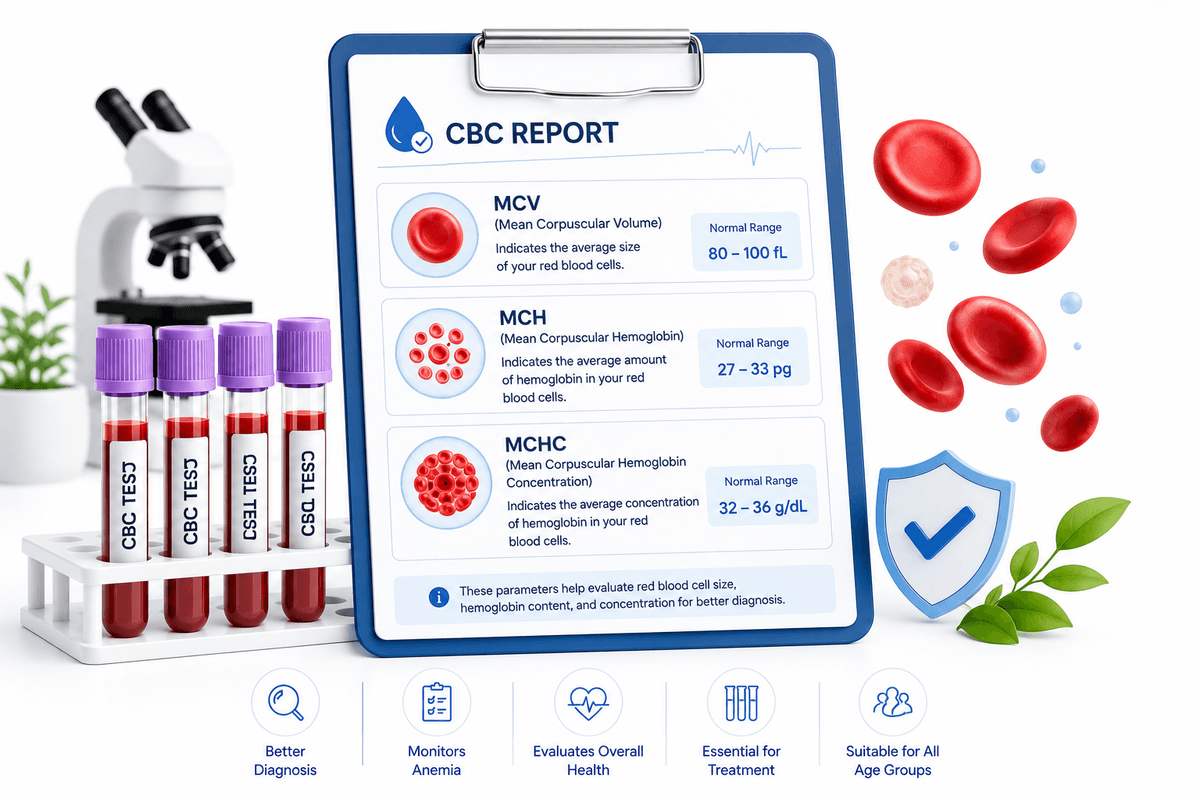
| MCV | Mean Corpuscular Volume | Average size of each RBC (fL — femtolitres) |
| MCH | Mean Corpuscular Haemoglobin | Average amount of haemoglobin per RBC (pg — picograms) |
| MCHC | Mean Corpuscular Haemoglobin Concentration | Average concentration of haemoglobin inside each RBC (g/dL) |
Think of RBCs as cars:
- MCV = size of the car (compact vs SUV)
- MCH = amount of cargo (haemoglobin) per car
- MCHC = how densely the cargo is packed inside
Normal Ranges in India
| Index | Normal Range | Unit |
|---|---|---|
| MCV | 80 – 100 | fL (femtolitres) |
| MCH | 27 – 33 | pg (picograms) |
| MCHC | 32 – 36 | g/dL |
Ranges vary slightly by lab and age. Children have different paediatric ranges. Newborns have high MCV that gradually falls.
Classification by MCV
| MCV Category | Range | Common Causes |
|---|---|---|
| Microcytic (small cells) | <80 fL | Iron deficiency, thalassaemia, anaemia of chronic disease |
| Normocytic (normal size) | 80–100 fL | Early iron deficiency, chronic disease, haemolysis, aplastic |
| Macrocytic (large cells) | >100 fL | B12/folate deficiency, alcohol, liver disease, hypothyroidism, medicines |
This classification is the first step in anaemia diagnosis worldwide.
MCV (Mean Corpuscular Volume) — Explained
Low MCV (Microcytosis) — <80 fL
Small red blood cells. The bone marrow makes smaller cells when it lacks iron or haemoglobin building blocks.
| Cause | How to Distinguish |
|---|---|
| Iron deficiency | Low ferritin, low serum iron, high TIBC, response to iron |
| Thalassaemia trait | Normal/high ferritin, normal iron, Hb electrophoresis abnormal |
| Anaemia of chronic disease | Normal/high ferritin, inflammation markers high |
| Sideroblastic anaemia | Rare; ring sideroblasts on marrow — specialist diagnosis |
Indian pitfall: Thalassaemia trait is common and gives low MCV — giving iron blindly wastes money and can cause iron overload in trait carriers.
High MCV (Macrocytosis) — >100 fL
Large red blood cells. Usually means impaired DNA synthesis during cell division.
| Cause | Notes |
|---|---|
| B12 deficiency | Vegetarians, elderly, metformin users — check serum B12 |
| Folate deficiency | Pregnancy, malnutrition, alcohol |
| Alcohol | Even moderate regular drinking raises MCV |
| Liver disease | Lipid deposition on RBC membrane |
| Hypothyroidism | Check TSH |
| Medicines | Azathioprine, hydroxyurea, zidovudine (AZT), phenytoin |
| Reticulocytosis | Young RBCs are larger — haemolysis or recovery from bleeding |
| Myelodysplasia | Elderly; macrocytosis without B12/folate deficiency — needs marrow evaluation |
Mild macrocytosis (100–105 fL) is often benign. Marked macrocytosis (>110 fL) needs B12/folate testing.
Normal MCV with Low Haemoglobin
Normocytic anaemia — the trickiest category:
- Early iron deficiency (before cells shrink)
- Anaemia of chronic disease
- Acute blood loss (body hasn't had time to change cell size)
- Haemolytic anaemia
- Aplastic anaemia
- Kidney disease (low erythropoietin)
MCH (Mean Corpuscular Haemoglobin) — Explained
MCH tells you the average mass of haemoglobin per red blood cell.
| MCH Level | Pattern | Meaning |
|---|---|---|
| Low MCH (<27 pg) | Usually with low MCV | Hypochromic (pale) cells — iron deficiency, thalassaemia |
| Normal MCH (27–33 pg) | With normal MCV | May be early disease or normocytic anaemia |
| High MCH (>33 pg) | Usually with high MCV | Macrocytic cells — B12/folate deficiency |
MCH largely mirrors MCV. It is less commonly used alone in clinical decisions but appears on every Indian lab report.
MCHC (Mean Corpuscular Haemoglobin Concentration) — Explained
MCHC measures how concentrated haemoglobin is inside the cell — essentially the "colour intensity" of RBCs.
| MCHC Level | Meaning |
|---|---|
| Low MCHC (<32 g/dL) | Hypochromia — cells are pale (less haemoglobin packed in) — iron deficiency, thalassaemia |
| Normal MCHC (32–36 g/dL) | Normal colour intensity |
| High MCHC (>36 g/dL) | Hyperchromia — rare; spherocytosis, lab artefact from high lipid levels |
Low MCHC is one of the earliest signs of iron deficiency — sometimes before haemoglobin drops below anaemia threshold.
Putting It All Together: Common Patterns
Pattern 1: Iron Deficiency
| Index | Value |
|---|---|
| MCV | Low (<80) |
| MCH | Low |
| MCHC | Low |
| Haemoglobin | Low |
| Ferritin | Low |
| RDW | High (variable cell sizes) |
Action: Iron supplementation. Recheck in 4–8 weeks.
Pattern 2: Thalassaemia Trait
| Index | Value |
|---|---|
| MCV | Low (<80) |
| MCH | Low |
| MCHC | Low-normal |
| Haemoglobin | Mildly low or normal |
| Ferritin | Normal |
| RDW | Normal (uniform small cells) |
Action: Hb electrophoresis. Genetic counselling before marriage/pregnancy. No iron unless proven deficient.
Pattern 3: B12 Deficiency
| Index | Value |
|---|---|
| MCV | High (>100) |
| MCH | High |
| MCHC | Normal |
| Haemoglobin | Low |
| B12 | Low |
| RDW | May be high |
Action: B12 replacement. Check folate. Neurological exam if symptomatic.
Pattern 4: Alcohol-Related
| Index | Value |
|---|---|
| MCV | High (often 100–110) |
| MCH | High |
| Haemoglobin | May be normal or low |
| GGT | Often elevated on LFT |
Action: Reduce/stop alcohol. Check B12 and folate. Retest in 2–3 months.
RDW: The Fourth Clue (Bonus)
RDW (Red Cell Distribution Width) measures variation in RBC size. It often appears next to MCV on reports.
| RDW | Meaning |
|---|---|
| High RDW | Mixed cell sizes — iron deficiency, B12/folate deficiency, haemolysis recovery |
| Normal RDW | Uniform cell sizes — thalassaemia trait, chronic disease |
High RDW + low MCV strongly favours iron deficiency over thalassaemia trait.
What Causes Abnormal Indices Without Anaemia?
Sometimes MCV is abnormal but haemoglobin is still normal:
| Finding | Possible Meaning |
|---|---|
| Low MCV, normal Hb | Early iron deficiency or thalassaemia trait — investigate before Hb drops |
| High MCV, normal Hb | B12/folate insufficiency, alcohol, hypothyroidism — retest and supplement |
| Low MCHC, normal Hb | Earliest iron depletion stage |
This is why a "normal" haemoglobin does not always mean all-clear.
Tests That Follow Abnormal MCV/MCH/MCHC
| If MCV Is… | Order These Tests |
|---|---|
| Low | Ferritin, serum iron, TIBC, transferrin saturation. If ferritin normal → Hb electrophoresis |
| High | Serum B12, folate, TSH, LFT, reticulocyte count. If all normal → consider myelodysplasia workup in elderly |
| Normal with low Hb | Ferritin, reticulocytes, kidney function, CRP/ESR |
Peripheral blood smear review by a pathologist adds cell shape clues (target cells in thalassaemia, macro-ovalocytes in B12 deficiency, spherocytes in haemolysis).
Treatment by Pattern
| Pattern | Treatment |
|---|---|
| Low MCV + low ferritin | Iron therapy 3–6 months |
| Low MCV + normal ferritin | Hb electrophoresis for thalassaemia |
| High MCV + low B12 | B12 supplementation (oral or injection) |
| High MCV + low folate | Folic acid 5 mg/day |
| High MCV + alcohol | Abstinence; retest in 8–12 weeks |
| Normal MCV + low Hb | Investigate cause — do not assume iron |
Special Situations in India
Pregnancy
Physiological haemodilution lowers haemoglobin and may affect indices. Iron deficiency is common — WHO recommends screening. Thalassaemia screening in high-risk communities prevents misdiagnosis.
Children
Age-specific MCV ranges are essential. Iron deficiency from poor weaning diet is common. Thalassaemia major presents in infancy with severe microcytic anaemia.
Elderly
New macrocytosis without obvious cause — check B12, folate, TSH, and consider myelodysplastic syndrome (MDS) if unexplained.
Reading Your Report: A Worked Example
Example CBC from an Indian lab:
| Parameter | Value | Reference | Interpretation |
|---|---|---|---|
| Haemoglobin | 10.2 g/dL | 12–15.5 | Anaemia |
| RBC | 4.1 million/µL | 4.0–5.0 | Low-normal |
| MCV | 72 fL | 80–100 | Microcytic |
| MCH | 24 pg | 27–33 | Low |
| MCHC | 30 g/dL | 32–36 | Low (hypochromic) |
| RDW | 16% | 11–14 | High |
Reading: Microcytic, hypochromic anaemia with high RDW — classic iron deficiency pattern. Next step: ferritin. If ferritin is low, start iron. If ferritin is normal, order Hb electrophoresis for thalassaemia trait.
This single worked example shows why MCV/MCH/MCHC together are more powerful than haemoglobin alone.
When to Worry
| Situation | Action |
|---|---|
| Very low MCV (<70) with Hb <8 | Urgent haematology — severe anaemia |
| MCV >110 with neurological symptoms | B12 deficiency affecting nerves — treat urgently |
| Low MCV + normal ferritin + not thalassaemia | Search for chronic disease, lead poisoning |
| Progressively rising MCV in elderly | Rule out MDS with blood smear and possibly marrow biopsy |
| Indices not improving after 8 weeks of iron | Wrong diagnosis — recheck ferritin, consider electrophoresis |
Questions to Ask Your Doctor
- "Is my MCV low, normal, or high — and what type of anaemia does that suggest?"
- "Should I check ferritin before starting iron?"
- "Could this be thalassaemia trait rather than iron deficiency?"
- "Do I need B12 testing with my high MCV?"
- "When should we repeat the CBC to see if treatment is working?"
How scanura Helps
Upload your CBC to scanura and see MCV, MCH, MCHC, RDW, and haemoglobin explained together in plain Hindi or English. Understand whether your red cell indices point to iron deficiency, B12 deficiency, or thalassaemia — before your next doctor visit.
Key Takeaways
- MCV measures average red blood cell size — low = microcytic, high = macrocytic.
- MCH measures average haemoglobin per cell — usually follows MCV.
- MCHC measures haemoglobin concentration inside cells — low means pale (hypochromic) cells.
- Low MCV + low ferritin = iron deficiency — the most common pattern in Indian women.
- Low MCV + normal ferritin = think thalassaemia — get Hb electrophoresis before iron.
- High MCV = check B12 and folate — especially in vegetarians and elderly.
- RDW helps distinguish iron deficiency (high RDW) from thalassaemia (normal RDW).
- Abnormal indices with normal haemoglobin still need investigation — early treatment prevents worsening.
Disclaimer: This article is for educational purposes only. scanura does not provide medical diagnosis. Always consult your doctor for medical decisions.
Medical References
Step-by-Step Guide
- 1
Check if MCV is low, normal, or high
Under 80 = microcytic, over 100 = macrocytic, 80–100 = normocytic.
- 2
Read MCH and MCHC alongside MCV
Low MCH/MCHC with low MCV means hypochromic (pale) cells.
- 3
Check RDW for cell size variation
High RDW favours iron deficiency over thalassaemia trait.
- 4
Order ferritin if MCV is low
Low ferritin = iron deficiency. Normal ferritin = consider Hb electrophoresis.
- 5
Order B12/folate if MCV is high
Macrocytosis needs B12 and folate testing.
- 6
Retest after 8 weeks of treatment
MCV normalises as anaemia improves.
📬 One health report guide, every week
Normal ranges, what your values mean, and what to ask your doctor — in plain language. Free, unsubscribe anytime.