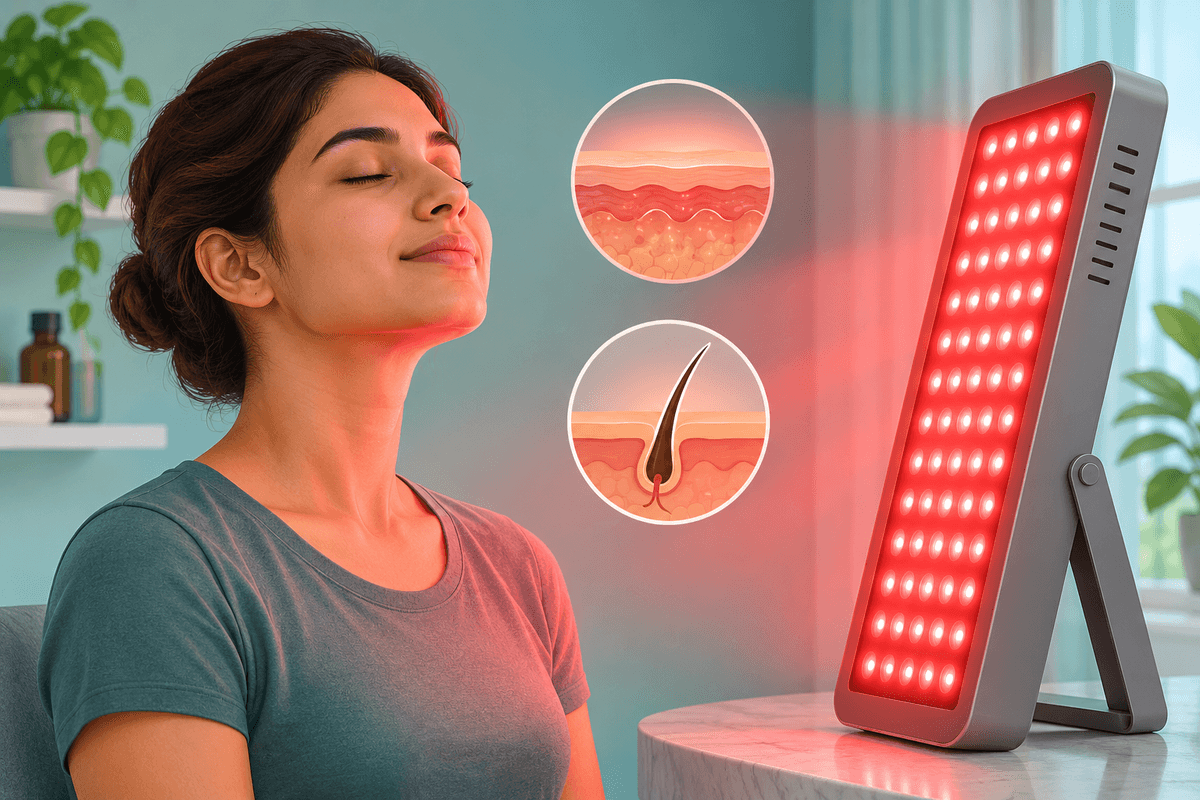
🔴Red Light Therapy: Skin, Hair and Pain — What the Evidence Shows
Red light therapy is trendy for skin, hair and pain. Learn which uses are FDA-cleared, what dermatologists say, and where evidence is still thin.
Scanura Editorial
Health Education Team
Written by Scanura Editorial for health education. This article is not a substitute for advice from a qualified doctor. About our editorial standards
Red Light Therapy: Skin, Hair and Pain — What the Evidence Shows
Red light therapy (RLT) and LED devices are everywhere — masks, panels, wands — promoted for wrinkles, hair regrowth, acne and pain. Some uses are FDA-cleared, but many claims outpace the evidence. This guide explains what dermatologists and trials actually show.
It is educational, not medical advice.
Direct Answer: Does Red Light Therapy Work?
For some narrow uses, modestly — but most popular claims are not firmly proven. The FDA has cleared certain RLT devices for specific, limited purposes (e.g., temporary relief of minor muscle/joint pain, some skin and hair devices). Dermatologists note that large, high-quality trials are limited, and results vary by device, wavelength and dose. LED masks may improve skin quality slightly in some studies, but effects are modest and temporary.
RLT is not a cure for skin disease, hair loss or chronic pain.
What the Evidence Shows
| Use | Evidence status |
|---|---|
| Skin quality / fine lines | Small short-term improvement in some trials |
| Hair regrowth (androgenetic alopecia) | Some cleared devices show modest benefit |
| Acne | Mixed — blue light is more studied for acne |
| Muscle and joint pain | FDA-cleared for temporary minor pain relief; evidence limited |
| Wound healing | Early research, not a standard treatment |
| Anti-aging / wrinkle reversal | Not proven; results are modest and temporary |
FDA Clearance Is Narrow
"FDA-cleared" does not mean FDA-approved for broad benefits. Clearance is typically for a specific claim (e.g., "temporary relief of minor muscle pain") based on showing the device is substantially similar to an existing one. Many consumer devices make much broader claims than their clearance supports.
Choosing a Device
If you try RLT, consider:
- Wavelength — red (~660 nm) or near-infrared (~850 nm) are most studied
- Irradiance (power) — too low may be ineffective; too high may irritate skin
- Treatment area and time — follow the device's instructions
- Eye protection — use it for bright or face-level devices
- Realistic expectations — benefits, if any, appear over weeks, not sessions
Safety
RLT is generally low-risk when used as directed. Possible issues:
- Eye strain or damage from bright light (use protection)
- Skin irritation or redness from overuse
- Burns from faulty or misused devices
Do not use RLT to treat moles, suspicious skin lesions, or undiagnosed skin changes — see a dermatologist first.
Key Takeaways
- RLT has modest evidence for a few narrow uses — not a cure-all.
- FDA clearance is claim-specific, not broad approval.
- Some devices may slightly improve skin quality or hair density temporarily.
- Acne, hair loss and chronic pain need professional diagnosis.
- Protect your eyes and follow device instructions.
- Do not self-treat suspicious skin lesions with light devices.
Sources and Further Reading
- AAD — Is red light therapy right for your skin?
- PMC — What to look for in red light therapy: a product guide
- Stanford Medicine — Red light therapy: what the science says
This article is for educational purposes only. Scanura does not provide medical diagnosis or treatment advice. Always consult your dermatologist for skin, hair or pain concerns.
Medical References
Step-by-Step Guide
- 1
Check FDA clearance
Look for devices cleared for your specific concern — clearance is narrow and claim-specific.
- 2
Choose wavelength and dose
Effective devices typically use red (~660 nm) or near-infrared (~850 nm) light at appropriate irradiance.
- 3
Be consistent but patient
Benefits, if any, usually appear after weeks of regular use — not after one session.
- 4
Protect your eyes
Use eye protection if the device is bright or used near the face.
- 5
See a dermatologist for conditions
Acne, hair loss and chronic pain need professional diagnosis — don't self-treat with a device.
📬 One health report guide, every week
Normal ranges, what your values mean, and what to ask your doctor — in plain language. Free, unsubscribe anytime.