🦋Thyroid Test Results Explained: What TSH, T3, T4 Mean
Your doctor ordered a thyroid test but you're not sure what TSH, T3, and T4 mean? Here's a simple guide to understanding your thyroid panel results.
Scanura Editorial
Health Education Team
Written by Scanura Editorial for health education. This article is not a substitute for advice from a qualified doctor. About our editorial standards
Thyroid Test Results Explained: What TSH, T3, T4 Mean
Thyroid reports confuse many people because the “main” hormone numbers and TSH can move in opposite directions. A high TSH with low Free T4 suggests a different story than a low TSH with high Free T4. Add pregnancy-specific ranges, lab-to-lab differences, and biotin interference, and self-interpretation gets risky.
This guide explains the common thyroid panel in plain language for Indian adults, how patterns are usually read together, and what to discuss with your doctor. It is not medical advice.
What the Thyroid Gland Does
The thyroid sits at the front of the neck and releases hormones that influence:
- Metabolic rate and weight tendency
- Energy, sleep, and mood
- Heart rate and body temperature
- Skin, hair, and menstrual regularity
- Growth and development (especially important in pregnancy and childhood)
Hypothyroidism means too little circulating thyroid hormone effect; hyperthyroidism means too much. Many Indians — especially women — live with undiagnosed or undertreated hypothyroidism for years.
The Core Blood Tests
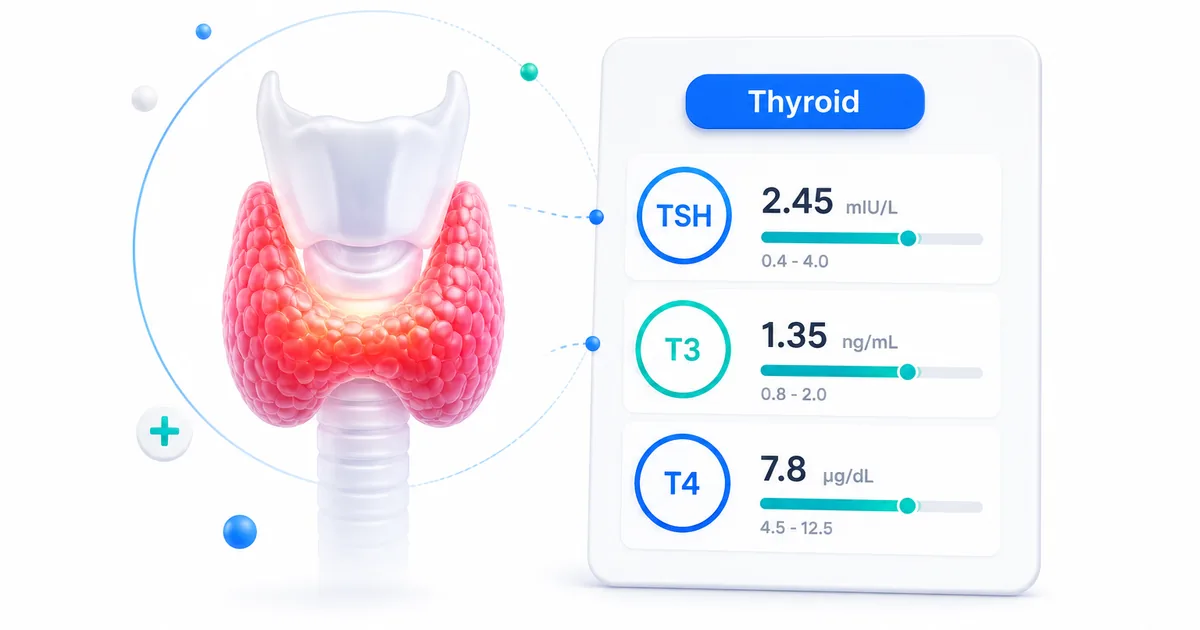
TSH (Thyroid-Stimulating Hormone)
TSH is made by the pituitary gland in the brain. It tells the thyroid how hard to work.
| Rough adult example | Common educational reading |
|---|---|
| About 0.4 – 4.0 mIU/L | Often labelled “normal” on many adult labs |
| Above the lab upper limit | May suggest hypothyroidism or inadequate replacement |
| Below the lab lower limit | May suggest hyperthyroidism or excess replacement |
Always use your lab’s printed range. Some guidelines and clinics use slightly different targets, especially in pregnancy or for people already on thyroxine.
- High TSH — pituitary is pushing harder because circulating thyroid hormone is (or was) low.
- Low TSH — pituitary is dialling down because hormone levels are high, or because of other pituitary issues (less common; doctor evaluates).
TSH is sensitive; it often shifts before Free T4 looks dramatically abnormal.
Free T4 (Thyroxine)
Free T4 is the unbound storage hormone that tissues convert toward active forms.
| Example adult range | Note |
|---|---|
| Roughly 0.8 – 1.8 ng/dL (lab-dependent) | Prefer Free T4 over total T4 when binding proteins change |
Low Free T4 with high TSH fits classic primary hypothyroidism. High Free T4 with low TSH fits hyperthyroidism or over-replacement.
Free T3 (Triiodothyronine)
T3 is the more active hormone. Not every basic panel includes it.
| Example | Note |
|---|---|
| Lab-specific Free T3 range | Useful in selected hyperthyroid workups; less often the first screening test |
Isolated T3 changes need clinical context — do not start or stop medicines based on a blog table.
Antibodies (when ordered)
| Test | Why it may be ordered |
|---|---|
| Anti-TPO | Autoimmune (Hashimoto) thyroiditis clues |
| TRAb / TSI | Graves’ disease evaluation in selected cases |
Antibody positivity alone does not always mean you need treatment today; your endocrinologist or physician decides.
Reading Patterns Together
| TSH | Free T4 | What is often discussed |
|---|---|---|
| High | Low | Overt hypothyroidism |
| High | Normal | Subclinical hypothyroidism — treat vs watch depends on TSH level, antibodies, symptoms, pregnancy plans |
| Low | High | Overt hyperthyroidism |
| Low | Normal | Subclinical hyperthyroidism — needs careful review (heart, bone, age) |
| Normal | Normal | Euthyroid on that day’s panel — symptoms may still need other evaluation |
Medicines (biotin, amiodarone, steroids), recent iodine contrast, non-thyroidal illness, and pregnancy all alter interpretation. Share a full medication list with your doctor.
Symptoms People Commonly Report
Underactive pattern (hypothyroid)
Weight gain, fatigue, hair fall, dry skin, constipation, cold intolerance, low mood, heavy periods, brain fog.
Overactive pattern (hyperthyroid)
Weight loss, palpitations, anxiety, tremor, heat intolerance, frequent stools, sleep disruption; eye symptoms in Graves’ disease need specialist care.
Symptoms overlap with anaemia, vitamin D deficiency, depression, and stress — which is why blood tests plus clinical exam matter.
India-Specific Context
- Autoimmune hypothyroidism is common in women; family history raises suspicion.
- Iodised salt programs reduced classic iodine-deficiency goitre in many regions, but thyroid disease remains widespread.
- Pregnancy needs trimester-specific TSH targets — do not use a non-pregnant chart to self-adjust thyroxine.
- If you take levothyroxine, take it on an empty stomach and separate it from calcium/iron supplements as your doctor advises; recheck labs after dose changes (often 6–8 weeks).
Related reading: TSH normal range for women by age.
When to Seek Care Sooner
- Rapid heart rate, chest pain, severe agitation, or eye pain with hyperthyroid symptoms
- Marked TSH elevation with myxoedema symptoms (extreme sleepiness, confusion) — emergency
- Pregnancy with abnormal thyroid tests — contact your obstetrician promptly
- Neck swelling with compressive symptoms (difficulty swallowing/breathing)
Practical Prep and Follow-Up Questions
- Fasting is not always required for TSH — follow your lab’s instruction sheet.
- Ask whether Free T4 (and antibodies) are needed, not only TSH.
- Ask your target TSH range if you are already on treatment or pregnant.
- Ask when to retest after a dose change.
- Ask whether ultrasound is indicated for nodules or goitre.
Scanura and Thyroid Reports
Uploading a thyroid panel to Scanura can surface which markers sit outside typical ranges and suggest clinician questions in Hindi or English. Final dosing and diagnosis belong with your doctor.
Treatment Context (Not a Dosing Guide)
Levothyroxine dosing is weight-, age-, heart-, and pregnancy-specific. Taking it with coffee, calcium, iron, or antacids too close together reduces absorption for many people. If TSH stays high despite “taking the tablet daily,” ask about timing and adherence before assuming you need large dose jumps.
Hyperthyroidism treatments (antithyroid drugs, radioiodine, surgery) require specialist pathways. Over-the-counter “thyroid boosters” can contain undeclared thyroid hormone — disclose supplements.
Subclinical hypothyroidism in practice
Many adults with TSH only mildly above range and normal Free T4 are monitored rather than immediately treated, especially without antibodies or symptoms. Exceptions often include pregnancy plans, infertility workups, strongly positive anti-TPO, or TSH clearly above a clinician’s treat threshold. Do not start thyroxine from a pharmacy based on a Facebook chart.
Monitoring schedule examples doctors use
- After starting or changing thyroxine: often recheck around 6–8 weeks
- Stable treated hypothyroidism: often every 6–12 months
- Pregnancy: more frequent — follow obstetric/endocrine advice only
Lab Timing and Interfering Factors
Biotin (Vitamin B7) in hair/skin supplements can falsely skew some thyroid immunoassays. Stop biotin before testing only if your clinician or lab instructs you — do not guess the washout period from social media.
Acute non-thyroidal illness (hospitalised infection, recent surgery) can temporarily lower T3/T4 and confuse TSH. Rechecking after recovery is often wiser than labelling a new lifelong disease during an ICU stay.
If your report includes only total T3/T4 (not free), binding-protein changes (pregnancy, estrogen therapy, illness) matter more. Ask whether a Free T4 assay is available when results and symptoms disagree.
If neck ultrasound shows nodules, most are benign, but size, suspicious features, and thyroid function together decide whether fine-needle aspiration is discussed. Do not assume every nodule equals cancer — and do not ignore compressive symptoms.
Educational only. Scanura does not diagnose or treat thyroid disease. Reference ranges and treatment thresholds vary by lab and clinical situation.
Medical References
Step-by-Step Guide
- 1
Get a thyroid panel test
Visit a diagnostic lab for a thyroid function test. No fasting is required for TSH, T3, T4 tests.
- 2
Check TSH level
Normal range is 0.4-4.0 mIU/L. High TSH indicates possible hypothyroidism. Low TSH indicates possible hyperthyroidism.
- 3
Review Free T3
Normal range is 2.3-4.2 pg/mL. T3 is the active thyroid hormone that affects metabolism.
- 4
Check Free T4
Normal range is 0.9-1.7 ng/dL. T4 is the storage form that gets converted to T3 as needed.
- 5
Interpret the pattern
High TSH + Low T3/T4 = Hypothyroidism. Low TSH + High T3/T4 = Hyperthyroidism. High TSH + Normal T3/T4 = Subclinical hypothyroidism.
- 6
Consult an endocrinologist
If your TSH is abnormal, consult an endocrinologist. Use scanura to understand your thyroid report in plain language.
📬 One health report guide, every week
Normal ranges, what your values mean, and what to ask your doctor — in plain language. Free, unsubscribe anytime.