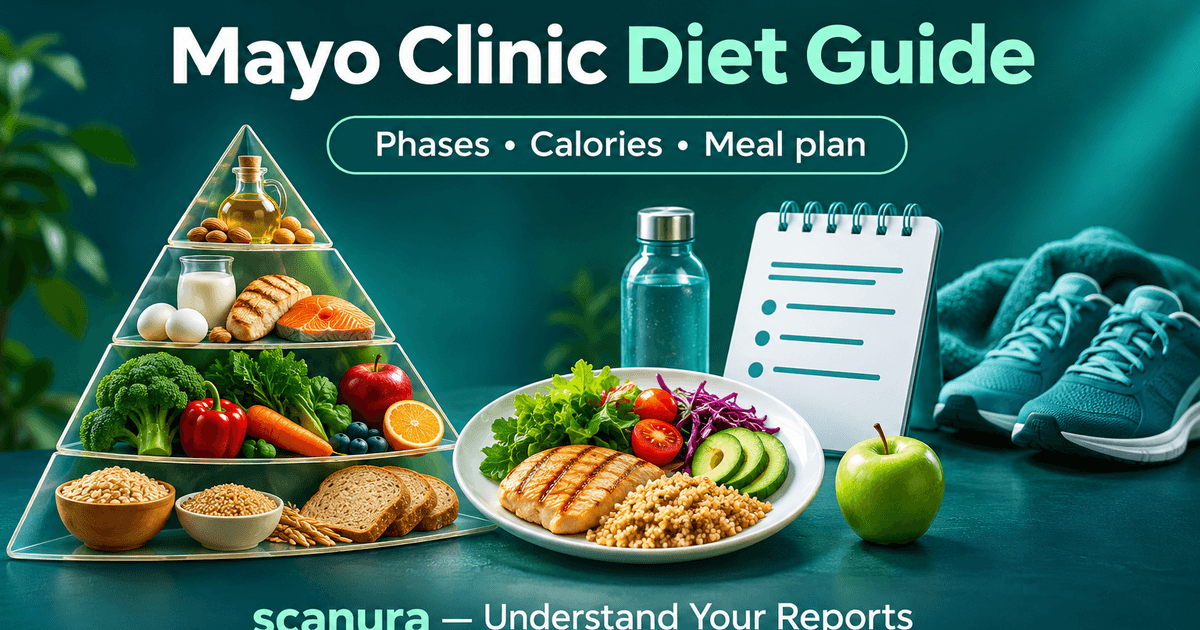
🥗Mayo Clinic Diet: How It Works, Benefits, Risks & Meal Plan
The Mayo Clinic Diet is a structured, low-calorie plan with two phases. Learn how the food groups, 1,200-calorie structure, maintenance and safety work.
Scanura Editorial
Health Education Team
Written by Scanura Editorial for health education. This article is not a substitute for advice from a qualified doctor. About our editorial standards
Mayo Clinic Diet: How It Works, Benefits, Risks & Meal Plan
The Mayo Clinic Diet is a weight-loss program built around portion control, lower calorie intake, activity and behaviour change. Its best-known tool is the Healthy Weight Pyramid, which puts vegetables, fruit and minimally processed foods at the base.
The direct answer is nuanced: the plan can teach sustainable habits, but “1,200 calories” is an example level—not a universal prescription. Mayo says goals vary with current weight and sex, with several styles and levels offered. Weight loss comes from a sustained energy deficit and healthier habits; there is no special “Mayo metabolism.”
In brief: The classic program has a two-week “Lose It!” start and lifelong “Live It!” maintenance; the current digital service adds “Love It!” Mayo describes up to 6–10 pounds (2.7–4.5 kg) in two weeks and about 1–2 pounds (0.5–1 kg) per week afterward. These are targets, not guaranteed outcomes.
What Is the Mayo Clinic Diet?
Mayo describes the diet as combining:
- a healthy, lower-calorie eating plan;
- portion awareness rather than obsessive calorie counting;
- daily physical activity;
- 15 starting habits;
- food and activity self-monitoring; and
- education for maintenance.
The Healthy Weight Pyramid is a visual guide: eat more foods from the broad base and fewer from the narrow top. Vegetables, fruit, whole grains and legumes provide fibre and nutrients with relatively low energy density, while foods high in added sugar, refined starch or excess fat are easier to limit.
It is not a juice cleanse, fasting protocol or “detox.” The service offers Mediterranean, vegetarian, higher-protein, heart-smart and healthy-keto variations; the classic approach is portion-controlled whole-food eating.
The Branded Programme Is Not a Clinic Nutrition Plan
A doctor or dietitian can tailor a plan for diabetes, kidney disease, pregnancy, allergies, an eating disorder or medicines. The Mayo Clinic Diet is a branded digital or book-based programme. It may support behaviour change, but cannot replace clinical assessment.
How Do the Mayo Clinic Diet Phases Work?
Phase 1: “Lose It!” — Two Weeks
The starting phase changes several habits rather than imposing one all-or-nothing rule. Mayo’s five habits to start are:
- eat a healthy breakfast;
- make vegetables and fruit a major part of meals;
- choose whole grains;
- use healthy fats and limit frying; and
- include at least 30 minutes of activity daily.
Habits to reduce include eating in front of screens, sweets, snack foods, excess high-fat foods and unplanned restaurant meals. Five bonus habits add food and activity records, gradual movement toward 60 minutes daily, more minimally processed “real food” and one achievable daily goal.
The goal is up to 6–10 pounds (2.7–4.5 kg) in two weeks. Some early change is water and intestinal-content change, not all fat. Anyone who feels unwell, dizzy or unusually weak should stop and seek advice.
Phase 2: “Live It!” — Lifelong Maintenance
This phase focuses on achievable goals, portion estimates, meal planning, nutrient needs and recovery after setbacks. Mayo says precise calorie counting is not required; participants learn suitable portions and repeatable meals.
The official article says this phase can support about 1–2 pounds (0.5–1 kg) per week until the goal weight is reached. CDC says this gradual pace is more likely to be maintained than faster loss.
What Is “Love It!”?
The current Mayo Clinic Diet website lists Lose It!, Live It! and Love It! “Love It!” is the long-term motivation and support stage. Mayo’s clinical overview still presents the core method as two phases, so readers may encounter both descriptions.
Is the Mayo Clinic Diet Just 1,200 Calories?
No. A 1,200-calorie day is one example on Mayo’s official article. The page says goals vary with weight and sex, with several styles and levels.
A 1,200-calorie plan can suit some adults, but it is not simply a smaller version of what everyone should eat. Energy needs vary with age, body size, sex, activity, pregnancy, illness and medication. A lower target needs smaller portions and careful attention to protein, fibre, fat and micronutrients; an appropriate higher level may be easier to sustain.
The Food Pattern
| Food group | Typical role in the plan |
|---|---|
| Vegetables and fruit | The broad base; Mayo describes these as virtually unlimited in the classic pattern, with sensible portions of higher-sugar fruit if needed |
| Whole grains | Bread, oats, brown rice and similar foods for carbohydrate and fibre |
| Protein foods | Lean meat, poultry, fish, legumes and soy; portion size matters |
| Dairy | Moderate amounts, including lower-fat choices when appropriate |
| Healthy fats | Olive oil, avocado, nuts, seeds and nut butters instead of repeated frying |
| Sweets | Small amounts near the top; fruit is the usual Mayo substitute |
WHO’s 2026 healthy-diet guidance offers four checks for any version: adequacy, balance, moderation and diversity. A lower-calorie menu must still provide nutrients, balance protein, fat and carbohydrate, limit harmful ingredients and include varied foods.
What Does a 1,200-Calorie Day Look Like?
Mayo’s official example:
| Meal | Mayo example | Indian-style adaptation |
|---|---|---|
| Breakfast | Smoothie with 1% milk, Greek yogurt, apple, banana, oats, almond butter and cinnamon | Curd or milk with fruit and oats, or a vegetable-and-egg preparation |
| Lunch | Vegetable and roast-beef whole-wheat wrap | Whole-wheat roti with vegetables and beans, paneer, tofu, egg or modest fish |
| Dinner | Broiled salmon with cabbage and tomato salad | Baked fish, tofu, paneer or dal with large vegetables and a measured carbohydrate serving |
| Snack | 15 cherries | Small fruit, plain curd or another food selected for the day |
These are examples, not a calorie prescription. A dietitian can adapt them for vegetarian, vegan, gluten-free, low-sodium, kidney-friendly or diabetes-specific needs. Avoid adding “detox” teas, fat burners or appetite-supplement capsules; the core approach is ordinary food, portions and behaviour support.
What Are the Benefits — and What Does the Evidence Show?
Plausible Benefits
The components are supported by general weight-management evidence:
- A modest calorie deficit can produce weight loss. No special food is required.
- Portion structure may reduce mindless intake. Vegetables, protein and a measured carbohydrate portion simplify meals.
- Fibre and minimally processed food may improve fullness and bowel health. Mayo notes temporary gas if fibre rises quickly; increase it gradually.
- Activity and behaviour support matter. NIDDK includes activity, counselling, progress monitoring and maintenance in successful programs.
- Modest weight loss can help health. CDC says a 5% reduction can improve blood pressure, cholesterol and blood sugar for many people with excess weight.
- Meal planning and tracking reveal patterns such as mindless snacking and screen-led eating.
Important Evidence Limitation
The general principles are well supported, but long-term evidence specific to the branded Mayo Clinic Diet is still developing. Mayo-sponsored pilot trial NCT06862375 compares 12 weeks of the diet with usual care and follows participants to 24 and 52 weeks. The registry estimates 250 participants, expects primary completion in March 2027 and study completion in March 2028, and posted no results as of October 21, 2026.
Marketing claims and testimonials are not completed comparative evidence. No published result does not prove the programme fails; general low-calorie, behaviour-change programmes can work, but the branded package is still being evaluated.
Mayo Clinic Diet vs Other Approaches
| Approach | What it emphasises | Consider it when |
|---|---|---|
| Mayo Clinic Diet | Two-week habit start, portions, activity and maintenance; the digital service adds a third stage | You want structured, food-based behaviour support; long-term branded comparative evidence is ongoing |
| Mediterranean-style diet | Flexible whole-food pattern with vegetables, pulses, grains, nuts, olive oil and fish | You prefer a flexible pattern; cardiovascular and metabolic research is strong |
| DASH-style diet | Fruit, vegetables, dairy and lower sodium | Blood pressure is a priority; portion and sodium guidance still matter |
| Juice or crash diet | Severe restriction, often with supplements or laxatives | Generally unsuitable: risks include dehydration, low blood sugar, nutrient gaps and poor maintenance |
| Clinic-tailored plan | Nutrition adjusted to diagnosis, medicines, allergies, culture and budget | Diabetes, organ disease, pregnancy, eating-disorder risk, medicines use or prior bariatric surgery |
How to Use the Mayo Clinic Diet Sensibly
1. Clarify the goal and calorie level
Decide whether the priority is weight, blood pressure, glucose control, fitness or meal confidence. “Lose 10 kg” is less useful than a behaviour goal, such as walking after dinner or replacing a sugary drink five days a week.
Do not automatically select 1,200 calories because it appears on a menu. NIDDK’s general example is an initial 5–10% weight reduction within six months for adults with overweight or obesity. A clinician or dietitian can choose a suitable level.
2. Build adequate meals
At most meals, include protein, vegetables or fruit, a sensible carbohydrate portion and some healthy fat. Increase fibre gradually and drink enough fluid unless you have a restriction.
Mayo’s starting phase targets at least 30 minutes of activity daily, gradually aiming toward 60 minutes. Choose safe, repeatable activity; heart symptoms, significant joint disease, pregnancy complications or limited mobility need individual guidance.
3. Track patterns and plan for maintenance
A food and activity record can show whether screens, restaurant meals or sweet drinks are the issue. Use it to guide decisions, not create guilt and restriction.
Plan how you will handle weekends, travel, festivals, eating out and a missed week. Maintenance tools, support and an appropriate higher calorie range are more valuable than extreme restriction.
4. Review health markers with your clinician
Weight, blood pressure, glucose or HbA1c, lipids and medication needs may change. scanura can explain routine blood-test reports, but cannot select a calorie target or replace a dietitian or doctor.
Safety, Who Should Get Advice and Warning Signs
Mayo says the programme is generally safe for most adults, but advises adjustment for diabetes and other conditions. A lower-calorie plan changes the relationship between food and medicines, so seek extra advice if you take:
- insulin or glucose-lowering medicines;
- GLP-1 or other weight-management medicines;
- diuretics or blood-pressure medicines;
- medicines with a narrow safe range; or
- medicines affected by dehydration or bowel changes.
Pregnant, breastfeeding or under-18 people, older or frail adults, and those with kidney or liver disease, an eating disorder, disordered eating or monitored medicines should not self-start a 1,200-calorie plan. Rapid weight changes or repeated dieting also deserve professional support.
Seek urgent medical care for fainting, confusion, severe dizziness, chest pain, a very fast or irregular heartbeat, breathing difficulty or inability to keep fluids down. Very little urine, persistent vomiting, marked weakness or dehydration also need prompt assessment. Stop the restrictive phase and seek advice rather than trying to outrun symptoms.
Frequently Asked Questions
Is the Mayo Clinic Diet a 1,200-calorie diet?
Not automatically. Mayo calls 1,200 calories one example menu; goals vary with current weight and sex.
How long do you stay on Phase 1?
The classic “Lose It!” start lasts two weeks. “Live It!” is for lifelong maintenance; the current commercial service adds “Love It!”
Do you have to count every calorie?
The classic approach teaches portion estimation. Some digital menus still display calorie goals, so check your version.
Does the Mayo Clinic Diet include exercise?
Yes. Activity is one of the 15 starting habits. Start with at least 30 minutes daily and aim toward 60 minutes, as your health allows.
Can vegetarians or people with diabetes follow it?
Yes, with adaptation. Vegetarian menus are available. Diabetes care may require changes to carbohydrate distribution, monitoring and medication, so a clinician should help.
Is it better than Mediterranean, DASH or a clinic plan?
No diet wins for everyone. Mayo offers structure; Mediterranean and DASH offer flexible patterns; a clinic plan suits complex medical or cultural needs.
Key Takeaways
- The Mayo Clinic Diet is a portion-controlled, lower-calorie behaviour programme. Its tools include the Healthy Weight Pyramid, 15 starting habits and maintenance support.
- 1,200 calories is an example, not everyone’s prescription. Mayo says goals vary with weight and sex and offers several levels.
- The classic method has two phases: a two-week “Lose It!” start and lifelong “Live It!” maintenance. The current service adds “Love It!”
- Early 6–10-pound loss includes fluid and gut-content change. A gradual pace is more likely to be maintained; CDC cites about 1–2 pounds per week.
- Benefits come from the calorie deficit and habits. Vegetables, whole grains, fibre, activity, monitoring and maintenance matter more than the name.
- Branded long-term comparative evidence is still developing. The Mayo-sponsored pilot has no results posted, with completion estimated in 2028.
- Choose the level with your health in mind. Diabetes, medicines, pregnancy, frailty, organ disease and eating-disorder risk require individual advice.
Sources and Further Reading
- Mayo Clinic, “The Mayo Clinic Diet: A weight-loss program for life”, updated June 5, 2026.
- Mayo Clinic Diet, “About the Mayo Clinic Diet”, official commercial programme page, 2026.
- ClinicalTrials.gov, “Weight Loss Through Mayo Clinic Diet; a Prospective Pilot Study” (NCT06862375), last update posted October 21, 2026.
- NIDDK, “Choosing a Safe & Successful Weight-loss Program”, last reviewed February 2024.
- CDC, “Steps for Losing Weight”, January 17, 2025.
- WHO, “Healthy diet”, January 26, 2026.
- MedlinePlus, “Dehydration”, last updated December 29, 2023.
Disclaimer: This article is for educational purposes only. It is not medical advice and does not establish a doctor–patient relationship. A Mayo Clinic Diet menu or branded programme is not a personalised prescription. Consult a doctor or registered dietitian before starting a lower-calorie plan or changing medicines.
Medical References
- Mayo Clinic — The Mayo Clinic Diet: A weight-loss program for life
- Mayo Clinic Diet — About the Mayo Clinic Diet
- ClinicalTrials.gov — Weight Loss Through Mayo Clinic Diet; a Prospective Pilot Study (NCT06862375)
- NIDDK — Choosing a Safe & Successful Weight-loss Program
- CDC — Steps for Losing Weight
- WHO — Healthy diet
- MedlinePlus — Dehydration
Step-by-Step Guide
- 1
Turn the goal into daily behaviours
Choose a focus such as blood pressure, glucose control, fitness or meal confidence and pair it with changes you can repeat.
- 2
Select an appropriate calorie level
Do not default to 1,200 calories because it appears on a menu; a clinician or dietitian can help match the target to your health needs.
- 3
Build adequate meals
Include protein, vegetables or fruit, a sensible carbohydrate portion and healthy fat, while increasing fibre gradually and drinking enough fluid.
- 4
Add safe activity and maintenance planning
Work toward at least 30 minutes of activity daily as able, and plan for travel, eating out and setbacks before they occur.
- 5
Review medicines and health markers
Diabetes treatment, weight-management medicines, pregnancy, frailty, organ disease and eating-disorder risk need individual advice; seek urgent help for severe symptoms.
📬 One health report guide, every week
Normal ranges, what your values mean, and what to ask your doctor — in plain language. Free, unsubscribe anytime.