☀️Vitamin D Deficiency: Symptoms, Causes & What Your Report Means
Feeling tired, achy, or just 'off'? Vitamin D deficiency is extremely common in India. Here's what your Vitamin D test results mean and how to fix them.
Scanura Editorial
Health Education Team
Written by Scanura Editorial for health education. This article is not a substitute for advice from a qualified doctor. About our editorial standards
Vitamin D Deficiency: Symptoms, Causes & What Your Report Means
Vitamin D deficiency is extraordinarily common in India despite abundant sunlight. Office workers, women with limited outdoor time, people with darker skin pigmentation, elderly adults, and those with chronic illness show low 25-hydroxy Vitamin D levels on routine panels year after year. The test is simple; interpreting it well — and treating it safely — needs a bit more care than buying the strongest Instagram supplement.
This guide explains the standard blood test, symptom patterns, why Indians are vulnerable, and how clinicians typically approach replacement. It is educational, not a prescription.
What Vitamin D Does in the Body
Vitamin D supports:
- Calcium and phosphate balance for bones and teeth
- Muscle function — deficiency can contribute to weakness and falls in older adults
- Immune signalling — associations with infection susceptibility are researched; it is not a cure-all
- Possible links with mood — evidence is mixed; treat deficiency for bone health first, not as sole antidepressant therapy
Your skin synthesises Vitamin D when UVB hits it; diet contributes smaller amounts unless you eat fortified foods or fatty fish regularly.
The Blood Test: 25-Hydroxy Vitamin D
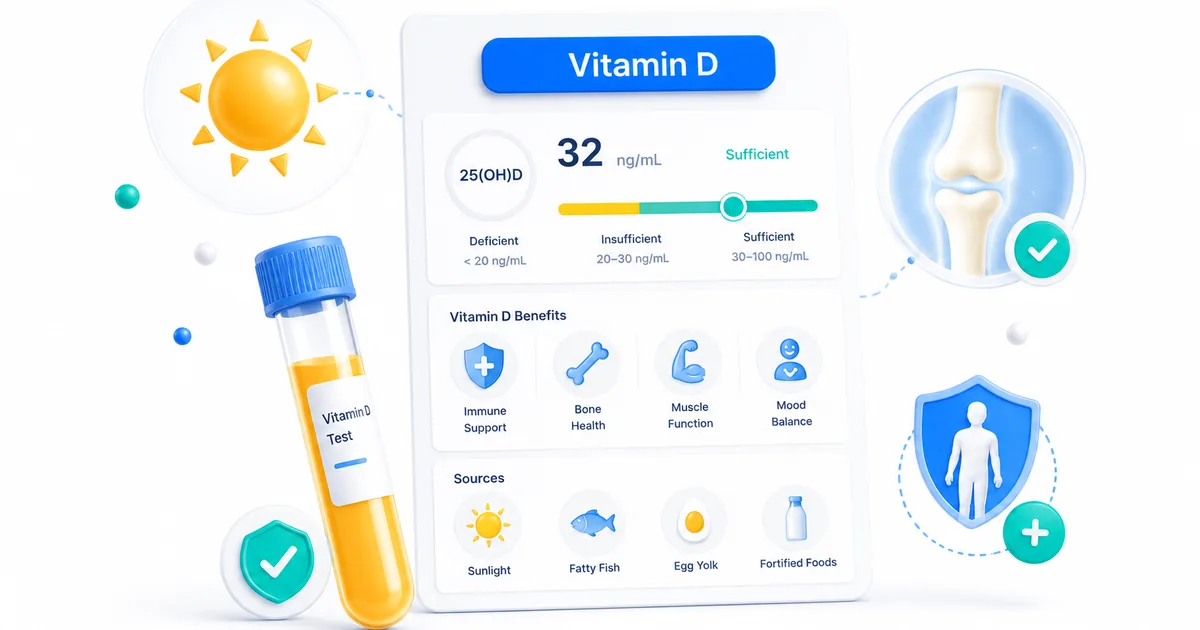
Labs report 25(OH)D, the storage form used for status.
| 25(OH)D level | Common educational label |
|---|---|
| Below ~10 ng/mL | Severe deficiency |
| ~10 – 20 ng/mL | Deficiency |
| ~20 – 29 ng/mL | Insufficiency (definitions vary) |
| ~30 – 100 ng/mL | Generally adequate / sufficient on many Indian reports |
| Very high (often >100 ng/mL) | Risk of toxicity — stop unsupervised mega-dosing |
Exact cut-offs differ by guideline and lab. Some societies use nmol/L (multiply ng/mL by 2.5). Always read the units on your PDF.
Many clinicians aim for a comfortable mid-range (often discussed around 40–60 ng/mL) rather than chasing the absolute ceiling.
Why Deficiency Is So Common in India
- Melanin reduces cutaneous Vitamin D production efficiency.
- Indoor lifestyles, commuting in covered vehicles, and high-rise living cut UVB exposure.
- Clothing that covers most skin for cultural or occupational reasons.
- Air pollution can reduce UVB reaching the ground.
- Mostly vegetarian diets with little fatty fish.
- Ageing skin produces less Vitamin D.
- Obesity can sequester Vitamin D in adipose tissue, lowering measured levels.
- Malabsorption (celiac, post-bariatric surgery, some pancreatic diseases) and chronic kidney/liver disease alter activation pathways.
Sunscreen is important for skin cancer prevention; short supervised sun exposure strategies should be personalised — do not burn yourself trying to “fix” a lab number.
Symptoms People Attribute to Low Vitamin D
- Bone discomfort or lower-back aches
- Fatigue that is multifactorial (also check anaemia, thyroid, sleep, depression)
- Muscle cramps or proximal weakness
- Frequent respiratory infections (association, not proof)
- Diffuse hair shedding (many other causes exist)
- Low mood
Because these symptoms are non-specific, a blood test plus clinical evaluation beats self-diagnosis. Severe long-standing deficiency can contribute to osteomalacia in adults or rickets in children — those need proper medical care.
Raising Levels: Sun, Food, and Supplements
Sunlight
Brief midday exposure of arms/face (when dermatologically appropriate) helps some people. Darker skin generally needs longer exposure than lighter skin for the same synthesis. Balance skin safety with bone health — ask a clinician if you have skin cancer risk.
Food sources
Fatty fish, egg yolks, UV-exposed mushrooms, and fortified milk/cereals help modestly. Diet alone rarely corrects severe deficiency quickly.
Supplements (doctor-directed)
| Situation | What clinicians often consider |
|---|---|
| Mild insufficiency | Daily cholecalciferol in moderate IU doses |
| Clear deficiency | Higher daily doses or weekly supervised courses |
| Severe deficiency | Structured loading then maintenance — medical dosing |
Take Vitamin D with a meal that contains some fat for absorption. Calcium intake and magnesium status may be discussed alongside. People with granulomatous disease, lymphoma, or high baseline calcium need specialist caution before high-dose Vitamin D.
Toxicity is real when people stack multiple “immunity boosters.” High calcium, kidney stones, nausea, and confusion can appear. More is not better.
Testing Cadence and Special Groups
- Recheck timing after loading doses is often after 8–12 weeks, not every week.
- Pregnancy, osteoporosis treatment, CKD, and malabsorption need individualised plans.
- Children and adolescents should not receive adult mega-capsules casually.
Pair low Vitamin D with a look at calcium, phosphate, ALP, and PTH when your doctor suspects metabolic bone disease.
Questions to Ask Your Doctor
- Is my level deficient enough to need a loading regimen?
- Which dose and duration — and when do we recheck?
- Should I add calcium, and how do I avoid constipation or kidney-stone risk?
- Could medicines or malabsorption explain why my level stays low?
- How much sun is reasonable for my skin type?
Scanura and Vitamin D on Reports
If Vitamin D appears on a multipanel checkup, Scanura can flag whether the value sits in deficient, insufficient, or typical adequate bands and help you prepare questions. Dosing decisions remain with your clinician.
FAQ
Can I treat based on symptoms alone? Better to measure 25(OH)D when deficiency is plausible — symptoms overlap with many conditions.
Are sprays or “nano” drops magic? Delivery forms differ; evidence and dosing still need medical guidance.
Will Vitamin D alone fix hair fall? Only if deficiency is a true contributor; evaluate iron, thyroid, and dermatology causes too.
Bone Health Beyond a Single Number
Vitamin D works with calcium intake, protein, weight-bearing activity, and fall prevention in older adults. Treating a level of 18 ng/mL while ignoring a calcium-poor diet or untreated osteoporosis risk is incomplete care.
People on long-term steroids, anticonvulsants, or malabsorption disorders often need proactive monitoring. CKD patients may need activated Vitamin D forms prescribed by nephrology — over-the-counter cholecalciferol strategies differ.
Supplement quality
Choose brands your clinician trusts; look for clear IU labelling. Combining multiple multivitamins that each contain Vitamin D is a common accidental overdose path. Keep a written list of every capsule you take.
Working With Your Report Numbers
Convert units if needed (ng/mL vs nmol/L) before comparing to an article table. Save the actual numeric value and date; “Vitamin D low” stamped by a lab software rule is less useful than knowing you moved from 12 to 38 ng/mL after supervised therapy.
If levels refuse to rise despite adherence, ask about malabsorption, medicine interactions (cholestyramine, orlistat, some anticonvulsants), obesity-related dosing needs, or whether you are taking active Vitamin D analogues incorrectly.
Children’s dosing is weight-based and formulation-specific. Never divide adult 60,000 IU capsules for toddlers without explicit paediatric instructions — accidental overdose presentations still occur in clinics.
Educational only. Do not start high-dose Vitamin D without professional advice if you have kidney disease, high calcium, or complex illness. Scanura does not prescribe supplements.
Step-by-Step Guide
- 1
Get a 25-OH Vitamin D test
Visit a diagnostic lab for a 25-Hydroxy Vitamin D blood test. No fasting required.
- 2
Check your Vitamin D level
Below 10 ng/mL = severe deficiency. 10-20 = deficiency. 20-29 = insufficiency. 30-100 = optimal. Above 100 = toxicity.
- 3
Get 15-20 minutes of midday sun
Expose arms and face to sunlight between 10 AM and 2 PM. Don't wear sunscreen during this brief period.
- 4
Start supplements if deficient
Insufficiency: 1,000-2,000 IU daily. Deficiency: 4,000-5,000 IU daily. Severe deficiency: 60,000 IU weekly for 8-12 weeks.
- 5
Take Vitamin D with fatty meal
Vitamin D is fat-soluble, so take it with a fatty meal for better absorption. Your doctor may prescribe calcium alongside.
- 6
Retest after 3 months
Retest Vitamin D levels after 3 months of supplementation to check improvement.
📬 One health report guide, every week
Normal ranges, what your values mean, and what to ask your doctor — in plain language. Free, unsubscribe anytime.