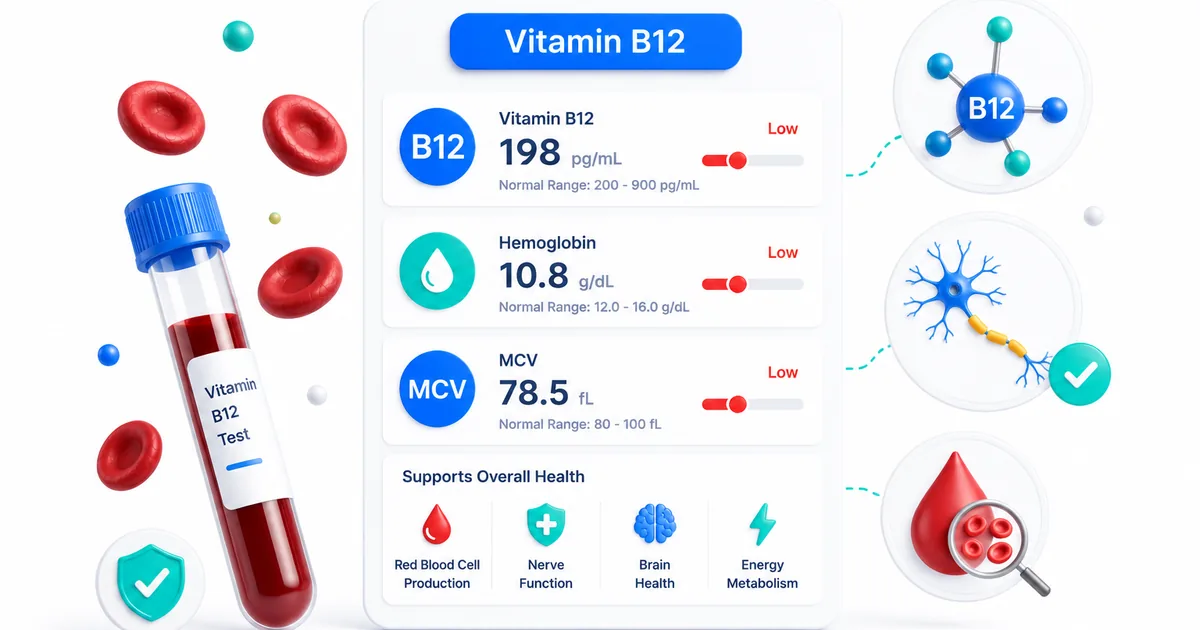
🧠Vitamin B12 Deficiency Explained: What Your Blood Test Results Mean
B12 deficiency is silently affecting millions of Indians — especially vegetarians. Here's how to read your B12 report and understand what low levels really mean for your nerves and brain.
Scanura Editorial
Health Education Team
Written by Scanura Editorial for health education. This article is not a substitute for advice from a qualified doctor. About our editorial standards
Vitamin B12 Deficiency Explained: What Your Blood Test Results Mean
India has a quiet epidemic that almost nobody talks about: Vitamin B12 deficiency. Studies suggest that over 40–80% of vegetarians and a large proportion of the general Indian population have insufficient B12 levels — yet most people only find out by accident on a routine blood report.
The damage it causes — to your nerves, brain, and blood — can be severe and sometimes irreversible if ignored for years.
Why B12 Matters So Much
Vitamin B12 (cobalamin) is essential for three critical functions:
- Nerve health — B12 maintains the myelin sheath, the protective coating around nerves. Without it, nerves degrade — causing tingling, numbness, and in severe cases, permanent damage.
- Red blood cell production — B12 is required to make healthy, normal-sized red blood cells. Without it, cells become large and dysfunctional (megaloblastic anemia).
- Brain and mood — B12 is involved in producing serotonin and dopamine. Low B12 is linked to depression, brain fog, and in the elderly, dementia-like symptoms.
Understanding Your B12 Report
Serum Vitamin B12
| Level | What It Means |
|---|---|
| Above 300 pg/mL | Optimal |
| 200 – 300 pg/mL | Grey zone — symptoms possible |
| Below 200 pg/mL | Deficiency confirmed |
| Below 100 pg/mL | Severe deficiency — nerve damage risk |
The "normal" cutoff of 200 pg/mL is debated. Many neurologists consider anything below 300 pg/mL functionally low — especially if symptoms are present.
MCV (Mean Corpuscular Volume) from CBC
| Level | What It Suggests |
|---|---|
| 80 – 100 fL | Normal red blood cell size |
| Above 100 fL | Macrocytosis — B12 or folate deficiency likely |
High MCV is often the first clue that B12 is low — sometimes appearing on a routine CBC before anyone has checked B12 directly.
Symptoms of B12 Deficiency
Neurological
- Tingling or numbness in hands and feet ("pins and needles")
- Balance problems and difficulty walking
- Weakness in arms or legs
- Memory problems and difficulty concentrating
Blood-Related
- Fatigue and weakness far beyond what seems normal
- Pale or slightly yellow skin (due to red cell breakdown)
- Shortness of breath on minor exertion
Psychological
- Depression, anxiety, or mood swings
- Irritability and mental fogginess
- In elderly: confusion and dementia-like symptoms
Key point: neurological symptoms can appear and worsen even before anemia develops. Do not wait for a low hemoglobin to investigate B12.
Why Is B12 Deficiency So Common in India?
Dietary (the biggest reason)
B12 is found almost exclusively in animal-sourced foods:
| High B12 Foods | B12 Content |
|---|---|
| Clams, shellfish | Very high |
| Liver (beef, chicken) | Very high |
| Fish (sardines, tuna, salmon) | High |
| Eggs | Moderate |
| Milk and dairy | Moderate |
| Fortified cereals | Variable |
Vegetables, fruits, lentils, and grains contain zero natural B12. A lifelong vegetarian who does not supplement is virtually guaranteed to develop deficiency over time.
Medical and Drug Causes
- Metformin (diabetes medication) — blocks B12 absorption in the gut; extremely important to monitor in diabetic patients
- PPIs and antacids (omeprazole, pantoprazole) — stomach acid is needed to absorb B12; long-term use reduces absorption
- Pernicious anemia — autoimmune condition where the stomach stops making "intrinsic factor," a protein needed to absorb B12
- Crohn's disease or bowel surgery — damages the absorption site in the small intestine
- Elderly age — stomach acid production declines naturally with age
Stages of B12 Deficiency
B12 deficiency progresses slowly over years — it takes 2–5 years to deplete stored B12 after dietary intake stops:
| Stage | What's Happening | Blood Markers |
|---|---|---|
| 1 — Depletion | Stores falling, no symptoms yet | B12 below 300, normal CBC |
| 2 — Deficiency | Cellular B12 insufficient | B12 below 200, high homocysteine |
| 3 — Damage | Nerve and blood cell effects | Low B12, high MCV, anemia |
| 4 — Severe | Irreversible nerve damage possible | Very low B12, neurological signs |
Treatment
Oral Supplements
- Methylcobalamin (preferred in India) — more bioavailable form than cyanocobalamin
- Typical dose: 500–1500 mcg/day for deficiency; 500 mcg/day for maintenance
- Works well for dietary deficiency when gut absorption is normal
Injections
- Used when oral absorption is impaired (pernicious anemia, bowel disease, post-surgery)
- Hydroxocobalamin or methylcobalamin injections — given weekly initially, then monthly
- Faster recovery of nerve symptoms compared to oral
Dietary Changes
- Include eggs, dairy, and fish if medically appropriate
- Look for B12-fortified foods (some plant milks and cereals)
- Vegans should supplement routinely — there is no plant food with adequate B12
How scanura Helps
Upload your blood report to scanura:
- Flag low B12 even when it appears in different panels (CBC, metabolic panel, standalone B12)
- Connect the dots between high MCV in CBC and possible B12/folate deficiency
- Remind you to check B12 if you are on metformin or long-term antacids
- Track recovery — watch B12 levels rise over repeated reports after starting supplements
Disclaimer: This article is for educational purposes only. scanura does not provide medical diagnosis. Always consult your doctor for medical decisions.
Step-by-Step Guide
- 1
Get a serum B12 test
A fasting blood test is preferred. Ask your doctor to include folate (B9) in the same panel as both work together.
- 2
Read your B12 level
Normal: 200–900 pg/mL. Deficiency: below 200. Grey zone: 200–300 pg/mL — symptoms possible even if 'technically normal'.
- 3
Check your CBC for clues
B12 deficiency causes large, misshapen red blood cells (high MCV). If your MCV is above 100 fL, B12 or folate deficiency is likely.
- 4
Identify your risk factors
Strict vegetarians, vegans, elderly, people on metformin or PPIs, and those with digestive conditions are highest risk.
- 5
Start treatment if needed
Mild deficiency: oral B12 supplements (methylcobalamin preferred in India). Severe or absorption-related: intramuscular B12 injections.
- 6
Retest after 3 months
B12 levels take time to replenish. Retest after 3 months of supplementation to confirm improvement.
📬 One health report guide, every week
Normal ranges, what your values mean, and what to ask your doctor — in plain language. Free, unsubscribe anytime.