🦴Uric Acid Test Explained: What High Uric Acid Really Means
Your doctor said your uric acid is 'slightly high' but didn't explain what that means. Is it gout? Kidney stones? Or just a number you shouldn't worry about? This guide covers everything — what uric acid is, what the numbers mean, and when to take action.
Scanura Editorial
Health Education Team
Written by Scanura Editorial for health education. This article is not a substitute for advice from a qualified doctor. About our editorial standards
Uric Acid Test Explained: What High Uric Acid Really Means
You got a routine blood test done and one number is flagged: Uric Acid — 8.2 mg/dL. Your doctor said it's "slightly high" and told you to "drink more water and avoid purine-rich foods." But what does it actually mean? Should you be worried? Can it cause gout? Kidney stones? Heart disease?
Here's the thing about uric acid — it's one of the most misunderstood numbers in a blood report. Most people associate it only with gout, but elevated uric acid is now recognized as a risk factor for kidney disease, heart disease, metabolic syndrome, and even certain cancers. Yet it's often ignored until symptoms appear.
This guide will help you understand what uric acid is, what the numbers mean, and what to do about it.
What Is Uric Acid?
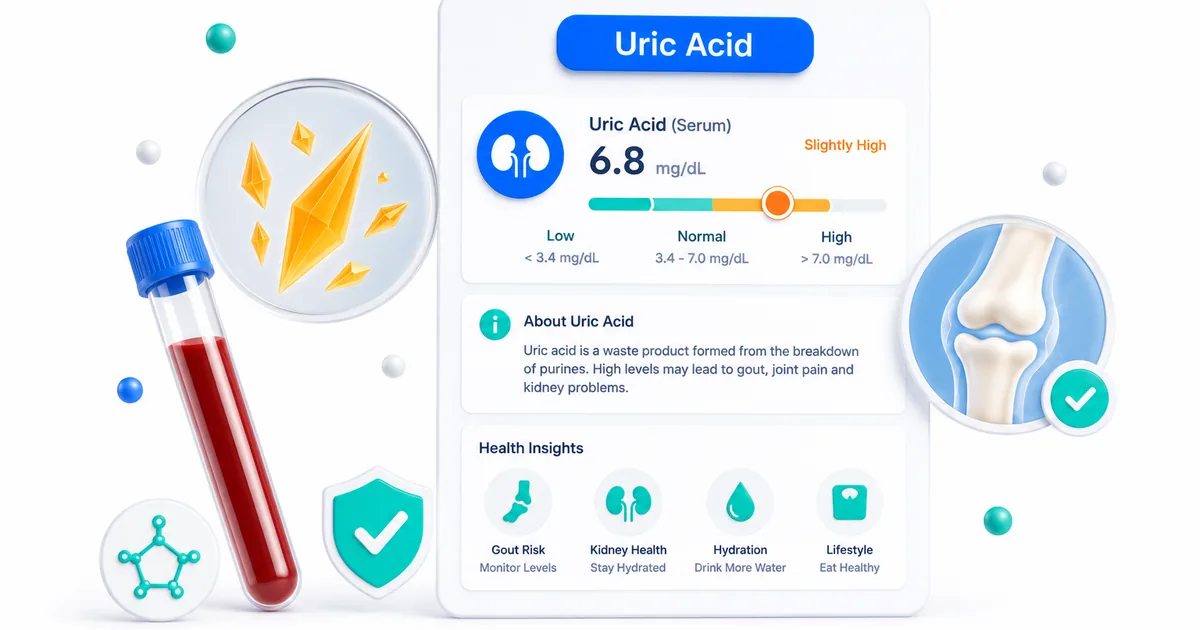
Uric acid is a waste product formed when your body breaks down purines — naturally occurring chemicals found in your body's cells and in certain foods. Your kidneys filter uric acid from your blood and excrete it in urine.
The problem arises when either:
- Your body produces too much uric acid (overproduction)
- Your kidneys excrete too little uric acid (underexcretion) — this is the more common cause (about 90% of cases)
When uric acid levels stay high for a long time, it can crystallize — forming needle-like monosodium urate crystals in your joints (causing gout), kidneys (causing stones), and soft tissues (causing tophi).
Uric Acid Levels — What's Normal?
| Level (mg/dL) | Category |
|---|---|
| Men | |
| Below 3.5 | Low (usually not a problem) |
| 3.5 – 7.0 | Normal |
| 7.0 – 8.0 | Mildly elevated — monitor |
| 8.0 – 9.0 | Moderately elevated — investigate |
| Above 9.0 | Severely elevated — treatment likely needed |
| Women (pre-menopause) | |
| Below 2.5 | Low |
| 2.5 – 6.0 | Normal |
| 6.0 – 7.0 | Mildly elevated |
| Above 7.0 | Elevated — investigate |
| Women (post-menopause) | |
| Same as men (estrogen protects pre-menopausal women) |
Important note: Uric acid fluctuates throughout the day. A single high reading doesn't necessarily mean you have a problem — your doctor will look at the trend over multiple tests.
High Uric Acid — The Five Things It Can Cause
1. Gout — The Most Well-Known Complication
Gout is a form of inflammatory arthritis caused by uric acid crystal deposition in joints. It's incredibly painful — patients describe it as one of the worst pains they've ever experienced.
How gout works:
- Uric acid levels stay above 6.8 mg/dL (the saturation point)
- Needle-like crystals form in joint fluid
- The immune system attacks the crystals → intense inflammation
- Sudden, severe joint pain (usually the big toe)
- Joint becomes red, hot, swollen, and extremely tender
Who gets gout:
- Men (especially after 30)
- Post-menopausal women (estrogen drops → uric acid rises)
- People who drink alcohol regularly
- People who eat lots of red meat and seafood
- People who are overweight
- People with kidney disease
- People on certain medications (diuretics, low-dose aspirin)
Key fact: Not everyone with high uric acid gets gout. About 2/3 of people with high uric acid never develop gout. But the higher the level and the longer it stays high, the greater the risk.
2. Kidney Stones — The Silent Problem
Uric acid crystals can form stones in the kidneys and urinary tract. Uric acid stones account for about 10% of all kidney stones.
Key facts:
- Uric acid stones are more common in people with diabetes and metabolic syndrome
- They're often "radiolucent" — meaning they don't show up on regular X-rays (need CT scan)
- High uric acid increases the risk of calcium oxalate stones too (not just uric acid stones)
- Uric acid stones are more common in acidic urine (pH below 5.5)
3. Kidney Disease — The Emerging Link
Multiple studies now show that high uric acid is an independent risk factor for chronic kidney disease (CKD). The mechanism:
- Uric acid crystals deposit in kidney tissue → inflammation
- Uric acid damages blood vessels in the kidneys → reduced blood flow
- Uric acid promotes oxidative stress and endothelial dysfunction
Key facts:
- Uric acid above 9 mg/dL increases CKD risk by 2-3x
- Treating high uric acid may slow kidney disease progression (debated)
- People with both hypertension and high uric acid are at especially high risk
4. Heart Disease — The New Risk Factor
High uric acid is now recognized as an independent cardiovascular risk factor, similar to high cholesterol or hypertension.
Key facts:
- Uric acid above 7 mg/dL increases heart disease risk by 15-20%
- Uric acid promotes inflammation, oxidative stress, and endothelial dysfunction
- It clusters with metabolic syndrome (high blood sugar, high BP, obesity, high triglycerides)
- Some studies suggest treating high uric acid reduces blood pressure
5. Metabolic Syndrome — The Cluster
High uric acid rarely travels alone. It clusters with:
- Obesity (especially belly fat)
- High blood sugar / diabetes
- High blood pressure
- High triglycerides
- Low HDL cholesterol
This cluster is called metabolic syndrome, and it dramatically increases your risk of heart disease, stroke, and diabetes.
What Causes High Uric Acid?
Dietary Causes (Controllable)
| Food Category | Examples | Impact |
|---|---|---|
| Red meat | Mutton, beef, lamb | High purine — major trigger |
| Organ meats | Liver, kidney, brain | Very high purine — avoid |
| Seafood | Shrimp, lobster, sardines, anchovies | High purine |
| Alcohol | Beer (worst), spirits, wine | Beer is doubly bad — purines + blocks uric acid excretion |
| Fructose-sweetened drinks | Cold drinks, packaged fruit juice | Fructose increases uric acid production |
| High-fructose corn syrup | Packaged foods, sweets | Increases uric acid |
Medical Causes (May Need Treatment)
- Kidney disease — reduced excretion
- Hypertension — damages kidneys
- Diabetes — metabolic dysfunction
- Obesity — increased production, decreased excretion
- Hypothyroidism — slows metabolism
- Medications — diuretics (furosemide, HCTZ), low-dose aspirin, cyclosporine
- Psoriasis — rapid skin cell turnover
- Tumour lysis syndrome — chemotherapy releases purines
Genetic Causes
Some people have genetic mutations that cause overproduction or underexcretion of uric acid. These are rare but important to identify — they often require lifelong medication.
How to Lower Uric Acid — Lifestyle Changes
Diet Modifications
Foods to reduce or avoid:
- Red meat (limit to 1-2 times per week maximum)
- Organ meats (avoid completely)
- High-purine seafood (sardines, anchovies, shellfish)
- Beer and spirits (eliminate or limit to occasional)
- Cold drinks and packaged juices (eliminate)
- High-fructose corn syrup products (eliminate)
Foods that help lower uric acid:
- Low-fat dairy — milk, yogurt, paneer (proteins in dairy may promote uric acid excretion)
- Cherries — contain anthocyanins that reduce uric acid and inflammation
- Vitamin C — 500mg/day can lower uric acid by 0.5 mg/dL
- Coffee — moderate consumption (2-3 cups/day) is associated with lower uric acid
- Vegetables — most vegetables are low in purines (including spinach and mushrooms, which are wrongly avoided)
- Whole grains — complex carbs help with metabolic health
- Water — 2-3 liters per day to help kidneys excrete uric acid
Lifestyle Modifications
- Lose weight — every 1 kg lost reduces uric acid by about 0.1 mg/dL
- Exercise — 150 minutes per week of moderate exercise
- Limit alcohol — beer is worst, wine is least harmful
- Stay hydrated — drink enough to produce 2+ liters of urine per day
- Avoid crash diets — rapid weight loss temporarily raises uric acid
Medication — When Is It Needed?
You May Need Medication If:
- You've had gout attacks (even one attack)
- Uric acid is above 9 mg/dL with risk factors
- You have tophi (uric acid deposits under the skin)
- You have uric acid kidney stones
- You have chronic kidney disease with high uric acid
- Lifestyle changes haven't lowered uric acid after 6 months
First-Line Medications:
| Medication | How It Works | Typical Dose |
|---|---|---|
| Allopurinol | Xanthine oxidase inhibitor — reduces uric acid production | 100–300 mg/day |
| Febuxostat | Xanthine oxidase inhibitor — more selective | 40–80 mg/day |
Important Rules for Uric Acid Medication:
- Start low, go slow — begin with a low dose and increase gradually
- Don't start during a gout attack — wait 2-3 weeks after the attack resolves
- Target uric acid below 6 mg/dL (or below 5 mg/dL if you have tophi)
- Don't stop suddenly — uric acid will rebound
- May need prophylactic colchicine for first 3-6 months to prevent gout flares
Indian Diet and Uric Acid — Special Considerations
The Indian diet presents unique challenges:
The dal dilemma: Dal (lentils) contains moderate purines. However, studies show that plant-based purines are less likely to trigger gout than animal-based purines. You don't need to avoid dal — just be mindful of portion sizes.
The mutton problem: Mutton (goat meat) is deeply embedded in Indian culture — festivals, celebrations, non-veg thalis. Mutton is high in purines. If you have gout or high uric acid, limit to 1-2 servings per week maximum.
The beer and biryani combination: Friday night biryani with beer is a common pattern. This combination is a perfect storm for uric acid — high purines from meat + alcohol blocking excretion.
Practical tips:
- Drink 1 glass of low-fat milk daily (helps lower uric acid)
- Add 5-6 cherries to your daily diet (fresh or frozen)
- Take Vitamin C 500mg daily
- Replace cold drinks with water, coconut water, or buttermilk (chaas)
- Keep a glass of water by your bed — drink first thing in the morning
- Limit mutton to 1-2 times per week; choose chicken or fish on other days
Monitoring and Follow-Up
How Often to Test
- Initial diagnosis: Test every 2-4 weeks while starting treatment
- Once stable: Every 3-6 months
- Without treatment: Every 6-12 months if mildly elevated
- With gout history: Every 3-6 months (target below 6 mg/dL)
When to See a Rheumatologist
- First gout attack (to confirm diagnosis and start treatment)
- Uric acid above 9 mg/dL
- Recurrent gout attacks despite treatment
- Tophi (visible lumps under the skin)
- Uric acid kidney stones
- Uncertainty about whether symptoms are gout vs. another condition
How scanura Helps
Upload your uric acid report to scanura and get:
- Plain-language explanation of your uric acid level
- Risk assessment for gout, kidney stones, and cardiovascular disease
- Diet recommendations specific to Indian food and cooking practices
- Questions to ask your doctor — like "Should I start allopurinol?" or "Do I need a kidney ultrasound?"
- Tracking over time to see if lifestyle changes are working
Key Takeaways
- Normal uric acid is below 7 mg/dL for men and below 6 mg/dL for pre-menopausal women
- Not everyone with high uric acid gets gout — but the higher and longer, the greater the risk
- High uric acid affects more than joints — it's a risk factor for kidney disease and heart disease
- Diet changes can lower uric acid by 1-2 mg/dL — reduce purines, increase water, add cherries and vitamin C
- Medication is needed if you've had gout, uric acid is above 9, or you have kidney stones
- Don't start allopurinol during a gout attack — wait 2-3 weeks
- Target below 6 mg/dL if you have gout history
- Indian diet challenges — mutton and beer are the biggest triggers; dal is fine in moderation
Disclaimer: This article is for educational purposes only. scanura does not provide medical diagnosis. Always consult your rheumatologist or doctor for medical decisions.
Step-by-Step Guide
- 1
Get uric acid tested
A simple blood test (serum uric acid) measures uric acid levels. Fasting is preferred but not always required. Normal range: 3.5–7.0 mg/dL for men, 2.5–6.0 mg/dL for women.
- 2
Check if you have symptoms
High uric acid without symptoms (asymptomatic hyperuricemia) may not need treatment. But if you have joint pain, kidney stones, or tophi — treatment is needed.
- 3
Identify the cause
Common causes: purine-rich foods (red meat, organ meats, seafood), alcohol (especially beer), fructose-sweetened drinks, obesity, kidney disease, and certain medications (diuretics).
- 4
Start lifestyle changes
Reduce purine-rich foods, limit alcohol, drink 2-3 liters of water daily, lose weight if overweight. These changes can lower uric acid by 1-2 mg/dL.
- 5
Consider medication if needed
Allopurinol or febuxostat are first-line medications for chronic gout or uric acid above 9 mg/dL with symptoms. Never start medication without doctor guidance.
- 6
Monitor regularly
Retest in 2-4 weeks after starting treatment. Target: below 6 mg/dL (or below 5 mg/dL if you have tophi). Retest every 3-6 months once stable.
📬 One health report guide, every week
Normal ranges, what your values mean, and what to ask your doctor — in plain language. Free, unsubscribe anytime.