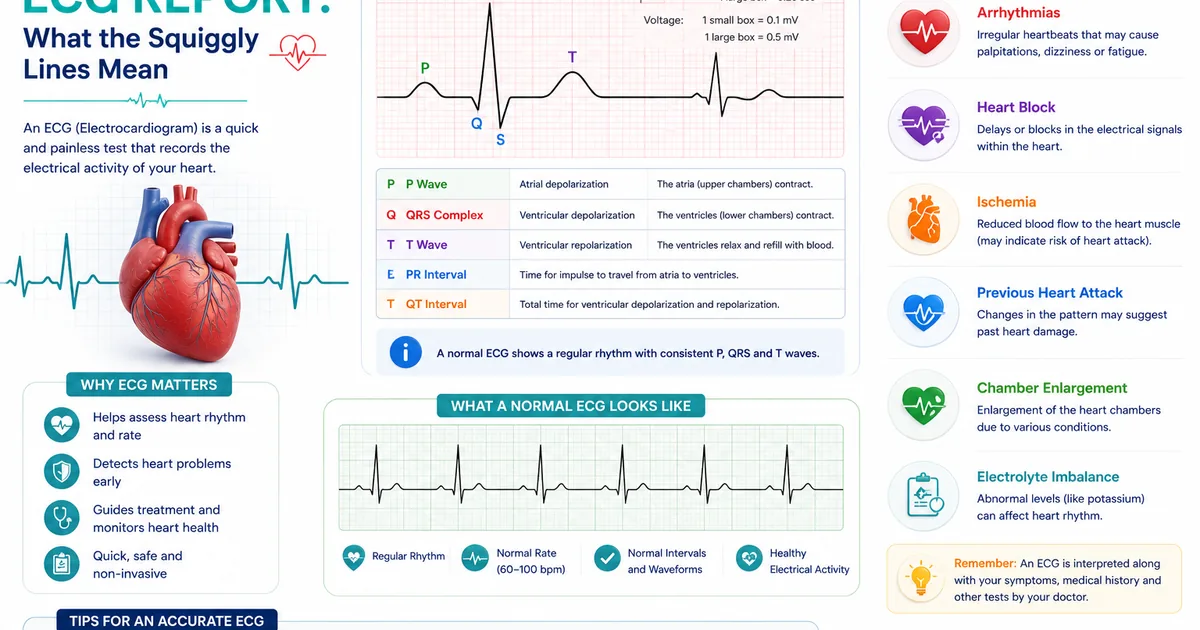
💓Understanding Your ECG Report: What the Squiggly Lines Mean
Your doctor ordered an ECG but you have no idea what all those waves and spikes mean? Here's a plain-language guide to reading your own ECG report.
Scanura Editorial
Health Education Team
Written by Scanura Editorial for health education. This article is not a substitute for advice from a qualified doctor. About our editorial standards
Understanding Your ECG Report: What the Squiggly Lines Mean
You've just had an ECG done. The doctor hands you a long strip of paper (or a PDF) covered in jagged lines — peaks, valleys, and spikes that look like a seismograph reading. You look at it, confused. What does any of this mean?
You're not alone. Most patients receive their ECG report and have zero idea what they're looking at. The good news? You don't need to be a cardiologist to understand the basics. This guide will help you decode the most important parts of your ECG in plain language.
What is an ECG?
ECG stands for Electrocardiogram (also called EKG). It's a quick, painless test that records the electrical activity of your heart. Every time your heart beats, it generates an electrical signal that makes the heart muscle contract. The ECG captures these signals and prints them as waves on paper.
The test takes about 5 minutes. Small sticky patches (electrodes) are placed on your chest, wrists, and ankles. These electrodes detect the electrical signals and send them to a machine that prints the ECG strip.
An ECG can detect:
- Heart rhythm problems (arrhythmias)
- Heart attacks (past or ongoing)
- Heart enlargement
- Electrolyte imbalances (potassium, calcium)
- Effects of medications on the heart
- Blocked coronary arteries
The ECG Grid — Understanding the Paper
Before reading the waves, you need to understand the grid:
- Small squares = 0.04 seconds (1 mm wide)
- Large squares (5 small squares) = 0.20 seconds (5 mm wide)
- Vertical axis = voltage (amplitude)
This grid is how cardiologists measure timing and size of each wave. When someone says "the QRS is 3 small squares wide," they mean 0.12 seconds.
The Five Waves — P, Q, R, S, T
Every normal ECG has these components in order:
1. P Wave — Atrial Depolarization
The P wave is the first small bump on the ECG. It represents the atria (upper chambers of the heart) contracting to push blood into the ventricles.
Normal P wave:
- Small, rounded, and upright in Lead II
- Duration: less than 0.12 seconds (3 small squares)
- Amplitude: less than 2.5 mm
What abnormal P waves mean:
- Large P waves → atrial enlargement (often from high blood pressure)
- Absent P waves → atrial fibrillation (irregular heart rhythm)
- Irregular P waves → wandering atrial pacemaker
2. PR Interval — Conduction Time
The PR interval is the time from the start of the P wave to the start of the QRS complex. It measures how long the electrical signal takes to travel from the atria to the ventricles.
Normal PR interval: 0.12 to 0.20 seconds (3-5 small squares)
What abnormal PR intervals mean:
- Short PR (< 0.12s) → pre-excitation syndrome (WPW) — the signal bypasses the normal conduction system
- Long PR (> 0.20s) → first-degree heart block — the signal is delayed but still gets through
- Progressively lengthening PR → second-degree heart block (Mobitz Type I) — some signals don't reach the ventricles
- Fixed long PR with dropped beats → second-degree heart block (Mobitz Type II) — more serious
- Complete dissociation of P and QRS → third-degree heart block — emergency
3. QRS Complex — Ventricular Depolarization
The QRS complex is the largest, most prominent part of the ECG. It represents the ventricles (lower chambers) contracting to pump blood to the body.
The QRS complex has three parts:
- Q wave — first downward deflection (small or absent in normal ECG)
- R wave — first upward deflection (the tall spike)
- S wave — downward deflection after the R wave
Normal QRS: 0.06 to 0.10 seconds (1.5-2.5 small squares)
What abnormal QRS means:
- Wide QRS (> 0.12s) → ventricular conduction delay. Could be:
- Right bundle branch block (RBBB)
- Left bundle branch block (LBBB)
- Ventricular tachycardia (emergency)
- Tall R waves → ventricular hypertrophy (enlarged heart)
- Deep S waves → may indicate right heart strain
- Pathological Q waves → old heart attack (myocardial scar)
4. ST Segment — The Critical Zone
The ST segment is the flat line between the end of the S wave and the start of the T wave. This is the most important part of the ECG for diagnosing heart attacks.
Normal ST segment: isoelectric (flat, on the baseline)
What abnormal ST changes mean:
- ST elevation → acute heart attack (STEMI) — emergency! The coronary artery is completely blocked.
- ST depression → heart muscle ischemia (not enough blood flow) — may indicate unstable angina or non-STEMI heart attack
- ST changes in specific leads → tells the cardiologist which artery is affected:
- Leads V1-V4 → Left Anterior Descending (LAD) artery — "widow maker"
- Leads II, III, aVF → Right Coronary Artery (RCA)
- Leads I, aVL, V5-V6 → Left Circumflex Artery (LCx)
5. T Wave — Ventricular Repolarization
The T wave represents the ventricles recovering (recharging) after contraction. It's usually upright in most leads.
Normal T wave: upright, rounded, less than 5 mm tall
What abnormal T waves mean:
- Tall, peaked T waves → hyperkalemia (high potassium) — can be dangerous
- Inverted T waves → may indicate ischemia, heart attack, or ventricular hypertrophy
- Flat T waves → hypokalemia (low potassium) or hypothyroidism
- Wellens syndrome (biphasic T waves in V2-V3) → critical LAD stenosis — high risk of anterior heart attack
6. QT Interval — Repolarization Time
The QT interval is measured from the start of the QRS to the end of the T wave. It represents the total time for ventricular depolarization and repolarization.
Normal QT interval: varies by heart rate. Use the corrected QT (QTc):
- Men: less than 440 ms
- Women: less than 460 ms
What abnormal QT means:
- Prolonged QT (> 460ms) → risk of dangerous arrhythmias (Torsades de Pointes). Can be caused by medications (some antibiotics, antipsychotics), electrolyte imbalances, or genetic conditions.
- Short QT (< 350ms) → rare, also increases arrhythmia risk
Common ECG Patterns — What You Might See
Normal Sinus Rhythm (NSR)
This is the "normal" ECG. Regular rhythm, regular P waves before every QRS, heart rate 60-100 bpm. If your report says "Normal Sinus Rhythm" — congratulations, your heart rhythm is normal.
Sinus Bradycardia
Heart rate below 60 bpm but otherwise normal pattern. Common in athletes and people who exercise regularly. Usually not a problem unless you have symptoms (dizziness, fainting, fatigue).
Sinus Tachycardia
Heart rate above 100 bpm with normal pattern. Common causes: anxiety, pain, fever, dehydration, thyroid problems, anemia, caffeine. Usually not a heart problem — treat the underlying cause.
Atrial Fibrillation (AFib)
No P waves, irregularly irregular rhythm. The atria are quivering instead of contracting properly. Increases stroke risk 5x. Common in elderly, people with hypertension, and heart disease. Needs blood thinners and rate control.
Atrial Flutter
Sawtooth pattern in the baseline (Flutter waves). Similar to AFib but more organized. Also increases stroke risk.
Premature Beats
Extra beats that come early:
- PAC (Premature Atrial Contraction) — extra beat from the atria. Usually harmless.
- PVC (Premature Ventricular Contraction) — extra beat from the ventricles. Occasional PVCs are usually benign. Frequent PVCs may need evaluation.
Left Bundle Branch Block (LBBB)
Wide QRS with broad, notched R waves in lateral leads (I, aVL, V5-V6). Can be new (may indicate acute heart attack) or old (chronic finding). Always needs cardiology evaluation.
Right Bundle Branch Block (RBBB)
Wide QRS with rsR' pattern in V1-V2. Can be normal variant or indicate right heart strain. Often benign but should be evaluated.
ST Elevation
The most emergency finding on ECG. Indicates acute heart attack (STEMI). Needs immediate treatment — angioplasty or thrombolytics within 90 minutes.
Reading Your ECG — A Simple Checklist
When you get your ECG report, look for these items:
| Parameter | Normal | What to Ask |
|---|---|---|
| Heart Rate | 60-100 bpm | "Is my heart rate normal?" |
| Rhythm | Normal Sinus Rhythm | "Is my rhythm regular?" |
| PR Interval | 0.12-0.20 sec | "Is my conduction normal?" |
| QRS Width | 0.06-0.10 sec | "Is there any block?" |
| ST Segment | Isoelectric | "Are there any ST changes?" |
| T Waves | Upright | "Are my T waves normal?" |
| QTc | <440ms (M), <460ms (F) | "Is my QT interval normal?" |
When to Worry
Your ECG report may say "abnormal" — but that doesn't always mean something serious. Many "abnormalities" are benign variants. However, seek immediate medical attention if:
- Your ECG shows ST elevation or depression
- You have chest pain, shortness of breath, or dizziness
- Your heart rate is very slow (<40 bpm) or very fast (>150 bpm)
- You've fainted or nearly fainted
- Your ECG shows a new bundle branch block
For non-emergency abnormalities, schedule a cardiology appointment within 1-2 weeks.
How scanura Helps
Upload your ECG report (or the written report) to scanura for:
- Plain-language explanation of each finding
- Risk assessment based on your specific pattern
- Questions to ask your cardiologist
- Comparison with previous ECGs if available
Key Takeaways
- The ECG records your heart's electrical activity — it's quick, painless, and incredibly informative
- P wave = atria contracting, QRS = ventricles contracting, T wave = ventricles recharging
- ST changes are the most critical finding — they can indicate heart attack
- "Normal Sinus Rhythm" is the ideal result
- Many "abnormal" findings are benign — don't panic, but do follow up
- Always share ECG results with your cardiologist for proper interpretation
Disclaimer: This article is for educational purposes only. scanura does not provide medical diagnosis. Always consult your cardiologist or doctor for medical decisions.
Medical References
Step-by-Step Guide
- 1
Get an ECG done
Visit a clinic or hospital. The test takes 5 minutes. Electrodes are placed on your chest, arms, and legs. Pain-free and non-invasive.
- 2
Check the heart rate
Normal resting heart rate is 60-100 bpm. Below 60 is bradycardia (slow heart). Above 100 is tachycardia (fast heart).
- 3
Look at the rhythm
Normal rhythm is 'Normal Sinus Rhythm' — regular and originating from the sinus node. Irregular rhythms may indicate arrhythmia.
- 4
Check the intervals
PR interval: 0.12-0.20 seconds. QRS duration: 0.06-0.10 seconds. QT interval varies by heart rate. Abnormal intervals suggest conduction problems.
- 5
Look for ST changes
ST elevation or depression may indicate heart attack or ischemia. This is the most critical part of the ECG for emergency diagnosis.
- 6
Consult a cardiologist
If your ECG shows any abnormality, don't Google and panic. Share it with your cardiologist for proper interpretation.
📬 One health report guide, every week
Normal ranges, what your values mean, and what to ask your doctor — in plain language. Free, unsubscribe anytime.