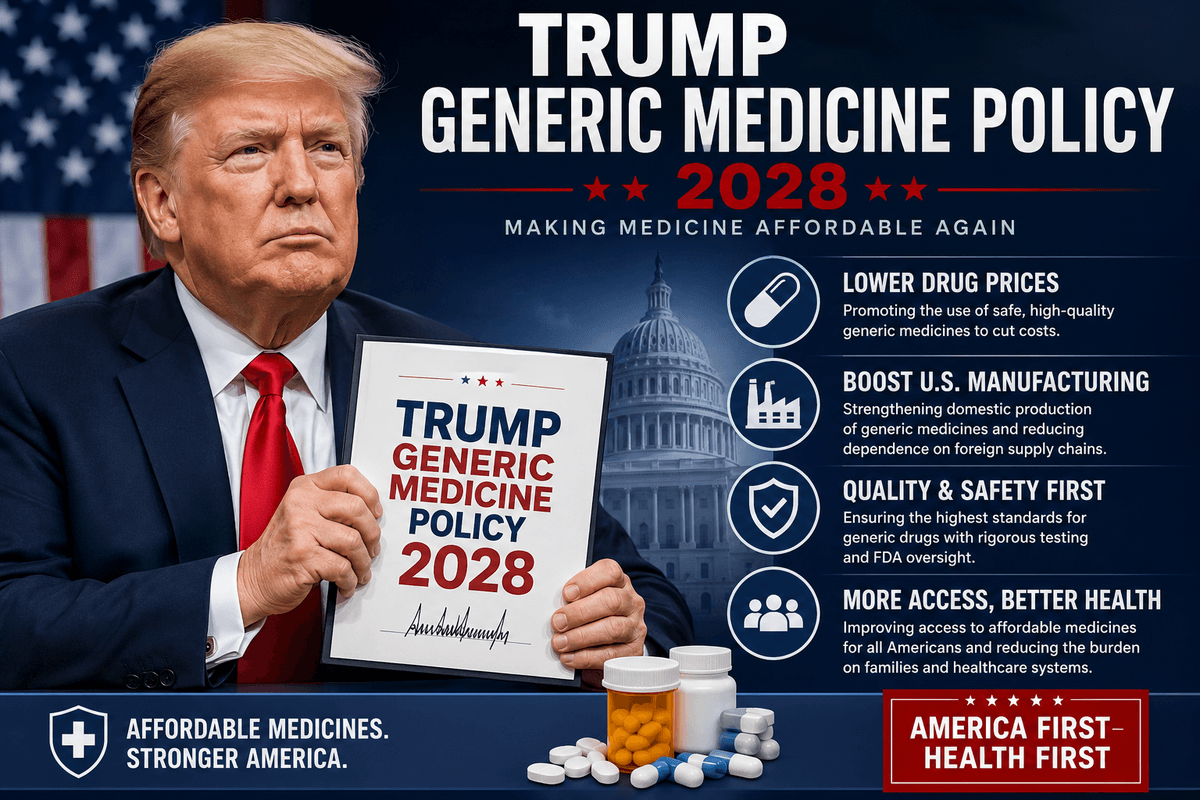
💊Trump Generic Medicine Policy 2028: What It Means
From August 2028, imported generic drugs face 100% U.S. tariffs (then 200%). Here's the timeline, why India is most exposed, and what patients and pharma should watch.
Scanura Editorial
Health Education Team
Written by Scanura Editorial for health education. This article is not a substitute for advice from a qualified doctor. About our editorial standards
Trump Generic Medicine Policy 2028: What It Means for India and Patients
On July 22, 2026, U.S. President Donald Trump announced a phased tariff plan for imported generic drugs. The message was blunt: companies get two years of zero tariffs to move manufacturing into America — then face steep penalties if they keep importing.
For Indian patients, doctors, and the pharmaceutical industry, this matters. India supplies nearly half of all generic medicines used in the United States. Here is a clear breakdown of the policy, the 2028 deadline, and what could change.
What Did Trump Announce?
In a Truth Social post, Trump set this schedule for generic drugs brought into the United States:
| Stage | When | Tariff on imported generics |
|---|---|---|
| Grace period | From August 1, 2026 for two years | 0% |
| First penalty | From August 2028 for one year | 100% |
| Full penalty | From August 2029 onward | 200% |
The stated goal is to reshore generic pharmaceutical production — build plants and equipment in the U.S. — with tariffs as the stick for companies that do not relocate within the window.
Trump also said the policy on patented, branded, or innovative drugs remains unchanged. Generics are on a separate track.
Why 2028 Matters
August 2028 is the first real cliff. Until then, imported generics stay tariff-free under this plan. That runway is intentional:
- Time to build — Pharmaceutical plants need capital, FDA inspections, skilled labor, and supply chains. Two years is short for a greenfield plant, but enough for expansions, partnerships, or contract-manufacturing deals.
- Time to negotiate — India and other exporters can seek exemptions, investment commitments, or trade offsets before tariffs bite.
- Political calendar — 2028 is a U.S. election year. Analysts note that New Delhi and industry may hope the rule is softened, delayed, or rewritten before it fully lands.
After 2028, a 100% tariff effectively doubles the landed cost of an imported generic (before the later jump to 200%). On thin-margin products, that can make continued export commercially impossible.
How This Differs from Branded Drug Policy
It helps to keep three Trump-era drug tools straight:
1. Generic drug tariffs (this announcement)
- Targets imported generics
- Zero → 100% (2028) → 200% (2029+)
- Goal: force U.S. manufacturing of low-cost medicines
2. Section 232 tariffs on patented / branded products
- Earlier, the administration imposed a 100% levy on many patented pharmaceutical products and ingredients, with phase-in windows for large and small makers
- Generics, biosimilars, and related ingredients had been exempt — until this new phased plan for generics
3. Most-Favored-Nation (MFN) pricing
- Aims to stop Americans paying more than patients in other wealthy countries for branded sole-source drugs
- Over a dozen major firms (including Eli Lilly, Pfizer, and Novo Nordisk) struck deals to lower prices
- Participating companies can get tariff exemptions for three years
- The White House has described large projected savings from voluntary MFN agreements; generics were largely left out of MFN because competition already keeps many generic prices low in the U.S.
Bottom line: MFN squeezes brand prices. The 2028 plan squeezes where generics are made.
Why India Is at the Center
| Fact | Why it matters |
|---|---|
| India supplies ~50% of U.S. generic prescriptions | Any tariff shock hits Indian exporters first |
| The U.S. takes ~one-third of India's pharma exports | Export earnings and jobs are exposed |
| Many ordinary generics have razor-thin margins | A 100–200% tariff may force product exits, not just price hikes |
| China dominates many APIs (active ingredients) | Even "Made in USA" pills may still depend on overseas inputs |
Trade experts warn that building U.S. plants is costly and complex. Even with a 200% tariff threat, the "fundamental math" of low-cost generics may not flip overnight — especially if key ingredients still come from abroad.
For New Delhi, the two-year window is a negotiation and investment period: lobby for relief, pledge U.S. facilities, secure FDA approvals, and diversify into other markets.
What Could Happen to Patients?
In the United States
- Short term (through mid-2028): Little immediate change for pharmacy shelves if supply continues under 0% tariffs.
- After August 2028: Possible outcomes include higher wholesale prices for imported generics, formulary switches, shortages of low-margin drugs, or more U.S.-made alternatives if capacity actually arrives.
- Risk: If manufacturers exit certain molecules rather than reshore, patients could face scarcity — not just higher prices — for specific cheap generics.
In India
- Domestic Indian patients mainly buy India-made generics for the local market. A U.S. tariff does not automatically raise your strip of metformin or amlodipine at the chemist.
- Indirect effects are real: company revenue, plant utilization, R&D budgets, and export mix may shift. Firms may prioritize markets with clearer access or push harder into regulated markets other than the U.S.
- Jobs and investment in export-heavy hubs (Hyderabad, Ahmedabad, etc.) could be affected if U.S. volumes fall sharply after 2028.
If your doctor changes a brand or asks you to switch generics because of supply, ask why — and confirm the new medicine is therapeutically equivalent.
What Pharma Companies Are Likely to Do
Expect a mix of strategies during the grace period:
- Announce or accelerate U.S. plants — or partner with U.S. contract manufacturers
- Lobby for product- or company-level exemptions
- Shift portfolios — exit ultra-low-margin SKUs; protect higher-value generics and complex products
- Diversify exports — Europe, Latin America, Africa, and other Asia markets
- Stockpile / front-load ahead of tariff cliffs where commercially and legally allowed
- API and fill-finish strategy — rethink how much of the chain must sit on U.S. soil to qualify as "domestic"
Patients and clinicians should watch FDA shortage lists and pharmacy substitution patterns more than political headlines alone.
Timeline at a Glance
Aug 1, 2026  →  0% tariff on imported generics (2-year window opens)
Aug 2028     →  100% tariff for one year
Aug 2029     →  200% tariff thereafter
Branded / patented drug rules and MFN deals continue on their own track.
Practical Questions People Ask
Will my medicines in India get expensive because of this?
Not automatically. Indian retail prices are set by local competition, NPPA rules (where applicable), and domestic supply — not by U.S. import tariffs. Watch for company-specific changes, not a blanket India price spike.
Does this apply to biosimilars too?
Trump's July 2026 post focused on generic drugs. Earlier Section 232 framing had treated generics and biosimilars differently from patented products. Treat biosimilars as a separate category until formal implementing rules clarify coverage.
Is this already law?
It was announced as administration policy via the president's statement. Final implementation can still involve agency rulemaking, legal challenges, and trade negotiations. Track official U.S. government notices for the binding details.
What should Indian exporters do first?
Map U.S. revenue by product, stress-test margins at 100% and 200% tariffs, and decide which SKUs justify U.S. capacity versus market exit or diversification — then engage trade and FDA strategy early.
What scanura Readers Should Remember
scanura helps you understand lab reports in plain language. Drug tariff policy will not change how to read your CBC or HbA1c — but it can change availability and cost of some medicines over time.
If a pharmacy says a usual generic is unavailable or much costlier after 2028:
- Ask for an equivalent substitute
- Confirm dose and strength with your doctor
- Do not skip chronic medicines without medical advice
- Upload related lab reports to scanura when your doctor is monitoring treatment response
Key Takeaways
- Trump announced 0% tariffs on imported generics for two years from August 1, 2026, then 100% from August 2028, then 200% from August 2029.
- The aim is to force generic manufacturing into the United States.
- Branded / patented drug policy and MFN pricing remain separate.
- India is highly exposed: ~50% of U.S. generics and ~one-third of India's pharma exports.
- Patients in India may see little direct retail impact, but exporters face a major strategic deadline.
- Building U.S. capacity is hard; some low-margin drugs may exit rather than reshore.
- Treat this as a live policy story — exemptions, talks, and legal fights can still reshape the 2028 cliff.
Disclaimer: This article is for educational and informational purposes only. It summarizes publicly reported policy announcements as of July 22, 2026 and is not legal, investment, or medical advice. Tariff rates, exemptions, and implementation details may change. Always consult a qualified doctor for medication decisions and rely on official government sources for trade compliance.
Medical References
Step-by-Step Guide
- 1
Know the three tariff stages
Zero tariff from August 1, 2026 for two years; 100% from August 2028 for one year; 200% from August 2029 onward for imported generics.
- 2
Separate generics from branded policy
Patented/branded drug tariffs and Most-Favored-Nation pricing deals are a different track — this announcement is specifically about generics.
- 3
Watch India supply risk
India supplies nearly half of U.S. generic prescriptions. Track company statements on U.S. plants, FDA filings, and product exits.
- 4
For patients: ask about alternatives
If a specific generic becomes scarce or costlier after 2028, ask your doctor or pharmacist about therapeutic equivalents and formulary changes.
- 5
For manufacturers: use the runway
The two-year grace period is meant for building U.S. capacity, seeking exemptions, or diversifying markets before tariffs bite.
- 6
Follow official updates
Tariff rates and exemptions can change through trade talks and rulemaking. Rely on White House, USTR, and FDA notices — not only headlines.
📬 One health report guide, every week
Normal ranges, what your values mean, and what to ask your doctor — in plain language. Free, unsubscribe anytime.