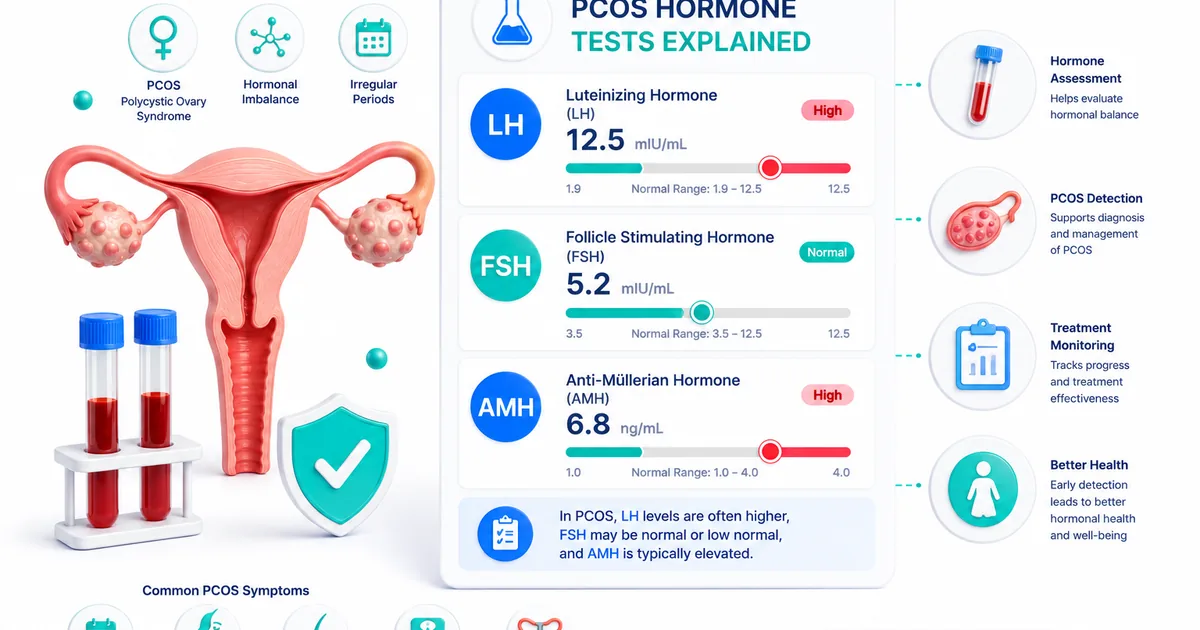
🌸PCOS Hormone Tests Explained: LH, FSH, AMH, Testosterone & More
Diagnosed with PCOS or suspect you might have it? Your hormone panel holds key answers. Here's exactly what LH, FSH, AMH, testosterone, and prolactin levels mean in plain language.
Scanura Editorial
Health Education Team
Written by Scanura Editorial for health education. This article is not a substitute for advice from a qualified doctor. About our editorial standards
PCOS Hormone Tests Explained: LH, FSH, AMH, Testosterone & More
Polycystic Ovary Syndrome (PCOS) — called PCOD in India — affects an estimated 1 in 5 Indian women of reproductive age. It's one of the most common hormonal disorders in the world, and one of the most misunderstood.
If your doctor has ordered a hormone panel, or if you've been told your report is "abnormal", this guide will walk you through every value.
What Is PCOS, Actually?
PCOS is a hormonal imbalance where the ovaries produce excess androgens (male hormones), disrupting the normal cycle of egg development and release. The result:
- Irregular or absent periods
- Small fluid-filled follicles on the ovaries ("cysts" — actually immature eggs that didn't release)
- Symptoms of excess androgens: acne, facial hair (hirsutism), hair thinning on the scalp
- Difficulty conceiving
- Insulin resistance and weight gain
It is diagnosed using the Rotterdam Criteria — you need at least 2 of these 3:
- Irregular or absent periods
- Clinical or biochemical signs of high androgens
- Polycystic ovaries on ultrasound
Blood tests confirm the biochemical picture.
The PCOS Hormone Panel — What Gets Tested
| Hormone | What It Does | When to Test |
|---|---|---|
| LH | Triggers ovulation | Day 2–3 of cycle |
| FSH | Stimulates follicle growth | Day 2–3 of cycle |
| AMH | Reflects egg reserve and follicle count | Any day |
| Estradiol (E2) | Main female sex hormone | Day 2–3 of cycle |
| Total Testosterone | Primary androgen | Any day (morning preferred) |
| Free Testosterone | Active androgen fraction | Any day |
| DHEA-S | Adrenal androgen | Any day |
| Prolactin | Hormone from pituitary gland | Any day (fasting, morning) |
| TSH | Thyroid function | Any day |
| Fasting Insulin | Checks insulin resistance | Fasting |
LH and FSH — The Ovulation Signals
Normal Values (Day 2–3)
| Hormone | Normal Range |
|---|---|
| LH | 2 – 15 mIU/mL |
| FSH | 3 – 10 mIU/mL |
| LH/FSH Ratio | Approximately 1:1 |
In a normal cycle, FSH rises first to stimulate follicle growth. LH then surges to trigger ovulation. In PCOS, LH is chronically elevated while FSH stays relatively low — the ratio flips.
LH/FSH ratio above 2:1 is a classic PCOS pattern. It means the pituitary gland is sending excess LH, overstimulating androgen production and disrupting the ovulation process.
Note: An isolated LH/FSH ratio is not diagnostic. It must be interpreted with symptoms and ultrasound findings.
AMH — Anti-Müllerian Hormone
AMH is produced by small follicles in the ovaries. It reflects how many follicles — and therefore how many potential eggs — your ovaries contain.
Normal Ranges
| Level | Interpretation |
|---|---|
| Above 4–5 ng/mL | High — suggests PCOS (large follicle pool) |
| 1 – 4 ng/mL | Normal reproductive age range |
| 0.5 – 1 ng/mL | Low — reduced ovarian reserve |
| Below 0.5 ng/mL | Very low — poor ovarian reserve |
In PCOS, AMH is typically elevated because there are more small follicles than normal — but they fail to mature and release an egg.
AMH is also used to assess ovarian reserve in women planning to conceive or considering egg freezing — it is the most reliable single marker for this purpose.
Testosterone and Androgens
Total Testosterone (Women)
| Level | Interpretation |
|---|---|
| 20 – 70 ng/dL | Normal |
| Above 70 ng/dL | Elevated — hyperandrogenism |
| Above 150 ng/dL | Significantly elevated — rule out tumour |
Elevated testosterone explains the acne, hirsutism (facial and body hair), and scalp hair thinning in PCOS.
DHEA-S (Dehydroepiandrosterone Sulfate)
| Level | Interpretation |
|---|---|
| Women 18–50 | 44 – 332 mcg/dL (normal) |
| Elevated | Suggests adrenal contribution to androgen excess |
DHEA-S comes from the adrenal glands, not the ovaries. If DHEA-S is very high, your doctor may investigate adrenal causes of androgen excess alongside PCOS.
Prolactin — The Mimic
Normal Range
| Level | Interpretation |
|---|---|
| Below 25 ng/mL | Normal |
| 25 – 100 ng/mL | Mildly elevated — retest (stress, medications, timing affect results) |
| Above 100 ng/mL | Significantly elevated — pituitary evaluation needed |
High prolactin (hyperprolactinaemia) causes irregular periods and can completely mimic PCOS. A pituitary tumour (prolactinoma) — usually benign — is the most common cause of very high prolactin.
This is why prolactin must always be tested before confirming PCOS.
TSH — The Other Mimic
Hypothyroidism causes irregular cycles, weight gain, and hair loss — all overlapping with PCOS symptoms. TSH above 4 mIU/L should be treated before attributing all symptoms to PCOS.
Insulin Resistance and PCOS
Up to 70% of women with PCOS have some degree of insulin resistance — even those who are not overweight. High insulin stimulates the ovaries to produce more androgens, driving the hormonal imbalance.
Fasting Insulin
| Level | Interpretation |
|---|---|
| Below 10 mcIU/mL | Normal |
| 10 – 25 mcIU/mL | Borderline insulin resistance |
| Above 25 mcIU/mL | Significant insulin resistance |
If insulin resistance is confirmed, treatment often includes metformin alongside lifestyle changes — even without diabetes.
What a Typical PCOS Report Looks Like
| Test | PCOS Pattern |
|---|---|
| LH | High |
| FSH | Normal or low |
| LH/FSH Ratio | Above 2 |
| AMH | High (above 4–5 ng/mL) |
| Total Testosterone | High or high-normal |
| DHEA-S | Normal or mildly high |
| Prolactin | Normal |
| TSH | Normal |
| Fasting Insulin | Elevated |
Treatment Overview
PCOS has no cure, but it is very manageable:
- Lifestyle: Even 5–10% weight loss significantly improves hormone balance and restores ovulation in many women
- Metformin: Addresses insulin resistance; often restores regular cycles
- Oral contraceptive pills (OCPs): Regulate cycles and reduce androgen effects on skin and hair
- Anti-androgens (spironolactone): For significant hirsutism and acne
- Fertility treatment: Letrozole or clomiphene to induce ovulation when trying to conceive
How scanura Helps
Upload your hormone panel to scanura:
- Calculate and flag LH/FSH ratio automatically
- Explain each hormone in context of your cycle day
- Identify if prolactin or TSH findings need to be ruled out first
- Track how your hormone levels change with treatment over time
Disclaimer: This article is for educational purposes only. scanura does not provide medical diagnosis. Always consult your doctor or gynaecologist for medical decisions.
Medical References
Step-by-Step Guide
- 1
Time your blood test correctly
Most hormone tests (LH, FSH, estradiol) should be done on Day 2 or Day 3 of your menstrual cycle. AMH can be done on any day. Ask your doctor for the right timing.
- 2
Check the LH/FSH ratio
Normal ratio is roughly 1:1. A ratio above 2:1 (LH higher than FSH) is a classic PCOS pattern and suggests disrupted ovulation signalling.
- 3
Review AMH levels
AMH above 4–5 ng/mL in a reproductive-age woman suggests high antral follicle count — a key PCOS marker. Below 1 ng/mL suggests low ovarian reserve.
- 4
Check testosterone and DHEA-S
Total testosterone above 70 ng/dL or free testosterone elevated alongside DHEA-S above range confirms hyperandrogenism — a core PCOS feature.
- 5
Rule out thyroid and prolactin issues
Thyroid dysfunction and high prolactin can mimic PCOS symptoms perfectly. Always check TSH and prolactin before confirming a PCOS diagnosis.
- 6
Combine with ultrasound
Blood tests alone don't diagnose PCOS. The Rotterdam criteria require at least 2 of 3: irregular cycles, high androgens, polycystic ovaries on ultrasound.
📬 One health report guide, every week
Normal ranges, what your values mean, and what to ask your doctor — in plain language. Free, unsubscribe anytime.