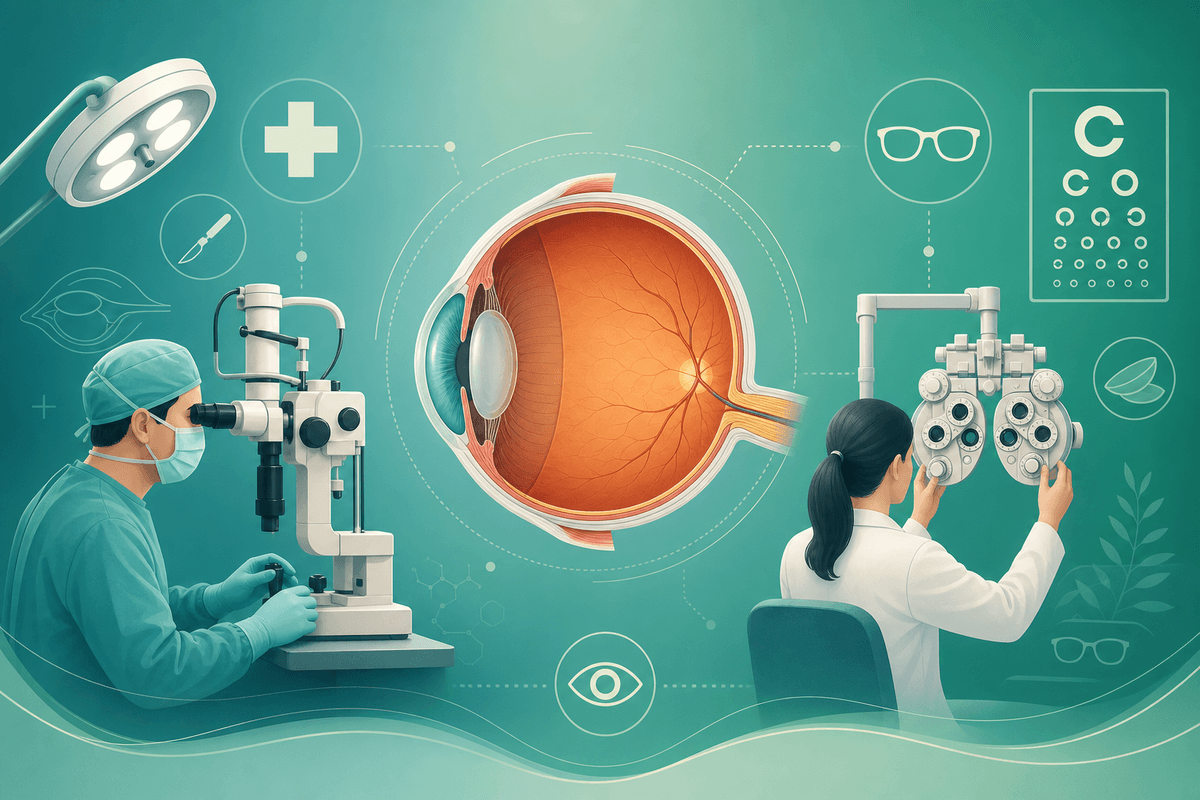
👁️Ophthalmologist vs Optometrist: Who Should You See?
Blurry vision, red eyes, or needing new glasses? Ophthalmologists and optometrists both care for eyes — but training, treatments, and when to see each one are very different.
Scanura Editorial
Health Education Team
Written by Scanura Editorial for health education. This article is not a substitute for advice from a qualified doctor. About our editorial standards
Ophthalmologist vs Optometrist: Who Should You See?
Your vision is blurry. The optical shop says you need an “eye check.” A relative says go to an “eye doctor.” Another says only an “eye surgeon” can help. In India, people often use eye doctor, spectacle doctor, and netra specialist interchangeably — but ophthalmologist and optometrist are not the same profession.
Both protect your sight. Their training, legal scope, and the problems they handle differ a lot. Choosing the wrong door rarely ruins a routine glasses visit — but delaying an ophthalmologist for sudden vision loss, severe pain, or diabetic eye disease can.
This 2026 guide explains what each specialist does, how training works in India, where opticians fit in, and a simple rule for who to see first.
The 30-Second Answer
| Question | Short answer |
|---|---|
| Who is an ophthalmologist? | A medical doctor (MBBS + eye specialty) who diagnoses and treats eye disease, gives medicines, and performs surgery |
| Who is an optometrist? | A vision-care professional (typically B.Optom / M.Optom) who examines eyes, detects many problems, and prescribes glasses or contact lenses |
| Who is an optician? | A dispensing professional who fits and supplies spectacles/lenses from a prescription — usually does not diagnose disease |
| Glasses or routine blur? | Start with an optometrist (or ophthalmology OPD if preferred) |
| Surgery, injections, complex disease, emergencies? | See an ophthalmologist |
What Is an Ophthalmologist?
An ophthalmologist is a physician and surgeon specialising in the eye and its related structures (lids, orbit, tear system, and visual pathways as they relate to eye disease).
Typical training path in India
- MBBS (medical school)
- Postgraduate specialty: MS Ophthalmology, DNB Ophthalmology, or equivalent
- Optional fellowship (retina, cornea, glaucoma, paediatric ophthalmology, oculoplasty, etc.)
Because they are medical doctors, ophthalmologists can:
- Diagnose and manage eye disease (cataract, glaucoma, uveitis, retinal detachment, diabetic retinopathy, macular degeneration, corneal ulcers, and more)
- Prescribe eye drops, oral medicines, and injections
- Perform surgery (cataract, glaucoma, retina, cornea transplant, lid surgery, laser procedures, and more)
- Interpret how systemic diseases (diabetes, hypertension, thyroid disease, autoimmune illness) affect the eyes
- Order and interpret specialised imaging (OCT, fundus photos, visual fields, fluorescein angiography) in clinical context
In hospital language, this is the person you meet in eye OPD / eye OT — the “eye surgeon” relatives often mean, even when surgery is not yet needed.
What Is an Optometrist?
An optometrist is a primary vision-care professional. Their core job is to assess how well you see, refine the optical correction you need, and screen for eye problems that may need medical or surgical care.
Typical training path in India
- Bachelor of Optometry (B.Optom) — usually 4 years including clinical training
- Optional Master of Optometry (M.Optom) or specialty training (contact lenses, low vision, binocular vision, etc.)
Optometrists commonly:
- Perform refraction (finding your spectacle or contact-lens power)
- Check visual acuity, binocular vision, and basic eye health screening
- Fit contact lenses and counsel on hygiene/safety
- Provide low-vision aids and vision therapy in some settings
- Detect signs of disease (high eye pressure suspicion, cataract clouding, diabetic changes, red-eye patterns) and refer to an ophthalmologist
- Work in optical chains, hospitals, community screening camps, and corporate eye clinics
Important nuance for India: scope of practice can vary by state, employer, and clinic protocol. Many excellent hospital eye departments run optometry refraction lanes alongside ophthalmology OPD — a team model, not a rivalry.
Ophthalmologist vs Optometrist: Side-by-Side
| Feature | Ophthalmologist | Optometrist |
|---|---|---|
| Core identity | Medical doctor + eye surgeon/specialist | Vision and primary eye-care professional |
| Degree (typical India) | MBBS + MS/DNB Ophthalmology | B.Optom (± M.Optom) |
| Prescribes glasses/contacts | Yes | Yes (major part of practice) |
| Prescribes medical treatment | Yes (full medical/surgical armamentarium) | Limited / protocol-dependent; disease care usually referred |
| Performs eye surgery | Yes | No |
| Manages cataract, glaucoma, retina disease | Yes — diagnosis and treatment | Screens and refers; may co-manage in some centres |
| Best first stop for | Pain, sudden vision change, known eye disease, diabetes eye review, surgery opinion | Routine blur, annual vision check, new glasses/contacts |
| Common workplace | Hospitals, specialty eye institutes, surgical centres | Optical clinics, hospitals, screening programmes |
Don’t Forget the Optician
A third title confuses families at the counter:
| Role | What they do |
|---|---|
| Optician | Makes, fits, and dispenses spectacles or optical devices from a valid prescription; advises on frames, lens coatings, and fit |
| Not usually | Full medical diagnosis, disease treatment, or eye surgery |
Buying frames without a proper eye exam is common — and risky if you have diabetes, high myopia, glaucoma risk, or unexplained headaches. A good optical store will insist on a recent refraction and flag red-eye or sudden change for clinical review.
Who Should You See for Common Problems?
Usually start with an optometrist
- Gradual blur for distance or near (possible refractive error / reading glasses)
- Wanting new spectacles or contact lenses
- School vision screening follow-up when the child is otherwise well
- Workplace computer-strain check when there is no pain or sudden vision loss
See an ophthalmologist (or go to eye emergency)
- Sudden vision loss or a curtain/shadow over vision
- New flashes of light with many floaters (possible retinal tear/detachment risk)
- Severe eye pain, nausea with eye pain, halos around lights (possible acute glaucoma)
- Eye injury, chemical splash, or foreign body you cannot safely remove
- Red eye with light sensitivity, discharge, or vision drop after contact-lens wear
- Known cataract, glaucoma, uveitis, or retinal disease
- Diabetes or long-standing hypertension — periodic dilated retinal exam
- Children with squint (strabismus), white pupil reflex in photos, or suspected lazy eye
- Second opinion before eye surgery
Either may be appropriate — follow local referral
- Mild red eye without vision loss (triage matters)
- Dry eye symptoms
- Gradual cataract symptoms (blur, glare, night-driving trouble) — optometrist may detect; ophthalmologist decides surgery timing
- Headache attributed to “eye power” — refraction helps, but persistent headache needs a broader medical look
When labs or systemic reports (HbA1c, lipid profile, thyroid panel) sit beside your eye file, tools like scanura can explain the PDF in plain language so you walk into the eye clinic prepared — especially for diabetic retinopathy follow-ups where sugar control and retinal findings travel together.
Why the Confusion Is So Common in India
- Language overlap — “eye doctor” covers everyone from a refractionist to a vitreoretinal surgeon.
- Optical-shop culture — many families’ first eye contact is a mall spectacle counter, not a hospital OPD.
- Team clinics — large eye hospitals correctly use optometrists for refraction and ophthalmologists for disease/surgery. Patients meet both and merge the titles.
- Cost anxiety — people fear “surgeon” equals expensive operation. An ophthalmology consult is often evaluation, drops, or monitoring — not automatic OT booking.
- Social media shortcuts — posts that say “never trust optometrists” or “skip ophthalmologists for glasses” are both wrong. Scope differs; quality varies by individual clinician and centre.
Training Depth vs Everyday Need
Think of it like dentistry vs a teeth-cleaning specialist vs a dental lab technician — imperfect analogy, but useful:
- You do not need a retinal surgeon to update reading glasses.
- You should not rely on a spectacle fitting alone for sudden vision loss.
- The best outcomes happen when optometry and ophthalmology refer to each other early.
A careful optometrist who says “this needs a retina opinion” has done excellent work. An ophthalmologist who sends you back for a precise contact-lens fit after treating a corneal issue has also done excellent work.
Cost and Access (Practical India Notes)
Exact fees vary by city and hospital, but patterns are familiar:
| Service | Typical setting |
|---|---|
| Refraction + glasses prescription | Optometry clinic / optical chain / hospital refraction desk |
| Comprehensive eye exam with dilation | Ophthalmology OPD (often with optometry support) |
| Cataract / glaucoma / retina procedures | Ophthalmology surgical centres |
| Government and NGO camps | High-volume screening; positive findings need hospital confirmation |
Insurance and package schemes usually cover disease treatment and surgery under ophthalmology, not routine fashion eyewear. Ask the hospital billing desk before assuming a “power check” is a full medical eye evaluation.
How to Prepare for Either Visit
- List symptoms: onset (sudden vs gradual), one eye or both, pain, redness, discharge, headache, trauma.
- Bring old spectacles and any previous prescription slip.
- Note diabetes, BP medicines, thyroid disease, steroids, and prior eye surgery.
- If you wear contacts, carry the lens brand/type and be ready to remove them for some tests.
- For dilated exams, arrange a drop home — reading and driving may be uncomfortable for a few hours.
- Write one clear question: “Do I only need glasses, or is there disease?”
When to Worry (Do Not Wait for a Spectacle Appointment)
Seek urgent ophthalmology / emergency care for:
- Sudden blackness, severe blur, or visual field cut
- Severe pain, especially with vomiting or coloured halos
- Chemical injury (irrigate with clean water immediately, then emergency care)
- Trauma, especially with metal/glass or after high-velocity injury
- Post-surgery sudden pain, vision drop, or increasing redness
- Contact-lens wearer with painful red eye (infection risk)
These are not “power problems.” Minutes and hours matter more than frames and coatings.
Key Takeaways
- An ophthalmologist is a medical doctor who treats eye disease and performs surgery.
- An optometrist is a vision-care professional focused on refraction, glasses/contacts, and screening — with referral when disease is suspected.
- An optician dispenses and fits eyewear from a prescription; they are not a substitute for disease diagnosis.
- Routine blur and new glasses → optometrist is often the right first stop.
- Pain, sudden vision change, diabetes eye disease, cataract/glaucoma/retina care, surgery → ophthalmologist.
- In many Indian hospitals, both work as a team — refraction lanes plus specialty OPD.
- Delaying emergency eye symptoms for a mall optical visit is unsafe.
- Bring your medical history and old glasses; ask explicitly whether the issue is refractive, medical, or both.
Disclaimer: This article is for educational purposes only. scanura does not provide medical diagnosis. Eye-care titles, training pathways, and legal scope of practice can vary by country and Indian state. Always consult a qualified ophthalmologist, optometrist, or your physician for personal medical decisions — especially for sudden vision changes, eye pain, injury, or known eye disease.
Medical References
Step-by-Step Guide
- 1
Name your main problem
Is it routine blur needing glasses, sudden vision loss, eye pain, diabetes eye check, or a known disease like cataract or glaucoma?
- 2
Start with the right door
For glasses, contact lenses, and routine vision checks, an optometrist is often enough. For surgery, injections, or complex disease, see an ophthalmologist.
- 3
Do not ignore red flags
Sudden vision loss, flashing lights with new floaters, severe eye pain, chemical injury, or trauma need emergency ophthalmology care — not a spectacle shop visit.
- 4
Bring your history
List diabetes, hypertension, thyroid disease, previous eye surgery, and current eye drops or steroid use before the appointment.
- 5
Know the third role
An optician fits and dispenses glasses or lenses from a prescription — they do not diagnose eye disease or perform surgery.
- 6
Follow the referral chain
Many optometrists refer you to an ophthalmologist when disease is suspected. That hand-off is normal, not a failure of the first visit.
📬 One health report guide, every week
Normal ranges, what your values mean, and what to ask your doctor — in plain language. Free, unsubscribe anytime.