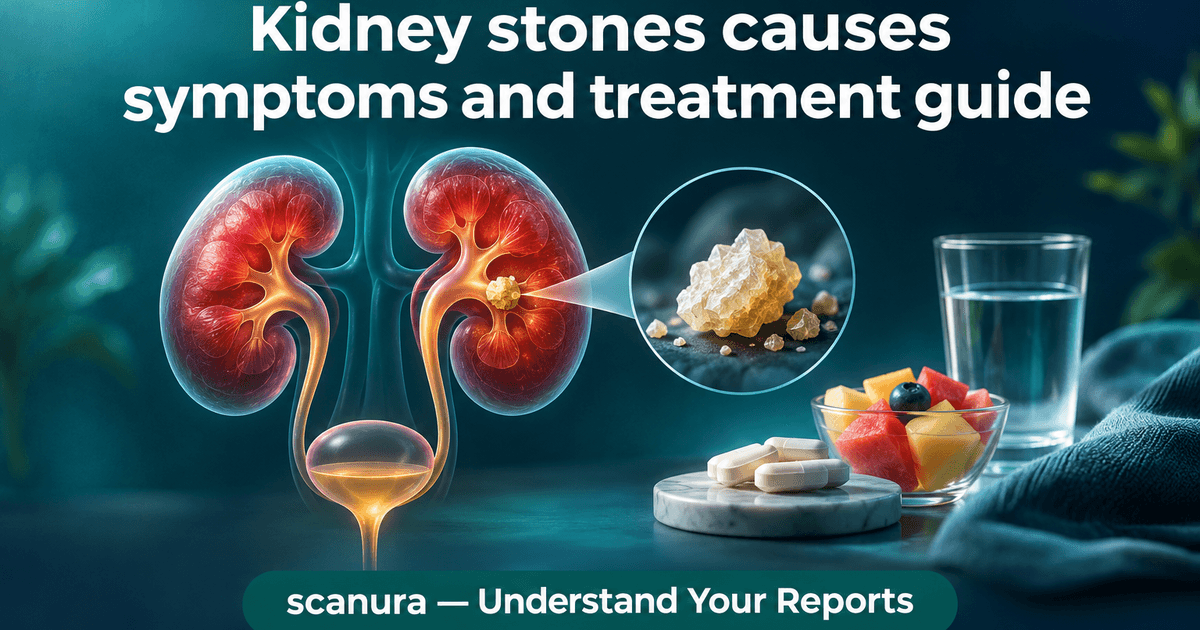
🫘Kidney Stones: Causes, Symptoms & When to Worry
Kidney stones affect 1 in 10 people and searches spike in summer. Here's how stones form, what the pain feels like, which tests confirm them, and when you need urgent care.
Scanura Editorial
Health Education Team
Written by Scanura Editorial for health education. This article is not a substitute for advice from a qualified doctor. About our editorial standards
Kidney Stones: Causes, Symptoms & When to Worry
A kidney stone is a hard deposit of minerals and salts that forms inside your kidney. About 1 in 10 people will have a kidney stone at some point, and searches for "what causes kidney stones" are among the most common health questions in the US and UK — especially in summer, when heat and dehydration drive rates up.
This guide explains how stones form, what the pain feels like, which tests confirm them, and when you need urgent care. It is not a substitute for a urologist or emergency evaluation.
What Is a Kidney Stone?
Your urine contains dissolved minerals — calcium, oxalate, uric acid, and others. When urine becomes too concentrated, these minerals crystallize and stick together, forming a stone. Stones can range from a grain of sand to a golf ball.
| Stone Type | What It's Made Of | Common Cause |
|---|---|---|
| Calcium oxalate | Calcium + oxalate | Most common; high oxalate foods, low calcium intake, dehydration |
| Calcium phosphate | Calcium + phosphate | Often linked to metabolic conditions or urinary tract infections |
| Uric acid | Uric acid | High-protein diet, gout, diabetes, dehydration |
| Struvite | Magnesium ammonium phosphate | Urinary tract infections; can grow large quickly |
| Cystine | Cystine (amino acid) | Rare genetic disorder (cystinuria) |
Symptoms: What the Pain Feels Like
Small stones may pass without symptoms. Larger stones usually cause:
- Severe flank or side pain — often sharp, cramping, and waves of intensity (renal colic)
- Pain radiating to the lower abdomen and groin
- Painful urination or urgency
- Pink, red, or brown urine (blood)
- Cloudy or foul-smelling urine (possible infection)
- Nausea and vomiting
- Fever and chills — always concerning with stone pain
Pain often starts suddenly and may come in waves as the stone moves through the urinary tract.
Causes and Risk Factors
| Factor | How It Raises Risk |
|---|---|
| Dehydration | Concentrated urine lets minerals crystallize |
| High-salt diet | More calcium in urine |
| High animal protein | More uric acid, less citrate (a natural stone inhibitor) |
| Obesity | Linked to higher stone risk |
| Digestive diseases | Crohn's, gastric bypass — affect calcium/oxalate absorption |
| Family history | Personal or family history of stones |
| Certain medications | Some diuretics, calcium-based antacids, topiramate |
| Recurrent UTIs | Can lead to struvite stones |
Heat and sweating without enough fluid replacement — common in summer in the US and UK — is a major trigger.
Tests That Confirm a Kidney Stone
| Test | What It Shows |
|---|---|
| Non-contrast CT scan | Gold standard; finds almost all stones, shows size and location |
| Kidney ultrasound | No radiation; good for pregnant people; may miss small stones |
| Urinalysis | Checks for blood, infection, crystals |
| Blood tests | Kidney function (creatinine), calcium, uric acid |
| Stone analysis | If you pass or have a stone removed, testing its composition guides prevention |
A CT scan is usually done in the ER when stone pain is severe. Ultrasound is often first-line for children and pregnant people.
Treatment: Depends on Size and Symptoms
Small stones (under 5 mm) — often pass on their own
- Drink plenty of water — aim for 2.5–3 litres daily so urine is pale
- Pain relief — paracetamol (acetaminophen) or ibuprofen as directed
- Medical expulsive therapy — a doctor may prescribe tamsulosin to relax the ureter and help the stone pass
- Strain your urine — catch the stone for analysis
Larger stones or stones causing blockage — may need procedures
| Procedure | When Used |
|---|---|
| Shock wave lithotripsy | Sound waves break the stone into smaller pieces |
| Ureteroscopy | A scope removes or breaks up the stone |
| Percutaneous nephrolithotomy | For very large stones; removed through a small back incision |
| Stent placement | A tube keeps the ureter open if blocked |
When to Seek Emergency Care
Go to A&E/ER immediately if you have:
- Fever and chills with flank pain — possible infected kidney (pyelonephritis), a surgical emergency
- Inability to pass urine — possible blockage
- Severe vomiting preventing fluids
- Pain so severe you cannot find a comfortable position
- Pregnancy with flank pain — always urgent
Prevention: What Lowers Your Risk
- Drink enough water — 2.5–3 litres daily (more in hot weather or if you exercise)
- Limit salt — under 5–6 g daily; sodium pushes calcium into urine
- Don't overdo animal protein — red meat, organ meats, and shellfish raise uric acid
- Get enough dietary calcium — dairy or fortified alternatives bind oxalate in the gut; don't cut calcium unless advised
- Limit high-oxalate foods if prone to calcium oxalate stones — spinach, rhubarb, beetroot, nuts, chocolate (don't eliminate entirely)
- Include citrate — lemon or lime juice in water can help inhibit stones
- Maintain a healthy weight
If you've had a stone, a 24-hour urine collection and blood tests can identify your specific risk factors.
Common Questions
Q: Can I pass a stone at home? A: Small stones (under 5 mm) often pass with fluids and pain relief. Larger stones or stones with fever, vomiting, or inability to urinate need medical care.
Q: Does cranberry juice help? A: No strong evidence for kidney stones; it's sometimes suggested for UTIs but can be high in oxalate.
Q: Will I get another stone? A: About half of people who form one stone form another within 5–10 years without prevention measures.
Key Takeaways
- Kidney stones are mineral deposits — calcium oxalate is the most common type
- Severe flank pain radiating to the groin is the classic symptom
- Dehydration and high-salt diets are top preventable causes
- Fever with stone pain is an emergency — seek urgent care
- Drink 2.5–3 litres of water daily to help prevent recurrence
Disclaimer: Educational only. Kidney stone diagnosis and treatment require evaluation by a doctor or urologist. Seek emergency care for fever, inability to urinate, or severe uncontrolled pain.
Medical References
Step-by-Step Guide
- 1
Recognise the symptoms
Severe flank or side pain radiating to the groin, blood in urine, nausea, or fever with stone pain needs medical assessment.
- 2
Get imaging if pain is severe
A non-contrast CT scan is the gold standard; ultrasound is used for pregnant people and children.
- 3
Drink plenty of water
Aim for 2.5–3 litres daily so urine stays pale; this helps small stones pass.
- 4
Manage pain safely
Use paracetamol or ibuprofen as directed; a doctor may prescribe tamsulosin to help the stone pass.
- 5
Know emergency red flags
Fever with flank pain, inability to urinate, or severe vomiting need emergency care.
- 6
Prevent recurrence
Limit salt, keep dietary calcium, and drink enough water; a 24-hour urine test can identify your specific risk factors.
📬 One health report guide, every week
Normal ranges, what your values mean, and what to ask your doctor — in plain language. Free, unsubscribe anytime.