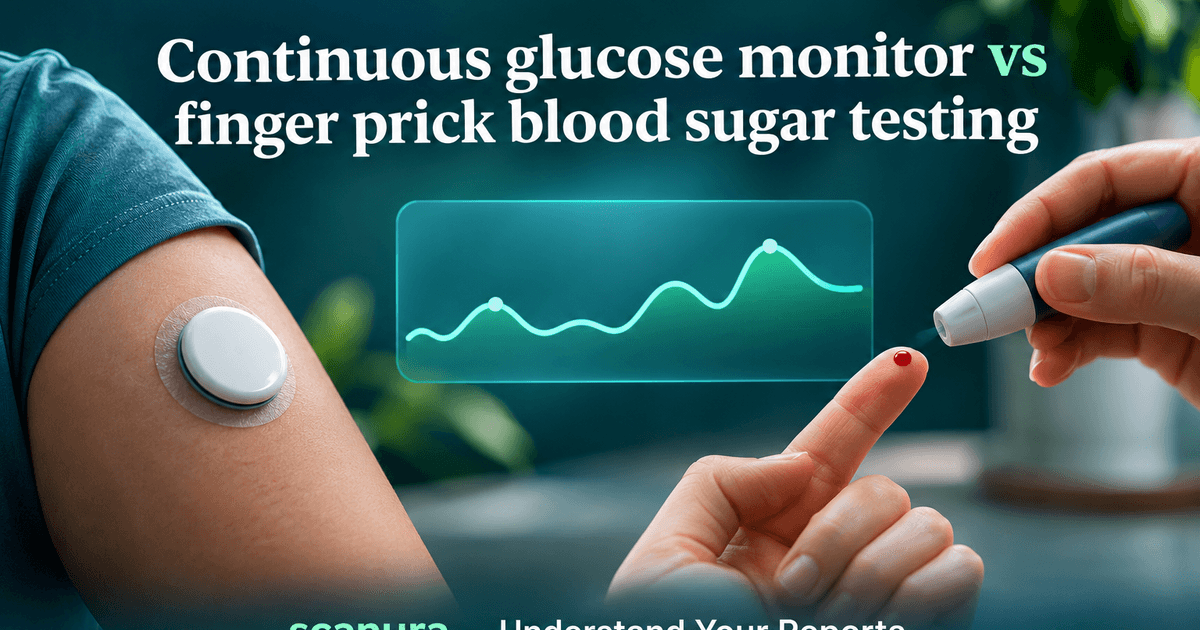
📱Continuous Glucose Monitor vs Finger-Prick: Which Blood Sugar Test?
CGMs are everywhere in 2026, but who actually needs one? Here's how continuous glucose monitoring compares with finger-prick testing, plus US and UK access and cost.
Scanura Editorial
Health Education Team
Written by Scanura Editorial for health education. This article is not a substitute for advice from a qualified doctor. About our editorial standards
Continuous Glucose Monitor (CGM) vs Finger-Prick: Which Blood Sugar Test?
Continuous glucose monitors (CGMs) are being widely discussed in 2026, fuelled by GLP-1 weight-loss drug trends and people without diabetes asking whether they should track their sugar. Here is how CGM compares with traditional finger-prick testing, who each suits, and what you need to know before buying one.
This guide explains CGM vs finger-prick, accuracy, cost, prescription rules in the US and UK, and who genuinely benefits. It is not a substitute for a GP, diabetes team, or endocrinologist.
CGM vs Finger-Prick: Side by Side
| Feature | Finger-Prick (Blood Glucose Meter) | Continuous Glucose Monitor (CGM) |
|---|---|---|
| How it works | Drop of blood on a test strip, inserted into a meter | Small sensor under skin measures glucose in interstitial fluid every few minutes |
| Frequency | Single readings when you test | Continuous readings, 24/7, with trends and alarms |
| What it shows | Glucose at that moment | Glucose now + direction (rising/falling) + graph over hours/days |
| Pain | Finger prick each time | Sensor inserted once, worn 10–14 days |
| Best for | Occasional checks, confirming a low/high | Pattern-spotting, tight control, hypo/hyper alerts |
| Prescription (US) | OTC widely available | Many require prescription; some OTC now available |
| Prescription (UK) | Available on NHS for eligible patients | NHS criteria apply; some buy privately |
| Cost | Low upfront, ongoing strip cost | Higher upfront; sensor replaced every 10–14 days |
What a CGM Actually Measures
A CGM does not measure blood glucose directly. It measures glucose in the interstitial fluid (the fluid between cells under the skin) via a tiny sensor inserted just under the skin, usually on the arm or abdomen. The reading lags blood glucose by a few minutes, which is most noticeable during rapid changes (after meals or exercise).
CGM readings are close but not identical to finger-prick results. If a CGM reading does not match how you feel — especially suspected hypoglycaemia — confirm with a finger-prick test.
Who Each Method Suits
Finger-prick may be enough if:
- You have type 2 diabetes managed with diet, exercise, or one oral medicine
- You are not on insulin or sulfonylureas (low hypo risk)
- You only need occasional checks (e.g., fasting and before meals)
- Cost or insurance coverage is a concern
CGM may be worthwhile if:
- You use insulin (type 1 diabetes, or insulin-treated type 2)
- You have frequent hypoglycaemia or hypoglycaemia unawareness
- You want to see how food, exercise, stress, and sleep affect your glucose
- You are pregnant with diabetes (tight control matters)
- You are on a GLP-1 medication and want to understand glucose response
CGM is generally NOT routinely recommended if:
- You do not have diabetes or impaired glucose regulation — there is no evidence that routine CGM improves health in people with normal glucose
- You want it purely for "wellness optimisation" without a medical reason
US vs UK Access and Cost
United States:
- Finger-prick meters and strips are available over the counter at pharmacies
- CGMs: many systems (Dexcom, FreeStyle Libre) require a prescription; some are available OTC for adults. Coverage varies by insurance plan. Medicare and Medicaid have specific eligibility criteria.
United Kingdom (NHS):
- Finger-prick testing strips are available on prescription for people with diabetes who need them
- CGM on the NHS: FreeStyle Libre is available on prescription for many people with type 1 diabetes and some with type 2 on insulin, depending on local Integrated Care Board (ICB) criteria. Dexcom and other CGMs are available for eligible patients. Private purchase is an option if you do not meet NHS criteria.
Ask your GP or diabetes team what you are eligible for.
Accuracy and Limitations
- Finger-prick is accurate when done correctly, but only tells you the moment you test. Washing hands and using a fresh strip matter.
- CGM shows trends and patterns but lags behind blood glucose. It can give false readings if the sensor is loose, compressed (lying on it), or affected by certain medications (e.g., hydroxyurea, high-dose vitamin C).
- Neither diagnoses diabetes. A diagnosis needs a fasting glucose, HbA1c, or oral glucose tolerance test interpreted by a doctor.
If You Do Not Have Diabetes
Buying a CGM "to see how food affects you" is popular, but:
- Glucose responses are highly individual; a spike after a particular food does not mean that food is harmful
- There is no evidence that CGM improves health outcomes in people with normal glucose
- Constant monitoring can cause unnecessary anxiety around normal fluctuations
- If you have symptoms (excessive thirst, frequent urination, unexplained weight loss, fatigue), see your GP for proper testing rather than self-monitoring
Questions to Ask Your Doctor or Diabetes Team
- "Am I eligible for a CGM on the NHS / through my insurance?"
- "How often should I finger-prick, and at what times?"
- "What should I do if my CGM shows a low reading but I feel fine?"
- "Which CGM is best for my insulin regimen or medication?"
- "How do I interpret CGM trend arrows and alarms?"
Key Takeaways
- Finger-prick gives one moment in time; CGM shows continuous trends
- CGM measures interstitial fluid and lags blood glucose by a few minutes
- CGM is most valuable for people on insulin or with frequent hypoglycaemia
- NHS and insurance eligibility varies — ask your GP or diabetes team
- If you do not have diabetes, CGM is not routinely recommended and will not diagnose anything
Disclaimer: Educational only. Diabetes diagnosis and monitoring require a GP, diabetes team, or endocrinologist. Do not change medication based on a CGM reading without medical advice.
Step-by-Step Guide
- 1
Check if you have diabetes or prediabetes
CGM is most valuable for people on insulin or with frequent hypoglycaemia; it does not diagnose diabetes.
- 2
Ask your GP about NHS or insurance eligibility
UK NHS CGM criteria vary by Integrated Care Board; US coverage varies by insurance plan.
- 3
Confirm CGM readings with finger-prick when needed
CGM lags blood glucose by a few minutes; verify suspected low readings with a finger-prick test.
- 4
Use CGM for trends, not single numbers
Look at direction (rising/falling) and patterns over days, not one isolated reading.
- 5
Discuss results with your diabetes team
Do not change insulin or medication based on a CGM reading without medical advice.
- 6
Avoid buying CGM if you do not have diabetes
There is no evidence CGM improves health in people with normal glucose and it can cause unnecessary anxiety.
📬 One health report guide, every week
Normal ranges, what your values mean, and what to ask your doctor — in plain language. Free, unsubscribe anytime.