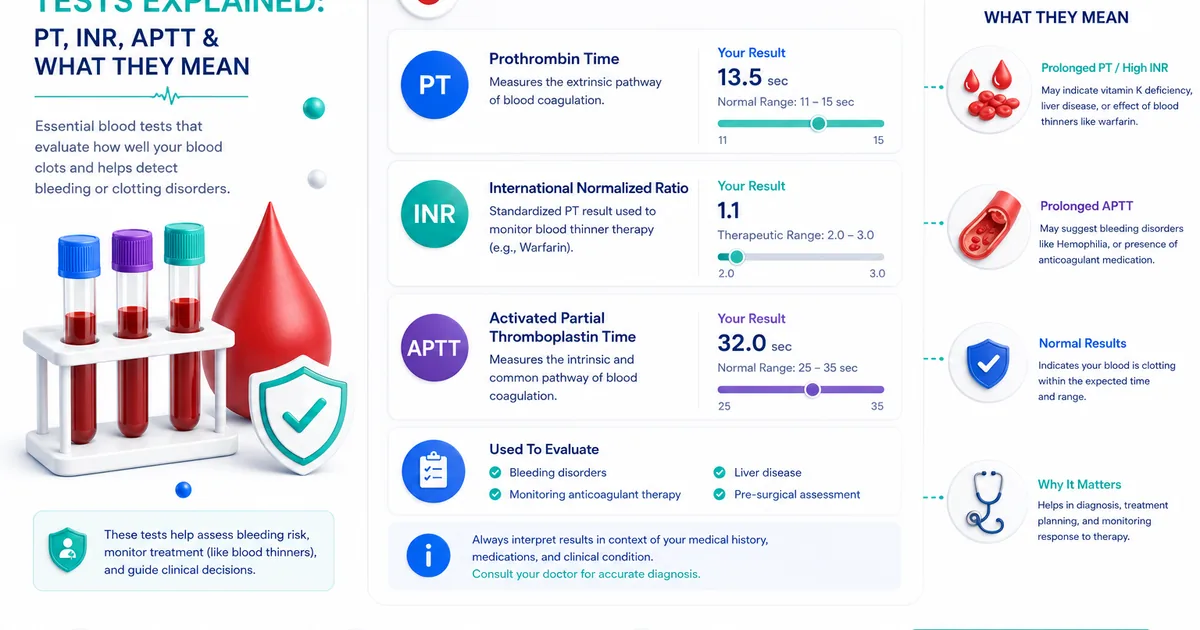
🩹Coagulation Tests Explained: PT, INR, APTT & What They Mean
Your blood needs to clot when you're wounded — but too much clotting is dangerous. PT, INR, APTT, and Fibrinogen reveal whether your blood is clotting too slowly or too aggressively.
Scanura Editorial
Health Education Team
Written by Scanura Editorial for health education. This article is not a substitute for advice from a qualified doctor. About our editorial standards
Coagulation Tests Explained: PT, INR, APTT & What They Mean
Your blood has a finely tuned clotting system — it needs to clot quickly when you're wounded, but not so aggressively that it forms dangerous clots inside your arteries and veins. Coagulation tests measure how well this balancing act is working.
Whether you're preparing for surgery, on blood thinners, or investigating unexplained bruising or bleeding, these tests give your doctor a clear picture of your clotting health.
Why Coagulation Tests Matter
A normal clotting system protects you from two opposite dangers:
- Too slow clotting → excessive bleeding, easy bruising, hemorrhage risk during surgery
- Too fast clotting → deep vein thrombosis (DVT), pulmonary embolism (PE), stroke
Coagulation tests help your doctor find which side of the spectrum you're on.
The 5 Key Coagulation Tests
1. PT (Prothrombin Time)
| Level | Interpretation |
|---|---|
| Normal | 11 – 13.5 seconds |
| Prolonged | Above 14 seconds |
What it measures: How quickly your blood clots through the extrinsic pathway — the faster, tissue-triggered clotting route.
Why it matters: PT is the most commonly ordered coagulation test. It's used to:
- Monitor patients on warfarin (blood thinner)
- Pre-surgical screening
- Investigate unexplained bleeding or bruising
- Assess liver function (the liver produces most clotting factors)
Key facts:
- PT is sensitive to Vitamin K status — low Vitamin K prolongs PT
- Liver disease (cirrhosis, hepatitis) prolongs PT because the liver makes clotting factors II, VII, IX, and X
- Warfarin works by blocking Vitamin K-dependent clotting factors — so PT monitors its effectiveness
- A PT of 14-16 seconds is generally the therapeutic target for warfarin users
Indian context: Warfarin remains the most widely prescribed oral anticoagulant in India. Proper PT monitoring is critical — Indian patients often have dietary Vitamin K variability due to high green leafy vegetable intake, which can cause fluctuating PT values.
2. INR (International Normalised Ratio)
| Level | Interpretation |
|---|---|
| Normal (not on medication) | 0.8 – 1.2 |
| Therapeutic (on warfarin) | 2.0 – 3.0 |
| Dangerously high | Above 4.0 |
What it measures: A standardised version of PT that allows comparison across different labs and reagents.
Why it matters: Raw PT values vary depending on the lab equipment and reagents used. INR standardises this, so an INR of 2.5 means the same thing whether you're tested in Mumbai or Manhattan.
Key facts:
- INR is calculated using a formula: INR = (Patient PT / Mean Normal PT)^ISI
- For most conditions requiring anticoagulation (atrial fibrillation, DVT, PE), the target INR is 2.0–3.0
- For mechanical heart valves, the target is often higher: 2.5–3.5
- INR below 2.0 = insufficient anticoagulation (clot risk)
- INR above 4.0 = excessive anticoagulation (bleeding risk)
- INR above 5.0 = medical emergency — high risk of spontaneous bleeding
How to maintain stable INR:
- Take warfarin at the same time daily
- Keep Vitamin K intake consistent (don't suddenly eat lots of spinach or avoid it entirely)
- Avoid excessive alcohol (it affects liver metabolism of warfarin)
- Report any new medications to your doctor — many drugs interact with warfarin
3. APTT (Activated Partial Thromboplastin Time)
| Level | Interpretation |
|---|---|
| Normal | 25 – 35 seconds |
| Prolonged | Above 36 seconds |
What it measures: How quickly your blood clots through the intrinsic pathway — the slower, contact-triggered clotting route.
Why it matters: APTT is used to:
- Monitor patients on heparin (injectable blood thinner)
- Investigate bleeding disorders (haemophilia A and B)
- Pre-surgical screening alongside PT
Key facts:
- Heparin works by enhancing antithrombin III activity — APTT monitors this effect
- Therapeutic APTT on heparin is typically 1.5–2.5 times the normal midpoint (approximately 50–80 seconds)
- Prolonged APTT with normal PT suggests a specific problem in the intrinsic pathway:
- Haemophilia A (Factor VIII deficiency)
- Haemophilia B (Factor IX deficiency)
- von Willebrand disease (most common inherited bleeding disorder)
- APTT can be falsely prolonged by lipemia (fatty blood), which is common after heavy meals
4. Fibrinogen
| Level | Interpretation |
|---|---|
| Normal | 200 – 400 mg/dL |
| Low | Below 150 mg/dL |
| High | Above 400 mg/dL |
What it measures: The concentration of fibrinogen — the protein that gets converted to fibrin during clot formation.
Why it matters: Fibrinogen plays a dual role:
- Too low → inability to form stable clots → bleeding risk
- Too high → increased blood viscosity → clotting risk (DVT, stroke, heart attack)
Key facts:
- Fibrinogen is an acute phase reactant — it rises significantly during infection, inflammation, surgery, and pregnancy
- A fibrinogen level below 100 mg/dL during active bleeding is a medical emergency requiring fibrinogen concentrate or cryoprecipitate transfusion
- Chronically elevated fibrinogen (above 400 mg/dL) is an independent risk factor for cardiovascular disease
- Disseminated intravascular coagulation (DIC) — a life-threatening condition — causes both fibrinogen depletion and simultaneous clotting throughout the body
- Fibrinogen is also measured as "clotting factor I" in factor-specific assays
Indian context: DIC is commonly seen in Indian ICUs due to sepsis, obstetric complications (placental abruption, amniotic fluid embolism), and snake bites. Fibrinogen monitoring is critical in these scenarios.
5. D-Dimer
| Level | Interpretation |
|---|---|
| Normal | Below 0.5 mg/L FEU |
| Elevated | Above 0.5 mg/L FEU |
What it measures: A fragment produced when a blood clot is broken down (fibrinolysis). Elevated D-Dimer means clots are being formed and broken down somewhere in the body.
Why it matters: D-Dimer is primarily used as a ruling-out test. A normal D-Dimer makes it very unlikely that you have:
- Deep vein thrombosis (DVT)
- Pulmonary embolism (PE)
- Disseminated intravascular coagulation (DIC)
Key facts:
- D-Dimer has very high sensitivity (nearly 95-100% for DVT/PE) but low specificity
- This means: normal D-Dimer = almost certainly no clot. But elevated D-Dimer = many possible causes (not necessarily a clot)
- Common causes of elevated D-Dimer:
- Recent surgery or trauma
- Pregnancy (D-Dimer naturally rises)
- Active infection or sepsis
- Cancer
- Liver disease
- Age over 65 (baseline D-Dimer rises with age)
- D-Dimer is used with clinical scoring (Wells score for DVT/PE) — not as a standalone diagnostic
- Age-adjusted D-Dimer threshold: Age × 10 ng/mL for patients over 50 (improves specificity)
How to Read Your Coagulation Report
Here's a quick reference for interpreting common patterns:
| Pattern | Likely Meaning |
|---|---|
| PT high + APTT normal | Liver disease, Vitamin K deficiency, warfarin effect |
| PT normal + APTT high | Haemophilia, heparin effect, von Willebrand disease |
| PT high + APTT high | Severe liver disease, DIC, multiple factor deficiency |
| Fibrinogen low + D-Dimer high | DIC (consumptive coagulopathy) |
| Fibrinogen high + D-Dimer normal | Acute inflammation (not necessarily clotting disorder) |
| All values normal | Clotting system is functioning normally |
When to Get Coagulation Tests
- Before surgery — PT and APTT are standard pre-op screening
- On warfarin or heparin — regular PT/INR or APTT monitoring
- Unexplained bruising or bleeding — investigate clotting factor deficiency
- Suspected DVT or PE — D-Dimer as first-line screening
- Pregnancy complications — DIC screening in obstetric emergencies
- Liver disease — assess synthetic function of the liver
- Family history of bleeding disorders — haemophilia and von Willebrand testing
How scanura Helps
When you upload your coagulation panel to scanura:
- Calculate INR automatically from PT values when not provided by the lab
- Flag each value with risk levels — green (normal), amber (borderline), red (prolonged/critical)
- Explain what prolonged PT vs prolonged APTT means for your specific situation
- Identify patterns — e.g., isolated APTT prolongation suggesting Factor VIII deficiency
- Generate doctor questions like "Should I get Factor VIII and IX levels tested?" or "Do I need a repeat D-Dimer to rule out DVT?"
Disclaimer: This article is for educational purposes only. scanura does not provide medical diagnosis. Always consult your haematologist or doctor for medical decisions.
Medical References
Step-by-Step Guide
- 1
Get a coagulation panel
Ask your doctor for PT, INR, APTT, Fibrinogen, and D-Dimer. No fasting is required. Inform the lab about all blood thinners and supplements you take.
- 2
Check Prothrombin Time (PT)
Normal range is 11–13.5 seconds. PT measures how quickly your blood clots via the extrinsic pathway. High PT means blood is taking longer to clot.
- 3
Review INR (International Normalised Ratio)
Normal INR is 0.8–1.2. If you're on warfarin, your target INR is typically 2.0–3.0. INR above 4.0 increases bleeding risk significantly.
- 4
Check APTT (Activated Partial Thromboplastin Time)
Normal range is 25–35 seconds. APTT measures the intrinsic clotting pathway. High APTT may indicate heparin effect, clotting factor deficiency, or a bleeding disorder.
- 5
Review Fibrinogen
Normal range is 200–400 mg/dL. Low fibrinogen increases bleeding risk. Very high fibrinogen is linked to increased clotting risk and cardiovascular disease.
- 6
Check D-Dimer if indicated
Normal D-Dimer is below 0.5 mg/L FEU. Elevated D-Dimer can indicate recent clot formation (DVT, PE) but also rises with infection, pregnancy, and surgery. Always interpret with clinical context.
📬 One health report guide, every week
Normal ranges, what your values mean, and what to ask your doctor — in plain language. Free, unsubscribe anytime.