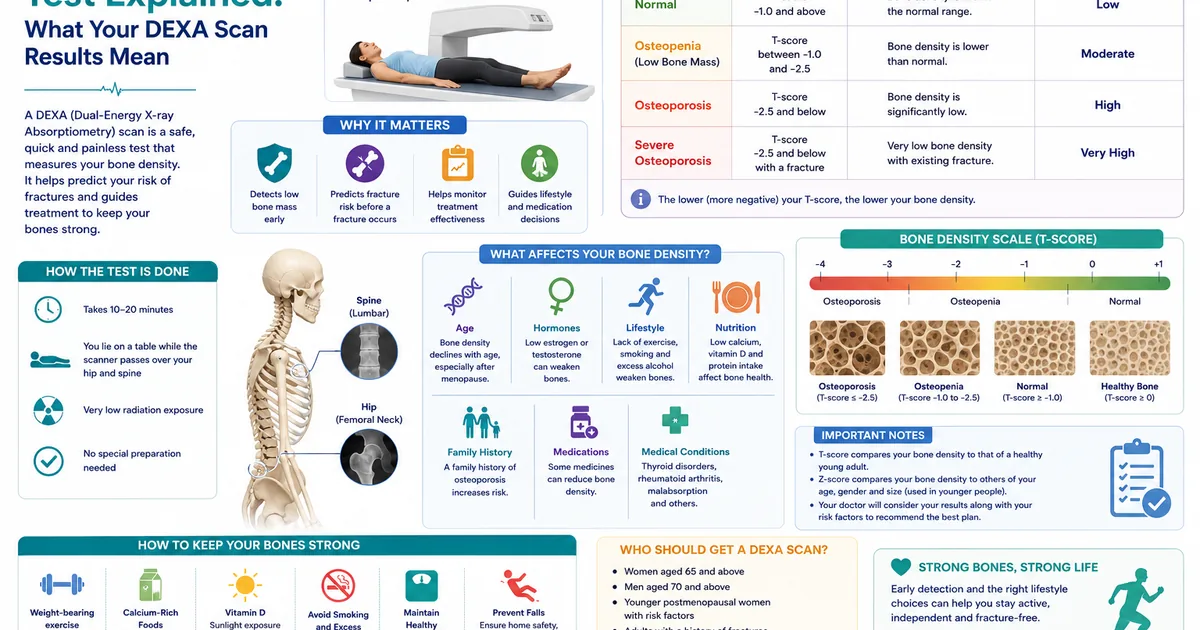
🦴Bone Density Test Explained: What Your DEXA Scan Results Mean
Got a DEXA scan done but confused by T-score and Z-score? Here's a complete guide to understanding your bone density test results, osteoporosis risk, and what to do next.
Scanura Editorial
Health Education Team
Written by Scanura Editorial for health education. This article is not a substitute for advice from a qualified doctor. About our editorial standards
Bone Density Test Explained: What Your DEXA Scan Results Mean
Your doctor has ordered a bone density test. You've heard the word "osteoporosis" thrown around, but you're not sure what it really means. You get a DEXA scan done, and now you have a report with numbers like T-score -2.3 and Z-score -1.8. What does any of this mean?
Bone health is one of the most neglected aspects of healthcare — especially in India. Most people don't think about their bones until they break one. By then, significant damage has already occurred. This guide will help you understand your bone density results, what they predict, and what you can do about it.
What is a DEXA Scan?
DEXA stands for Dual-Energy X-ray Absorptiometry. It's the gold standard for measuring bone mineral density (BMD). The scan uses two low-dose X-ray beams to measure how much calcium and other minerals are in your bones.
The test is simple:
- You lie on a comfortable table
- A scanner arm passes over your body (no pain, no needle)
- It takes about 10-15 minutes total
- The most common sites measured are the hip and spine
- Radiation exposure is minimal (less than a chest X-ray)
DEXA is different from a regular X-ray. A regular X-ray can only detect osteoporosis when bone loss is severe (about 30-40% mineral loss). DEXA can detect bone loss much earlier, when intervention is still effective.
Understanding Your Results: T-Score and Z-Score
Your DEXA report will show two key numbers — the T-score and the Z-score. These are the numbers that matter most.
T-Score — How You Compare to a Healthy 30-Year-Old
The T-score compares your bone density to the peak bone mass of a healthy young adult (around age 30). This is when bones are at their strongest.
How to read your T-score:
| T-Score | Category | What It Means |
|---|---|---|
| -1.0 or above | Normal | Your bone density is healthy |
| -1.0 to -2.5 | Osteopenia | Bone density is below normal but not yet osteoporosis |
| Below -2.5 | Osteoporosis | Significant bone loss — high fracture risk |
| Below -2.5 with fracture | Severe Osteoporosis | Very high fracture risk — urgent treatment needed |
Example: If your T-score is -1.5, it means your bone density is 1.5 standard deviations below the peak bone mass of a healthy 30-year-old. This puts you in the osteopenia range.
Key point: The T-score is used for diagnosis in postmenopausal women and men over 50. For younger people, the Z-score is more relevant.
Z-Score — How You Compare to People Your Age
The Z-score compares your bone density to the average bone density of people of the same age, sex, and ethnicity. This is more useful for younger adults and for identifying if something unusual is causing bone loss.
How to read your Z-score:
| Z-Score | Meaning |
|---|---|
| -2.0 or above | Within expected range for your age |
| Below -2.0 | Bone density is significantly lower than expected — may indicate a secondary cause |
Example: A 35-year-old woman with a Z-score of -2.5 should be investigated for secondary causes of bone loss — like thyroid problems, celiac disease, vitamin D deficiency, or medications (steroids).
T-Score vs Z-Score — Which Matters More?
- For diagnosis (postmenopausal women and men over 50): T-score is the primary criterion
- For younger adults: Z-score is more relevant
- For monitoring treatment: T-score is used to track changes over time
- For identifying secondary causes: Z-score is important
Osteopenia vs Osteoporosis — What's the Difference?
Osteopenia (T-score -1.0 to -2.5)
Osteopenia is the intermediate stage between normal bone density and osteoporosis. It means your bones are weaker than normal but haven't reached the osteoporosis threshold.
Important facts about osteopenia:
- It's NOT a disease — it's a risk factor
- Not everyone with osteopenia will develop osteoporosis
- Lifestyle changes can slow or reverse bone loss
- Medication is usually not needed unless fracture risk is high
- Regular monitoring (every 2 years) is recommended
What to do with osteopenia:
- Increase calcium intake to 1000-1200mg/day
- Ensure vitamin D is sufficient (600-800 IU/day)
- Start weight-bearing exercise
- Stop smoking and limit alcohol
- Get a FRAX score to assess fracture risk
- Retest DEXA in 2 years
Osteoporosis (T-score below -2.5)
Osteoporosis is a serious condition where bones become weak, brittle, and prone to fractures. The word literally means "porous bones" — the internal structure of the bone becomes honeycomb-like instead of dense and strong.
Facts about osteoporosis:
- 1 in 3 women and 1 in 5 men over 50 will have an osteoporotic fracture
- Hip fractures can be life-threatening — 20-30% of elderly patients die within a year
- Vertebral fractures cause chronic pain and height loss
- Osteoporosis is preventable and treatable
What to do with osteoporosis:
- Medication is almost always needed
- Calcium and vitamin D supplements
- Weight-bearing exercise (with precautions)
- Fall prevention strategies
- Regular monitoring (every 1-2 years)
Who Should Get a DEXA Scan?
You should get a bone density test if you:
Have risk factors:
- Postmenopausal woman (without risk factors, at age 65+)
- Postmenopausal woman with risk factors (at any age)
- Man over 70 (without risk factors)
- Man over 50 with risk factors
- History of fragility fracture (fracture from a minor fall)
- Parent had hip fracture
- Current or past smoking
- Excessive alcohol consumption
- Low body weight (BMI below 19)
- Long-term steroid use (more than 3 months)
- Rheumatoid arthritis
- Type 1 diabetes
- Hyperthyroidism
- Celiac disease or inflammatory bowel disease
- Chronic kidney or liver disease
Have had a fracture from minimal trauma: If you broke a bone from a fall from standing height or less, you need a DEXA scan — regardless of age.
Calcium and Vitamin D — The Bone Building Blocks
Calcium
Calcium is the primary mineral in bones. About 99% of your body's calcium is stored in bones and teeth. When blood calcium drops, the body pulls calcium from bones — weakening them.
Daily calcium requirements:
| Age Group | Daily Calcium Need |
|---|---|
| Children (1-8 years) | 1000 mg |
| Teens (9-18 years) | 1300 mg |
| Adults (19-50 years) | 1000 mg |
| Women (51-70 years) | 1200 mg |
| Men (51-70 years) | 1000 mg |
| Adults (71+ years) | 1200 mg |
Indian calcium sources:
| Food | Calcium per serving |
|---|---|
| Ragi (finger millet) | 344 mg per 100g |
| Sesame seeds (til) | 975 mg per 100g |
| Milk (doodh) | 300 mg per glass |
| Curd (dahi) | 250 mg per bowl |
| Paneer | 200 mg per 100g |
| Amaranth (rajgira) | 159 mg per 100g |
| Almonds (badam) | 264 mg per 100g |
| Figs (anjeer) | 162 mg per 100g |
| Soybean | 277 mg per 100g |
| Drumstick leaves (moringa) | 185 mg per 100g |
Calcium supplement tips:
- Take in divided doses (500mg at a time — body absorbs better)
- Take with food for better absorption
- Don't take with iron supplements (they compete)
- Calcium citrate is better absorbed than calcium carbonate
- Don't exceed 2000mg/day (kidney stone risk)
Vitamin D
Vitamin D is essential for calcium absorption. Without enough vitamin D, your body can only absorb 10-15% of dietary calcium. With adequate vitamin D, absorption jumps to 30-40%.
Vitamin D levels:
| Level | Status |
|---|---|
| Below 10 ng/mL | Severe deficiency |
| 10-20 ng/mL | Deficiency |
| 20-29 ng/mL | Insufficiency |
| 30-100 ng/mL | Optimal |
| Above 100 ng/mL | Toxicity |
Indian vitamin D deficiency is rampant:
- 70-80% of Indians are vitamin D deficient
- Indoor lifestyle, sunscreen use, and darker skin reduce vitamin D synthesis
- Food sources are limited (fatty fish, egg yolks, fortified milk)
- Supplementation is almost always necessary
Vitamin D supplementation:
- Insufficiency: 1000-2000 IU daily
- Deficiency: 4000-5000 IU daily
- Severe deficiency: 60,000 IU weekly for 8-12 weeks (under doctor's guidance)
- Take with a fatty meal for absorption
- Retest after 3 months
Exercise for Bone Health
Not all exercises strengthen bones. Only weight-bearing and resistance exercises stimulate bone growth.
Best Exercises for Bones
Weight-bearing exercises (your bones work against gravity):
- Walking (brisk)
- Jogging/running
- Dancing
- Stair climbing
- Hiking
- Tennis
- Jumping rope
Resistance exercises (muscles pull on bones):
- Weight lifting
- Bodyweight exercises (squats, lunges, push-ups)
- Resistance band exercises
- Yoga (weight-bearing poses)
Exercises that DON'T help bones:
- Swimming (buoyancy removes weight bearing)
- Cycling (seated position removes weight bearing)
- Rowing (seated)
Exercise prescription:
- 30 minutes of weight-bearing exercise, 4-5 days per week
- 2-3 resistance training sessions per week
- Start slowly and increase gradually
- If you have osteoporosis, avoid high-impact exercises and forward bending
FRAX — Your Personalized Fracture Risk
The FRAX tool is an online calculator (frax.ac.uk) that estimates your 10-year probability of major osteoporotic fracture and hip fracture. It considers:
- Age
- Sex
- Body weight and height
- Previous fracture
- Parent hip fracture
- Current smoking
- Glucocorticoid use
- Rheumatoid arthritis
- Secondary osteoporosis
- Alcohol intake
- Femoral neck bone density (from DEXA)
Your doctor uses the FRAX score to decide whether medication is needed — especially if your T-score is in the osteopenia range.
Medication for Osteoporosis
If you have osteoporosis or high fracture risk, your doctor may prescribe:
Anti-resorptive medications (slow bone breakdown):
- Bisphosphonates (alendronate, risedronate, zoledronic acid) — most commonly prescribed
- Denosumab (Prolia) — injection every 6 months
- Calcitonin — nasal spray (less effective, rarely used now)
Anabolic medications (build new bone):
- Teriparatide (Forteo) — daily injection for 2 years
- Romosozumab (Evenity) — monthly injection for 1 year
Bisphosphonate tips:
- Take alendronate on an empty stomach with a full glass of water
- Remain upright for 30 minutes after taking
- Don't eat or drink anything else for 30 minutes
- Take with calcium and vitamin D
How scanura Helps
Upload your DEXA scan report to scanura for:
- Plain-language explanation of T-score and Z-score
- Fracture risk assessment
- Personalized calcium and vitamin D recommendations
- Exercise suggestions for bone health
- Questions to ask your endocrinologist
Key Takeaways
- T-score compares you to a healthy 30-year-old — this is used for diagnosis
- Z-score compares you to people your age — this identifies unusual bone loss
- Osteopenia (T-score -1.0 to -2.5) is a warning — lifestyle changes can help
- Osteoporosis (T-score below -2.5) needs medication — don't ignore it
- Calcium: 1000-1200mg/day from food + supplements if needed
- Vitamin D: Get levels checked — most Indians are deficient
- Weight-bearing exercise strengthens bones — swimming and cycling don't
- FRAX tool calculates your personalized fracture risk
Disclaimer: This article is for educational purposes only. scanura does not provide medical diagnosis. Always consult your endocrinologist or doctor for medical decisions.
Medical References
Step-by-Step Guide
- 1
Get a DEXA scan
A DEXA scan takes 10-15 minutes. You lie on a table while a low-dose X-ray measures bone mineral density at the hip and spine.
- 2
Read your T-score
T-score compares your bone density to a healthy 30-year-old. Above -1.0 = normal. -1.0 to -2.5 = osteopenia. Below -2.5 = osteoporosis.
- 3
Read your Z-score
Z-score compares you to people your age and sex. Below -2.0 suggests something other than age is causing bone loss (medical conditions or medications).
- 4
Assess fracture risk
The FRAX tool calculates your 10-year fracture risk. Your doctor will combine T-score, age, and risk factors to determine treatment.
- 5
Increase calcium and vitamin D
Adults need 1000-1200mg calcium daily and 600-800 IU vitamin D. Include dairy, ragi, sesame seeds, leafy greens. Take supplements if deficient.
- 6
Start weight-bearing exercise
Walking, jogging, dancing, and resistance training strengthen bones. Swimming and cycling don't help bone density.
- 7
Consult your doctor
If T-score is below -2.0 or you've had a fragility fracture, medication may be needed. Don't ignore bone loss.
📬 One health report guide, every week
Normal ranges, what your values mean, and what to ask your doctor — in plain language. Free, unsubscribe anytime.