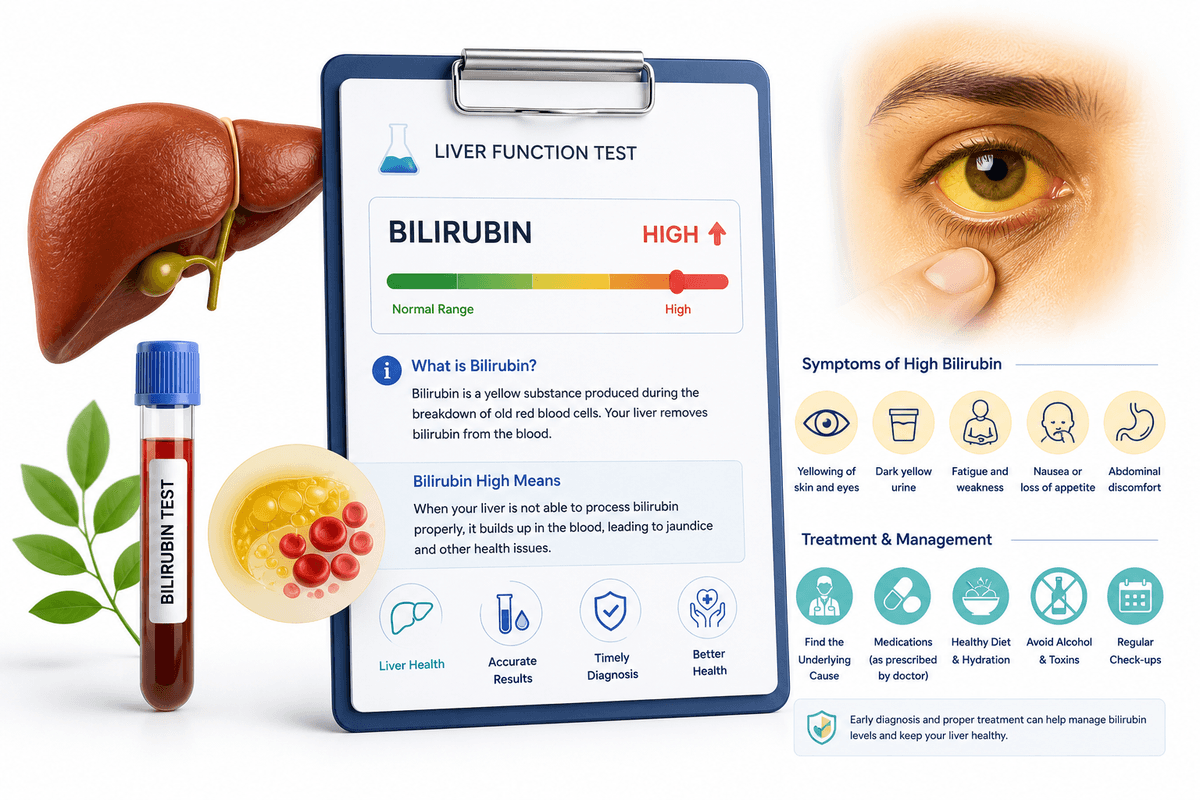
💛Bilirubin High Symptoms & Treatment: Jaundice Explained
High bilirubin causes yellow eyes and skin — jaundice. Direct vs indirect bilirubin points to completely different causes. Here's how to read your LFT report.
Scanura Editorial
Health Education Team
Written by Scanura Editorial for health education. This article is not a substitute for advice from a qualified doctor. About our editorial standards
Bilirubin High Symptoms & Treatment: Jaundice Explained
You noticed yellowish eyes, or your family said your skin looks "pila." The lab report confirms it: Total Bilirubin is 3.2 mg/dL — far above the normal 0.1–1.2 range. The word jaundice appears in the report notes. Fear sets in: hepatitis? Liver failure? Something serious?
Bilirubin elevation is common in India — from newborn jaundice and viral hepatitis A/E to gallstones, fatty liver, and haemolysis (rapid red cell breakdown). The good news: many causes are treatable and reversible. The key is understanding which type of bilirubin is high — direct (conjugated) vs indirect (unconjugated) — because that points to completely different causes.
This guide explains what bilirubin is, normal ranges, symptoms of jaundice, causes common in India, treatment options, and when to seek emergency care. For full liver panel context, see our liver function test guide and SGPT guide.
What Is Bilirubin?
Bilirubin is a yellow-orange pigment formed when old red blood cells break down. Haemoglobin from dead RBCs is converted to bilirubin in the spleen and liver.
The journey:
| Step | What Happens |
|---|---|
| 1. RBC breakdown | Unconjugated (indirect) bilirubin released into blood |
| 2. Liver uptake | Liver cells absorb indirect bilirubin |
| 3. Conjugation | Liver attaches glucuronic acid — becomes direct (conjugated) bilirubin |
| 4. Excretion | Conjugated bilirubin enters bile → intestines → stool (gives brown colour) |
When any step is blocked or overwhelmed, bilirubin accumulates in blood and deposits in skin and eyes — jaundice (icterus).
Bilirubin Normal Range in India
| Test | Normal Range (Typical) |
|---|---|
| Total Bilirubin | 0.1 – 1.2 mg/dL (some labs: up to 1.5) |
| Direct (Conjugated) Bilirubin | 0.0 – 0.3 mg/dL |
| Indirect (Unconjugated) | Total minus Direct — usually <1.0 mg/dL |
Mild vs Moderate vs Severe Elevation
| Total Bilirubin | Significance |
|---|---|
| 1.2 – 3 mg/dL | Mild jaundice — common in hepatitis A, Gilbert's syndrome |
| 3 – 10 mg/dL | Moderate — needs investigation; may be obstructive or hepatocellular |
| >10 mg/dL | Severe — urgent evaluation; risk of brain toxicity in newborns |
| >20 mg/dL (adults) | Very severe — hospitalisation usually required |
Types of Jaundice: Three Patterns
Doctors classify jaundice by which part of the bilirubin pathway is affected:
1. Pre-Hepatic (Haemolytic) Jaundice
Problem: Too much bilirubin produced — RBCs breaking down too fast.
| Feature | Details |
|---|---|
| Bilirubin pattern | Indirect (unconjugated) high; direct normal |
| Urine colour | Normal (no bilirubin in urine) |
| Stool colour | Normal to dark |
| Common causes in India | G6PD deficiency, sickle cell, thalassaemia, malaria, autoimmune haemolysis |
See our thalassemia guide for inherited causes.
2. Hepatic (Hepatocellular) Jaundice
Problem: Liver cells damaged — cannot process bilirubin properly.
| Feature | Details |
|---|---|
| Bilirubin pattern | Both indirect and direct elevated |
| Other LFT changes | High SGPT/SGOT, low albumin in severe disease |
| Common causes in India | Hepatitis A/E, hepatitis B/C, fatty liver, alcohol, medicines (anti-TB drugs) |
| Urine | Dark (conjugated bilirubin excreted in urine) |
3. Post-Hepatic (Obstructive) Jaundice
Problem: Bile duct blocked — conjugated bilirubin cannot reach intestines.
| Feature | Details |
|---|---|
| Bilirubin pattern | Direct (conjugated) predominantly high |
| Other LFT changes | High ALP and GGT |
| Stool colour | Pale/clay-coloured — classic sign |
| Urine | Very dark (tea-coloured) |
| Common causes | Gallstones, pancreatic head tumour, bile duct stricture, parasitic obstruction (rare) |
This pattern needs urgent imaging (ultrasound, MRCP).
Symptoms of High Bilirubin and Jaundice
| Symptom | What It Means |
|---|---|
| Yellow eyes (scleral icterus) | Often the first sign — appears before skin |
| Yellow skin | More noticeable in fair skin; check palms and under tongue |
| Dark urine | Conjugated bilirubin in urine — hepatocellular or obstructive |
| Pale stools | Bile not reaching gut — think obstruction |
| Itching (pruritus) | Bile salts in skin — common in obstructive jaundice |
| Abdominal pain (right upper) | Gallstones, hepatitis, liver swelling |
| Fatigue, nausea, poor appetite | Hepatitis, liver disease |
| Fever | Infectious hepatitis, cholangitis (bile duct infection — emergency) |
| Confusion, drowsiness | Severe liver failure — medical emergency |
Newborn Jaundice — Special Note
Physiological jaundice affects ~60% of term babies in the first week. Breastfeeding jaundice and pathological causes (ABO incompatibility, G6PD deficiency — common in India) need paediatric monitoring. Kernicterus (brain damage) is preventable with timely phototherapy.
Common Causes of High Bilirubin in India
Viral Hepatitis A and E
Food and water borne — extremely common. Hepatitis A especially affects children and young adults. Hepatitis E is dangerous in pregnant women.
| Feature | Hepatitis A/E |
|---|---|
| Transmission | Contaminated food/water |
| Course | Usually self-limiting in 4–8 weeks |
| Bilirubin | Rises with SGPT; peaks then falls |
| Treatment | Supportive — rest, hydration, avoid alcohol and unnecessary medicines |
Hepatitis B and C
Chronic infections; may cause persistent jaundice and cirrhosis. Screen with HBsAg and anti-HCV.
Alcoholic and Fatty Liver Disease
Mild bilirubin elevation with elevated SGPT/GGT. Jaundice in alcoholic hepatitis is serious — needs hospital care.
Gallstones (Choledocholithiasis)
Stone in common bile duct blocks bile flow. Classic triad: pain, jaundice, fever (if infected — Charcot's triad). ERCP removes stones.
Medicines and Anti-TB Drugs
Isoniazid, rifampicin, pyrazinamide can cause jaundice during TB treatment. Never stop anti-TB drugs without doctor guidance — modified regimen may be needed.
Haemolysis and Inherited Conditions
- G6PD deficiency — triggered by fava beans, certain drugs, infections
- Thalassaemia major — chronic jaundice from birth
- Sickle cell disease — episodic jaundice during crises
- Malaria — haemolysis raises indirect bilirubin
Gilbert's Syndrome — Harmless and Common
A benign genetic condition affecting ~5–10% of people. Mild unconjugated hyperbilirubinaemia (usually 1.5–3 mg/dL), worse during fasting, illness, or stress. No treatment needed — just awareness.
How Bilirubin Is Tested
| Test | Purpose |
|---|---|
| Total bilirubin | Screening |
| Direct + indirect split | Locates the problem (pre/hepatic/post-hepatic) |
| LFT panel | SGPT, SGOT, ALP, GGT, albumin |
| CBC | Anaemia, reticulocytes (haemolysis) |
| Hepatitis serology | A, B, C, E |
| Ultrasound abdomen | Gallstones, bile duct dilation, liver texture |
| MRCP/CT | Detailed bile duct imaging if obstruction suspected |
Treatment: What Actually Works
Treatment depends entirely on the cause:
| Cause | Treatment |
|---|---|
| Hepatitis A/E | Supportive care; avoid hepatotoxic drugs; alcohol abstinence |
| Hepatitis B/C | Antiviral therapy (tenofovir, sofosbuvir, etc.) under specialist |
| Gallstones | ERCP + laparoscopic cholecystectomy |
| Alcoholic hepatitis | Stop alcohol; steroids in severe cases (hospital) |
| Fatty liver | Weight loss, diabetes control — see SGPT guide |
| Gilbert's syndrome | No treatment — reassurance |
| Haemolysis | Treat underlying cause; blood transfusion if severe |
| Obstructive tumour | Surgery, stenting, oncology referral |
| Newborn jaundice | Phototherapy, exchange transfusion if severe |
General Supportive Measures
- Hydration — adequate fluids
- Avoid alcohol completely until liver recovers
- Avoid paracetamol and unnecessary medicines during acute hepatitis
- Nutritious diet — small frequent meals if nauseous
- Do not self-medicate with "liver tonics" without doctor approval
When to Worry — Emergency Signs
Go to hospital immediately if:
- High fever + jaundice + confusion — possible acute liver failure or cholangitis
- Vomiting blood or black stools — GI bleeding from liver disease
- Severe abdominal pain with jaundice — bile duct obstruction or pancreatitis
- Bilirubin rapidly rising with drowsiness
- Pregnant woman with jaundice — hepatitis E risk
- Pale stools + dark urine + itching — complete bile duct obstruction
Monitoring Recovery
In viral hepatitis, bilirubin often rises after SGPT starts falling — this can alarm families but is part of normal recovery ("bilirubin lag"). Total recovery may take 4–12 weeks.
Track trends:
- Falling bilirubin = improving
- Rising bilirubin after initial improvement = relapse or new problem — re-evaluate
Diet During Recovery from Hepatitis
While no food "cures" jaundice, sensible nutrition supports liver recovery:
| Recommended | Avoid During Acute Phase |
|---|---|
| Khichdi, dal, steamed vegetables | Deep-fried snacks, street food |
| Fresh fruits (not juice in excess) | Alcohol — absolutely zero |
| Adequate protein (dal, egg if tolerated) | Heavy ghee-rich meals |
| Small frequent meals if nauseous | Unnecessary herbal "liver tonics" |
| Boiled or filtered water | Raw shellfish, uncooked street items |
Turmeric in normal cooking amounts is fine. Mega-dose turmeric supplements are not proven to treat jaundice.
Myths About Jaundice in India
| Myth | Fact |
|---|---|
| "Yellow eyes mean permanent liver damage" | Many causes (hepatitis A, Gilbert's) fully recover |
| "Stop all protein during jaundice" | Adequate protein supports liver repair — unless encephalopathy |
| "Only alcoholics get jaundice" | Hepatitis A/E, gallstones, and G6PD are common non-alcohol causes |
| "Breast milk causes newborn jaundice" | Physiological jaundice is common; breastfeeding should continue per paediatric advice |
| "Ayurvedic liver tonics cure jaundice fast" | Unregulated products may contain heavy metals — consult a qualified doctor |
Newborn vs Adult Jaundice — Key Differences
| Feature | Newborn Jaundice | Adult Jaundice |
|---|---|---|
| Timing | First 1–2 weeks of life | Any age — always investigate cause |
| Bilirubin type | Usually unconjugated | Direct, indirect, or both — depends on cause |
| Danger level | Kernicterus risk if very high | Liver failure, obstruction, haemolysis risks |
| Treatment | Phototherapy, feeding support | Treat underlying cause — hepatitis, stones, etc. |
| Indian context | G6PD deficiency, ABO incompatibility common | Hepatitis A/E, gallstones, TB medicines common |
Parents should never ignore worsening yellow colour in newborns — bilirubin brain toxicity is preventable.
Questions to Ask Your Gastroenterologist
- "Is my bilirubin direct or indirect predominant?"
- "Does this pattern suggest obstruction, hepatitis, or haemolysis?"
- "Do I need ultrasound or MRCP?"
- "Is this Gilbert's syndrome — do I need any treatment?"
- "When should bilirubin normalise, and when do we retest?"
How scanura Helps
Upload your LFT report to scanura and see bilirubin (total, direct, indirect) alongside SGPT, ALP, and GGT explained in plain Hindi or English. Know whether your pattern suggests obstruction, hepatitis, or a harmless cause like Gilbert's syndrome.
Key Takeaways
- Bilirubin is a breakdown product of red blood cells — processed by the liver and excreted in bile.
- Normal total bilirubin is 0.1–1.2 mg/dL — jaundice appears when it rises above ~2–3 mg/dL.
- Direct vs indirect bilirubin tells doctors where the problem is — liver, bile duct, or RBC breakdown.
- Dark urine + pale stools + itching suggests bile duct obstruction — needs urgent imaging.
- Hepatitis A and E are very common in India — usually self-limiting with supportive care.
- Gilbert's syndrome is a harmless cause of mild lifelong jaundice — no treatment needed.
- Gallstones are a treatable cause of obstructive jaundice — ERCP is often curative.
- Never stop anti-TB medicines on your own if jaundice develops — consult your doctor for regimen adjustment.
Disclaimer: This article is for educational purposes only. scanura does not provide medical diagnosis. Always consult your doctor for medical decisions.
Step-by-Step Guide
- 1
Check total, direct, and indirect bilirubin
The split tells you if the problem is liver, bile duct, or RBC breakdown.
- 2
Look at urine and stool colour
Dark urine + pale stools suggest bile duct obstruction.
- 3
Review SGPT, ALP, and GGT
Hepatocellular vs obstructive pattern guides next tests.
- 4
Get ultrasound if obstructive pattern
Gallstones and bile duct dilation show on abdominal ultrasound.
- 5
Screen for hepatitis A, B, C, E
Viral hepatitis is a leading cause in India.
- 6
Avoid alcohol and unnecessary medicines
Support liver recovery during acute jaundice.
📬 One health report guide, every week
Normal ranges, what your values mean, and what to ask your doctor — in plain language. Free, unsubscribe anytime.